Map of DC Wards
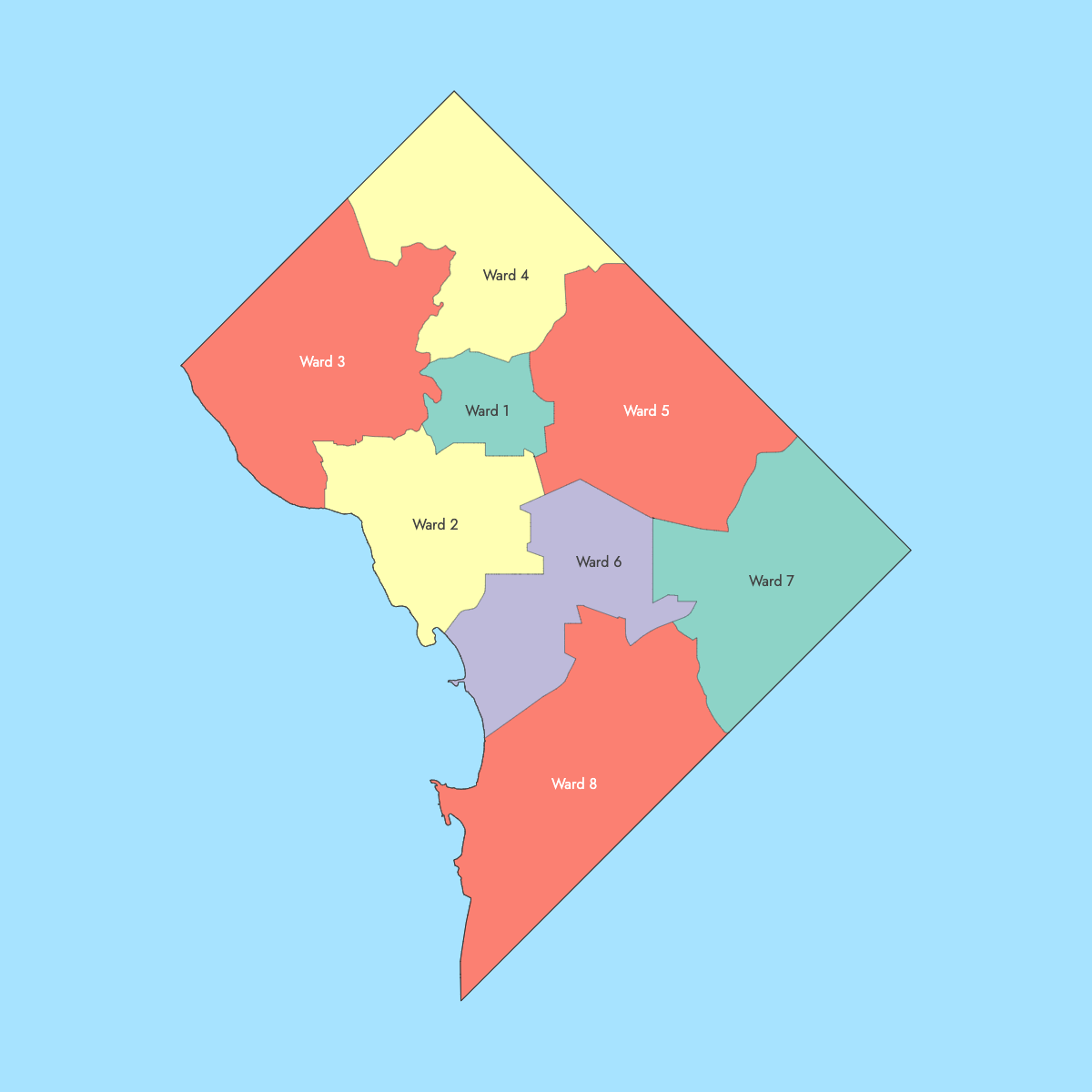
Washington, D.C. is divided into 8 wards, each electing one member to the Council of the District of Columbia. These wards cover the entire 68 square miles (177 km²) of the District and are redrawn every ten years following the Census to ensure equal representation. Use the interactive maps below to explore all 8 wards and their boundaries. Download free maps or learn more about creating a custom map of DC wards to visualize your own data.
Interactive Map of DC Wards
List of Wards (8)
DC Wards: Key Facts
- Total number of wards: 8, each electing one Councilmember to the Council of the District of Columbia.
- Total District area: 68 square miles (177 km²). DC has no counties; wards serve as its primary electoral divisions.
- Most populous ward: Ward 6 with 99,652 residents (2020 Census, 2022 boundaries), covering Capitol Hill, NoMa, and Judiciary Square.
- Least populous ward: Ward 8, historically the least populous at roughly 70,000 residents, located east of the Anacostia River.
- Wards with major urban centers: Ward 2 includes Downtown, Dupont Circle, and Georgetown. Ward 6 covers Capitol Hill and the U.S. Capitol. Ward 1 contains Columbia Heights and the U Street corridor.
- Administrative center: Washington, D.C. is itself the U.S. capital. Key government buildings sit in Ward 6 (U.S. Capitol, Judiciary Square) and Ward 2 (the White House area and parts of the National Mall).
- Bordering states and water: The District borders Maryland to the north and east and Virginia to the west and south across the Potomac River. The Anacostia River runs through the eastern portion of the city.
- Time zone: Eastern Time Zone (UTC-5, UTC-4 during daylight saving time).
- Current boundaries established: Approved by the DC Council in 2022, based on 2020 Census data. Wards are redistricted every 10 years.
Interesting Facts
- DC has no counties. Wards are the primary electoral divisions, overlapping with 131 unofficial neighborhoods defined by the DC Office of Planning, plus Advisory Neighborhood Commissions (ANCs) and Single Member Districts (SMDs).
- Ward 6 includes the historic neighborhood of "Swampoodle," an Irish immigrant community from the 1850s through the 1910s. The area is now largely redeveloped as NoMa and Near Northeast.
- Rock Creek Park, one of the largest urban parks in the United States, spans parts of Wards 1, 3, and 4.
- Adams Morgan, a culturally vibrant neighborhood in Ward 1 with a population of 17,113, was established in 1958 and named after two local schools as a symbol of integration.
- The National Mall and its monuments stretch across both Ward 2 and Ward 6, splitting some of the city's most iconic landmarks between two Councilmember districts.
Free Downloads
Free for personal and commercial use with a credit to Ultimaps. See the license terms for details.
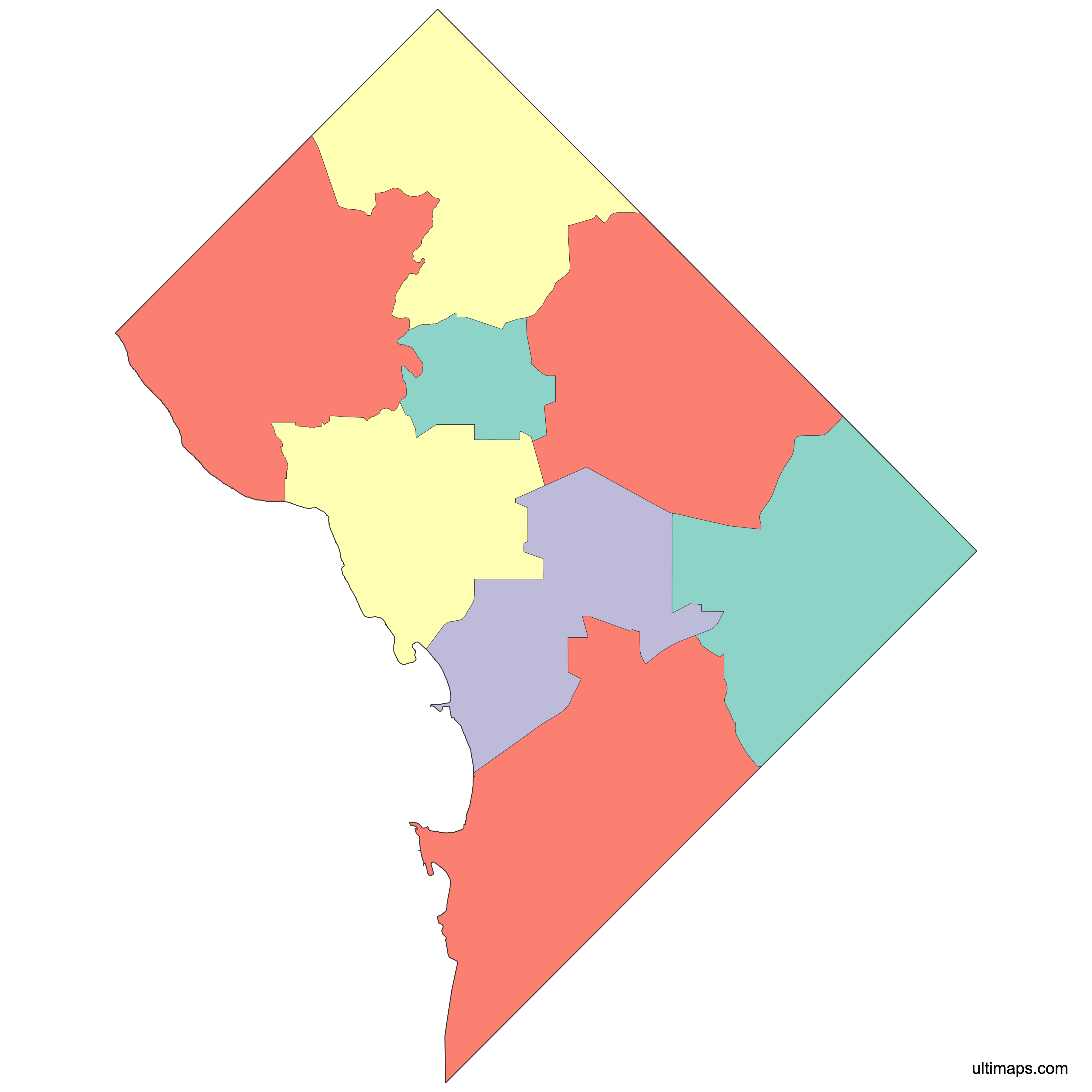
Need it without colors? The blank version of this map comes as a print-ready PDF (A4 and US Letter), a PNG and an editable SVG.
Custom Map Features
This map supports labels.
This map is divided into 8 wards.
Updates
May 14, 2026:
- Added map of Washington DC Wards (2022 redistricting cycle, effective 2023) with roads, rivers, and cities. Boundary data: DC Open Data (CC BY 4.0).
Frequently Asked Questions
Washington, D.C. has 8 wards. Each ward elects one member to the Council of the District of Columbia. The current ward boundaries were approved in 2022 based on 2020 Census data, and redistricting occurs every 10 years to maintain roughly equal populations across all wards.
Exact ward-level area figures are not published in a single official summary by the DC Office of Planning. The total land area of Washington, D.C. is 68 square miles (177 km²), divided among all 8 wards. Wards 3, 4, and 7 tend to cover larger geographic footprints due to their more residential and less dense character.
Official per-ward area totals are not uniformly published by the DC government. However, wards in the dense urban core, such as Ward 2 (Downtown, Dupont Circle, Georgetown) and Ward 1 (Columbia Heights, U Street), are generally among the most compact geographically while maintaining high population counts.
Ward 6 is the most populous ward with 99,652 residents based on the 2020 Census and 2022 ward boundaries. It covers Capitol Hill, NoMa, Judiciary Square, and the area surrounding the U.S. Capitol. Ward 2 is the second most populous at 89,518 residents.
Ward 8, located east of the Anacostia River, is historically the least populous ward with roughly 70,000 residents. Redistricting every decade aims to equalize populations across all 8 wards, but some variation remains after each cycle.
The U.S. Capitol sits in Ward 6 on Capitol Hill. Georgetown University is in Ward 2, within the historic Georgetown neighborhood. Howard University, a major historically Black university, is in Ward 1 near LeDroit Park. The National Mall and its Smithsonian museums span parts of both Ward 2 and Ward 6. Rock Creek Park stretches across Wards 1, 3, and 4.
DC ward boundaries are redrawn every 10 years by the DC Council following each U.S. Census. The goal is to ensure roughly equal population across all 8 wards for fair political representation. The current boundaries were approved in 2022 using 2020 Census data, replacing the previous map drawn after the 2010 Census.
Wards are the 8 official electoral divisions of Washington, D.C., each represented by one Councilmember. Neighborhoods are unofficial geographic designations. The DC Office of Planning recognizes 131 neighborhoods. Wards also overlap with Advisory Neighborhood Commissions (ANCs) and Single Member Districts (SMDs), which provide additional layers of local civic participation.
Washington, D.C. is a federal district, not a state, so it has no county-level government. Wards serve as the primary electoral divisions within the District's 68 square miles (177 km²). Each of the 8 wards elects one at-large Councilmember to the DC Council, functioning as the main unit of political representation for the city's residents.
You can use Ultimaps to create custom maps of DC wards. Color-code wards manually or upload your data, place pins, customize the look and feel, and export to PNG, PDF, or SVG. No sign-up required.