Philippines Map with Provinces
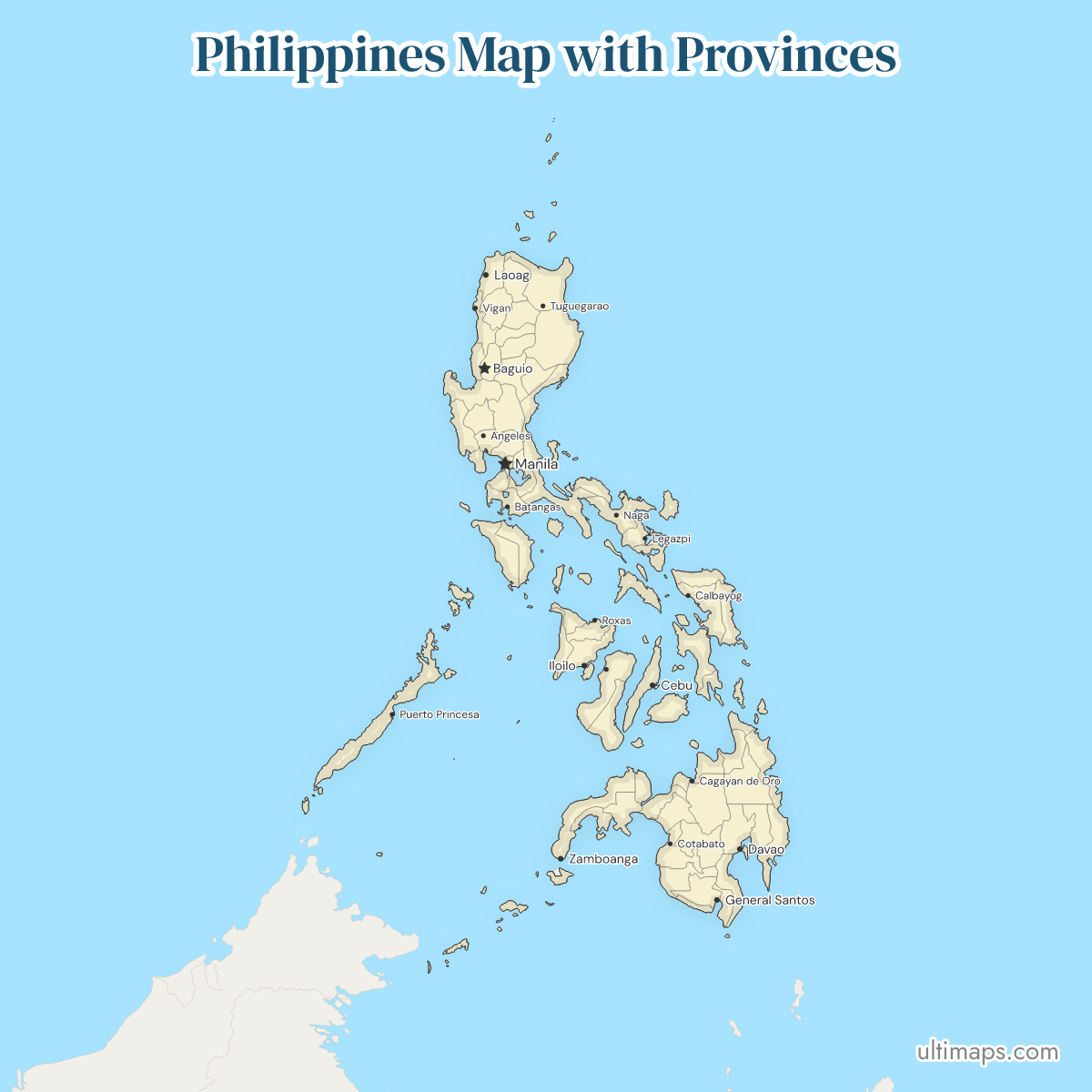
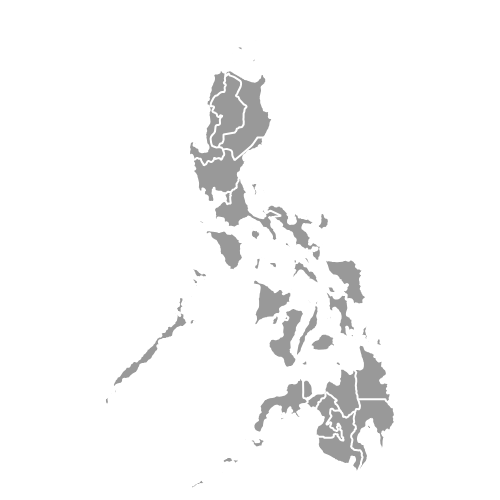
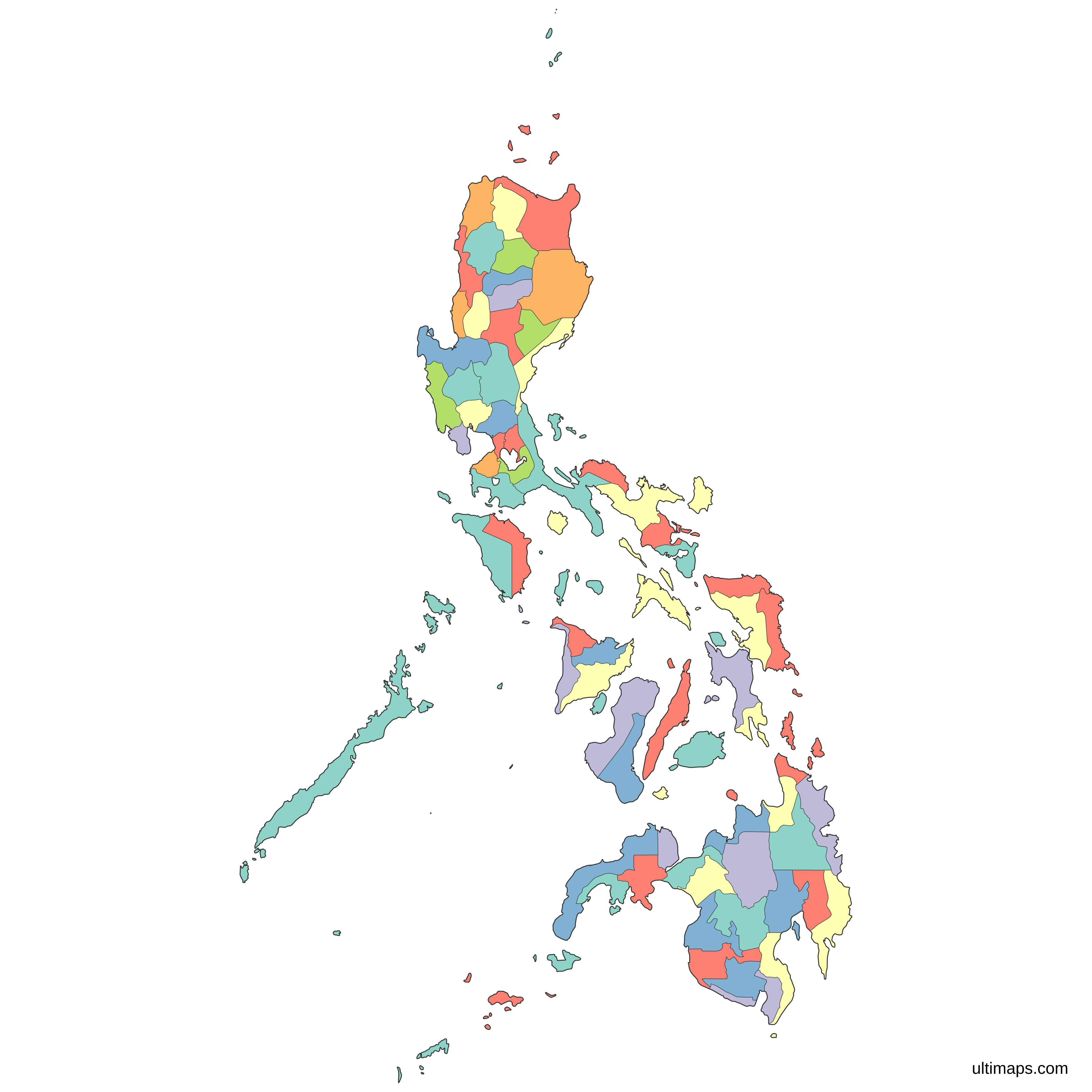
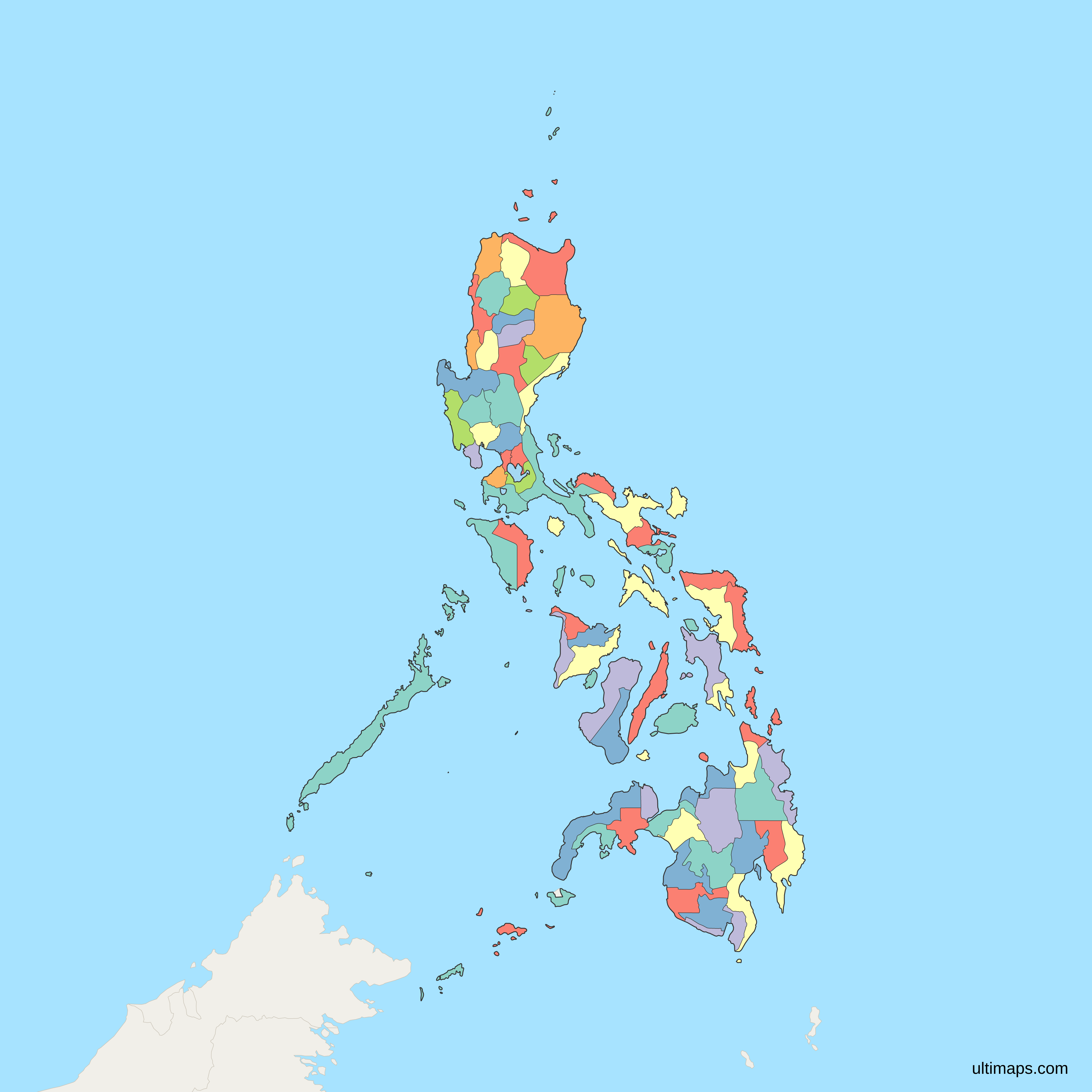
The map of the Philippines on this page shows 80 shapes: 79 provinces plus Metro Manila, drawn as a single unit. The Philippine Statistics Authority counts 82 provinces, grouped into 18 regions and spread across the three island groups of Luzon, Visayas and Mindanao. Three newer provinces are not drawn separately here. Dinagat Islands, created in 2006, sits inside Surigao del Norte; Davao Occidental, created out of Davao del Sur in 2013, sits inside its parent province; and Maguindanao appears as one shape rather than as Maguindanao del Norte and Maguindanao del Sur, which separated after the plebiscite of 17 September 2022.
Cavite leads on population with 4,344,829 residents (2020 Census), followed by Bulacan at 3,708,890. Palawan is the largest province by area at 14,649.73 km² (5,656 sq mi), and Batanes is the smallest on both measures, 219.01 km² (84.6 sq mi) and 18,831 people (2020 Census). Manila, the national capital, belongs to no province at all, sitting in the National Capital Region with 1,846,513 residents of its own (2020 Census). Zoom in on the archipelago to check which island falls under which province, then save the plain map for free, or bring in provincial figures and export a colored version.
Interactive Philippines Map with Provinces
List of Provinces (80)
Philippines Provinces: Key Facts
- Shapes drawn on this map: 80 — 79 provinces plus Metro Manila as a single shape
- Official number of provinces: 82, organized into 18 administrative regions across Luzon, Visayas and Mindanao
- Most populous province: Cavite, 4,344,829 residents (2020 Census), part of Calabarzon south of Manila, with Bulacan next at 3,708,890
- Least populous province: Batanes, 18,831 residents (2020 Census), on the islands between Luzon and Taiwan
- Largest province by area: Palawan, 14,649.73 km² (5,656 sq mi, 2020 PSA figures). The figure leaves out Puerto Princesa, a highly urbanized city administered independently of the province
- Smallest province by area: Batanes, 219.01 km² (84.6 sq mi, 2020 PSA figures), with Camiguin next at 237.95 km² (91.9 sq mi)
- Provinces holding major urban centers: Cebu (Cebu City), Davao del Sur (Davao City), Iloilo (Iloilo City), Negros Occidental (Bacolod), Benguet (Baguio), and Bulacan and Pampanga on the Central Luzon plain
- Capital: Manila, 1,846,513 residents (2020 Census), located in the National Capital Region rather than in a province. Metro Manila as a whole held 13,484,462 people in 2020 on 636.00 km² (245.56 sq mi)
- Borders: no land borders. The Philippines is an archipelago, with the South China Sea to the west, the Philippine Sea and the Pacific to the east, the Celebes Sea to the south and the Luzon Strait to the north. Maritime neighbors include China, Vietnam, Malaysia, Taiwan, Indonesia and Palau
- Time zone: Philippine Standard Time (UTC+8), one zone for the whole country, no daylight saving
- Boundary history: the provincial framework dates back to Spanish colonial provincias. The three most recent changes — Dinagat Islands created in 2006, Davao Occidental in 2013 and the division of Maguindanao on 17 September 2022 — all postdate the boundaries drawn on this map
Interesting Facts
- The Philippines counts 7,641 islands (NAMRIA count, announced 2017), so most provincial boundaries follow coastlines instead of land lines. Batanes, Camiguin and Siquijor are each a single island or a small island cluster.
- The National Capital Region is the only region without provinces. It consists of 16 cities plus the municipality of Pateros.
- Central Luzon holds more provinces than any other region, with 7: Aurora, Bataan, Bulacan, Nueva Ecija, Pampanga, Tarlac and Zambales.
- Highly urbanized cities run independently of the provinces around them. Davao City is not governed by Davao del Sur, Cebu City is not governed by Cebu, and Baguio is not governed by Benguet, though each sits within those provincial outlines.
- Well-known landmarks each fall within a province: the Chocolate Hills to Bohol, Boracay to Aklan, the heritage streets of Vigan to Ilocos Sur, the Underground River to Palawan, and Tagaytay on the Taal ridge to Cavite.
Free Downloads
Free for personal and commercial use with a credit to Ultimaps. See the license terms for details.
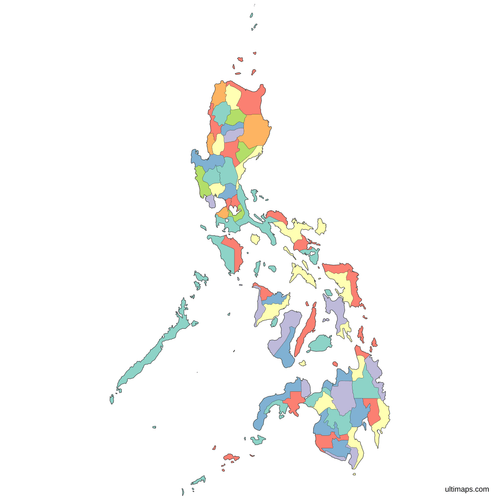 Colored Philippines Map with Provincespng572 KB
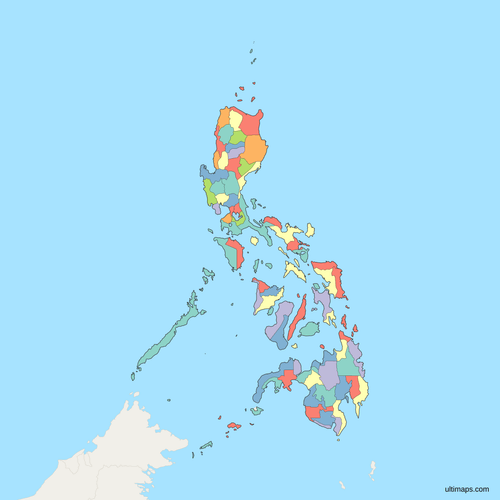 Political Map of the Philippines with Provincespng574 KB
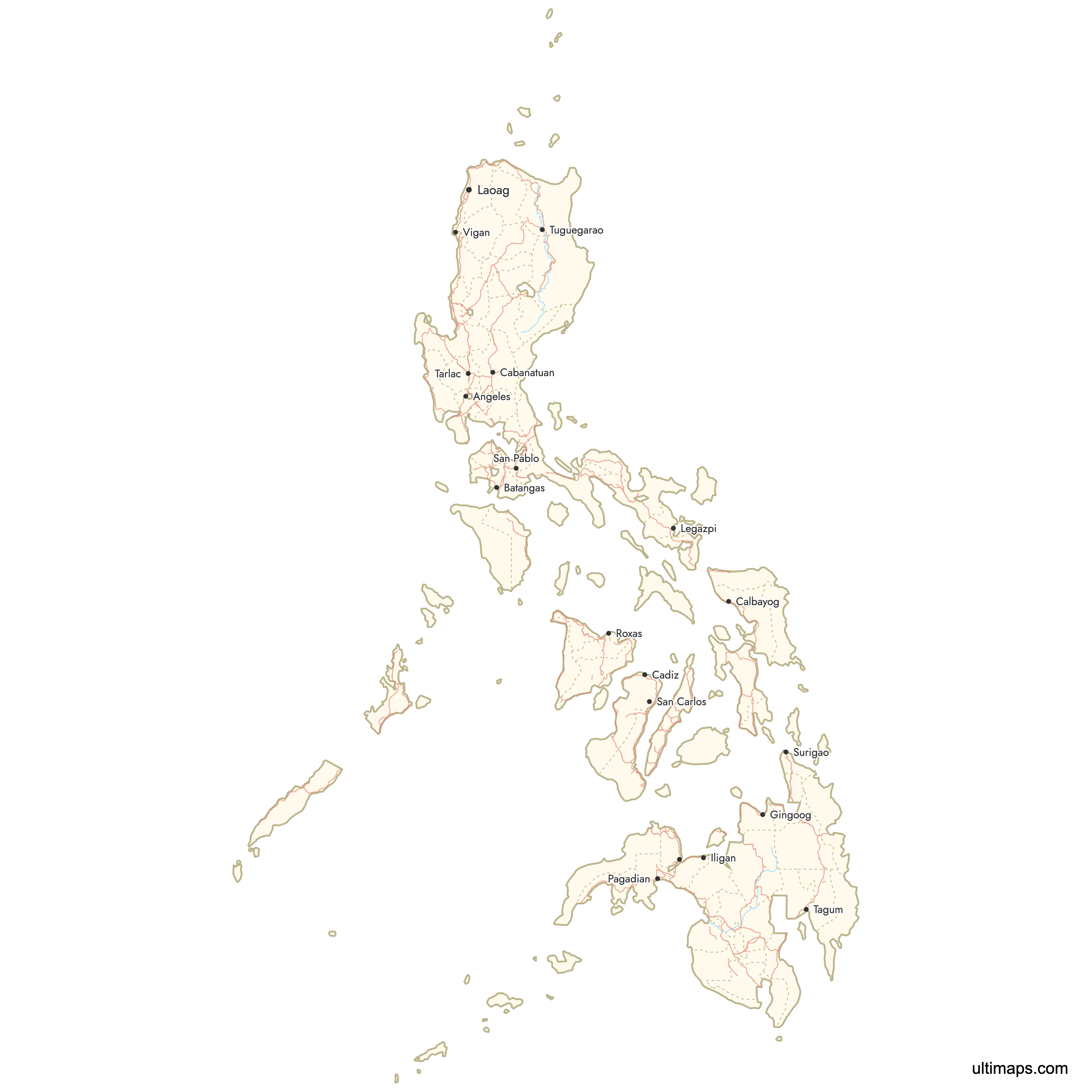
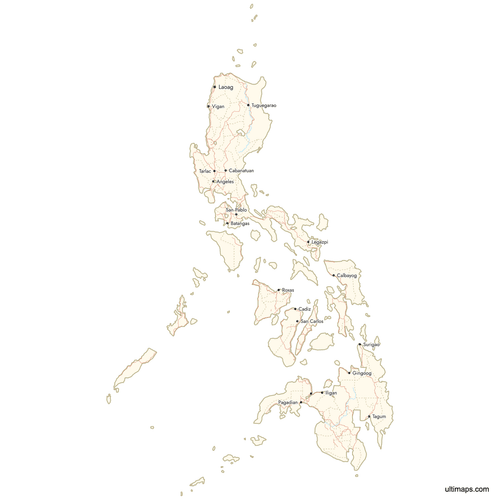 Map of the Philippines with Cities and Roadspng763 KB
Need it without colors? The blank version of this map comes as a print-ready PDF (A4 and US Letter), a PNG and an editable SVG.
Custom Map Features
This map supports surrounding areas, roads, rivers and cities. New
This map is divided into 80 provinces.
Updates
May 14, 2026:
- Added map of Philippines Provinces with surrounding countries, cities, roads, rivers and lakes
Frequently Asked Questions
The Philippines has 82 provinces, grouped into 18 administrative regions and distributed across the island groups of Luzon, Visayas and Mindanao. The map on this page draws 79 of them, plus Metro Manila as a single shape; Dinagat Islands, Davao Occidental and the two provinces of the 2022 Maguindanao division are shown inside their parent provinces rather than as separate shapes. Provinces are the country's main local government tier below the regional level, each with an elected governor, a provincial board and a provincial capital. Under them sit cities, municipalities and barangays, and the barangay count alone runs past 42,000.
This map shows 80 shapes while the official province count is 82. Metro Manila, which is not a province, is drawn as one shape of its own, and three newer provinces sit inside their parents: Dinagat Islands, created in 2006, within Surigao del Norte; Davao Occidental, carved out of Davao del Sur in 2013, within Davao del Sur; and Maguindanao del Norte with Maguindanao del Sur, separated after the plebiscite of 17 September 2022, drawn as one undivided Maguindanao. For data imports listing all 82 provinces, merge Dinagat Islands into Surigao del Norte, Davao Occidental into Davao del Sur, and the two Maguindanao provinces into one; add a Metro Manila row if that shape needs a color.
Palawan is the largest province in the Philippines by area at 14,649.73 km² (5,656 sq mi), a long island chain lying between the South China Sea and the Sulu Sea. That figure excludes Puerto Princesa, the highly urbanized city on the same island that is administered independently, although the provincial capitol is located there. Isabela is the largest province on Luzon at 12,414.93 km² (4,793 sq mi), the second-largest in the country. At the other extreme, Batanes covers 219.01 km² (84.6 sq mi), roughly a sixty-seventh of Palawan's area, across ten small islands in the far north.
Cavite is the most populated province in the Philippines, with 4,344,829 residents at the 2020 Census, ahead of Bulacan at 3,708,890 and Laguna at 3,382,193. All three border Metro Manila, and Cavite belongs to Calabarzon, the country's most populous region at 16,195,042 people in 2020. Dasmariñas is Cavite's largest city, and the province runs from the Manila Bay shoreline up to the Tagaytay ridge above Taal Lake. Cebu recorded 3,325,385 residents in 2020, a total that excludes Cebu City, Lapu-Lapu and Mandaue, counted separately as highly urbanized cities.
Metro Manila is not a province. It is the National Capital Region, one of the country's 18 regions, and the only one containing no provinces: 16 cities plus the municipality of Pateros. Manila is the national capital, with 1,846,513 residents at the 2020 Census, while Quezon City, also in NCR, is the largest city in the Philippines at 2,960,048. The region as a whole counted 13,484,462 people in 2020 within 636.00 km² (245.56 sq mi). Because NCR is not a province, provincial datasets normally report it as a separate line beside Rizal, Bulacan and Cavite.
The newest provinces in the Philippines are Maguindanao del Norte and Maguindanao del Sur, which came into being when voters ratified Republic Act 11550 in a plebiscite on 17 September 2022 and the old province of Maguindanao was divided. Since then the official list has stood at 82 provinces. Before it, the most recent addition was Davao Occidental, separated from Davao del Sur under Republic Act 10360 and confirmed by plebiscite on 28 October 2013. None of the newest provinces — Dinagat Islands, created in 2006, included — appear as separate shapes here, which is why the map carries 79 province shapes rather than 82.
Regions and provinces serve different purposes in the Philippines. The 18 regions are administrative groupings that organize national government offices and statistical reporting, and apart from the Bangsamoro region they have no elected regional government. The 82 provinces are genuine local governments, each with an elected governor, vice governor and provincial board, and each subdivided into cities and municipalities. Every province belongs to exactly one region. The National Capital Region is the exception to the pattern, holding cities and one municipality but no provinces at all. Philippine Statistics Authority tables usually present provincial data region by region.
The Bangsamoro Autonomous Region in Muslim Mindanao replaced the ARMM in 2019 and is the only Philippine region with its own parliament and elected regional government. Its provinces are Basilan, Lanao del Sur, Maguindanao del Norte, Maguindanao del Sur and Tawi-Tawi, together with the city of Cotabato, which joined through the 2019 plebiscite. Sulu voted against inclusion in that plebiscite, and the Supreme Court ruled in 2024 that Sulu is not part of BARMM. Sulu remains a province of the Philippines regardless. Maguindanao was a single province until the split of September 2022.
Start from this page's Philippines map and open it in Ultimaps, a free map editor that runs in the browser — no download, and the free tier does not ask for an account. To color provinces from data, upload a spreadsheet where each row pairs a province name with a value; the matching shapes are shaded automatically. Manual coloring works too: choose a province such as Palawan or Cebu and give it any fill from the palette. You can rename or hide labels, change the typeface, adjust boundary thickness and background, and drop location markers with short captions on cities or coordinates. Finished maps export as PNG for presentations, PDF for print, or SVG for design software.