Croatia Map with Counties
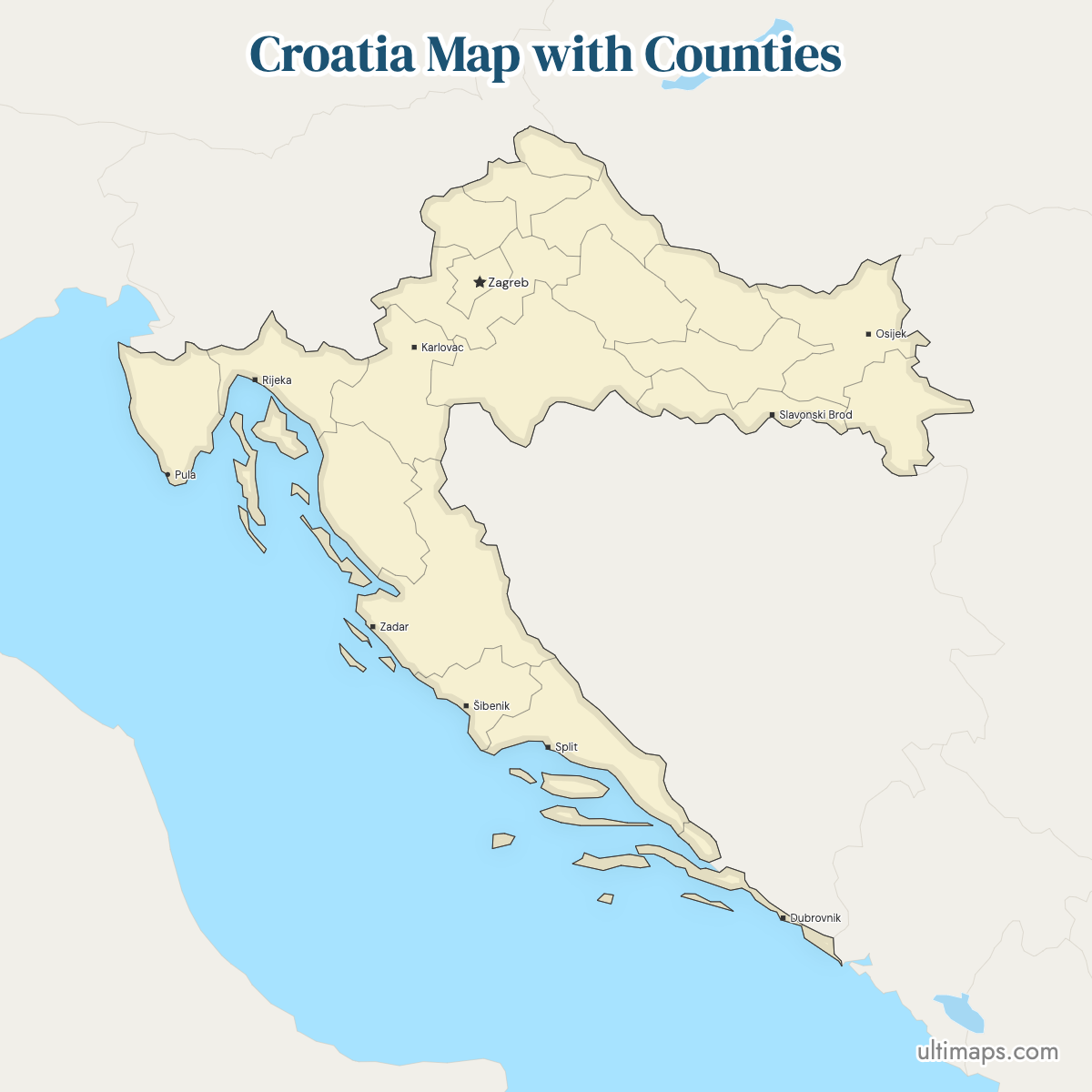
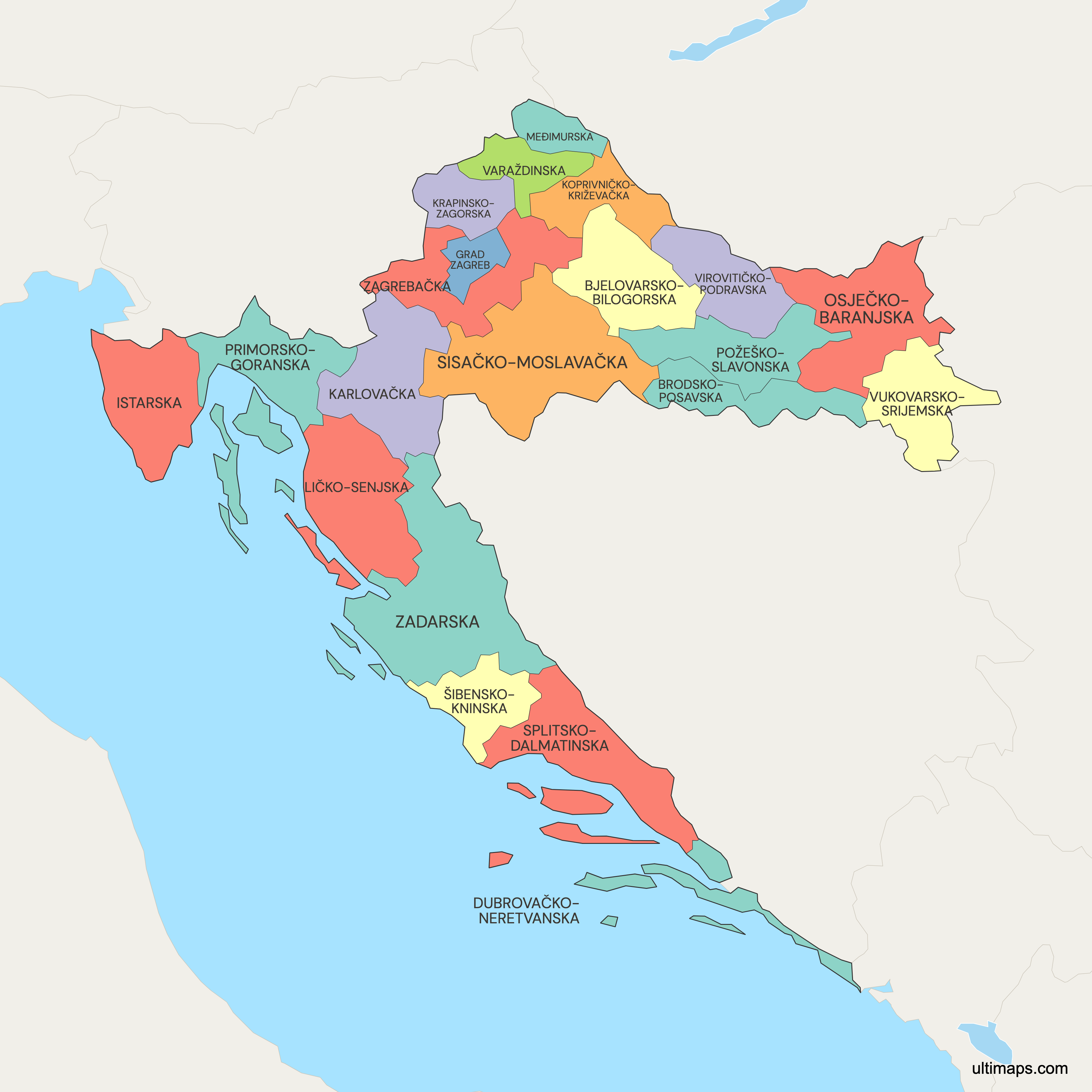
Croatia's top administrative tier consists of 20 counties, called županije in Croatian, together with the City of Zagreb, which is run as a county in its own right. That gives 21 first-level units, and this map draws all 21. Counts of 20 that you find elsewhere come from the same arrangement described differently: official usage keeps the word county for the 20 županije and lists the capital separately as a city with county powers.
The present division dates from 1992. It spans Adriatic island counties such as Primorje-Gorski Kotar and Split-Dalmatia, the mountainous interior of Lika-Senj, and the Pannonian east around Osijek-Baranja. Open the interactive map to follow a county line or locate a county seat. You can save the reference map for free, or attach county-level statistics and Ultimaps shades the 21 units to match.
Interactive Croatia Map with Counties
List of Counties (21)
Croatia Counties: Key Facts
- Total number of counties: 20 counties plus the City of Zagreb, a total of 21 first-level units, all shown on this map. Sources that report 20 are excluding the capital, which is classed as a city with county status rather than as a županija.
- Most populous unit: City of Zagreb, 767,131 residents (2021 census)
- Least populous county: Lika-Senj County, 42,748 residents (2021 census)
- Largest county by area: Lika-Senj County, 5,353 km² (2,067 sq mi)
- Smallest county by area: Međimurje County, 729.5 km² (282 sq mi)
- Counties with major urban centers: Split-Dalmatia (Split), Primorje-Gorski Kotar (Rijeka), Osijek-Baranja (Osijek), Zadar (Zadar), Šibenik-Knin (Šibenik), Dubrovnik-Neretva (Dubrovnik), Istria (seat at Pazin, with Pula, Poreč and Rovinj as its largest cities)
- Capital: Zagreb, both the national capital and the seat of the county-level City of Zagreb
- Borders: Slovenia and Hungary to the north, Serbia to the east, Bosnia and Herzegovina to the southeast, Montenegro in the far south, and a long Adriatic Sea coastline with numerous islands
- Time zone: Central European Time (UTC+1), moving to Central European Summer Time (UTC+2) in summer
- Historical note: the current county system was established in 1992, after independence-era administrative reform
Interesting Facts
- Lika-Senj is at once the biggest county by territory, 5,353 km² (2,067 sq mi), and the one with the fewest people, 42,748 in the 2021 census — Croatia's lowest population density at roughly 8 residents per km².
- The City of Zagreb and Zagreb County are two separate units. The capital is not administered as part of the county that surrounds it.
- Lika-Senj holds a second national park besides Plitvice: Sjeverni Velebit, at the northern end of the Velebit range.
- Island groups are divided among several counties: Krk, Cres, Lošinj and Rab in the north, Brač, Hvar and Vis in the center, Korčula and Mljet in the south.
- Four national parks sit in three counties: Plitvice Lakes mostly in Lika-Senj, Paklenica in Zadar, and both Krka and Kornati in Šibenik-Knin.
Free Downloads
Free for personal and commercial use with a credit to Ultimaps. See the license terms for details.
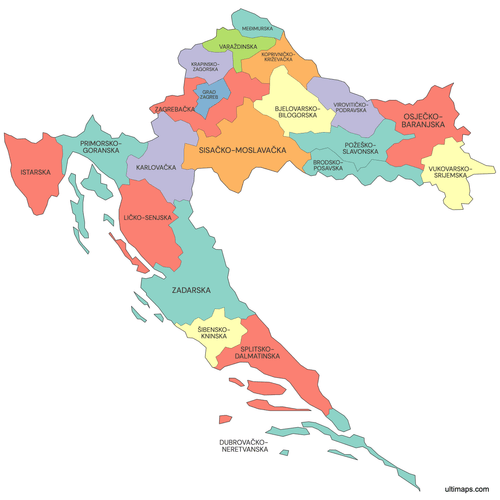 Colored Croatia Map with Countiespng826 KB
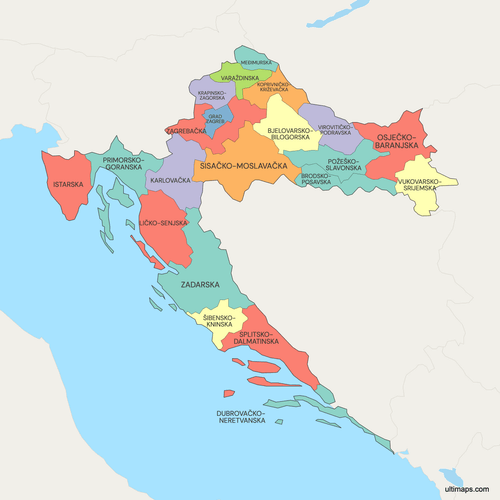 Political Map of Croatia with Countiespng903 KB
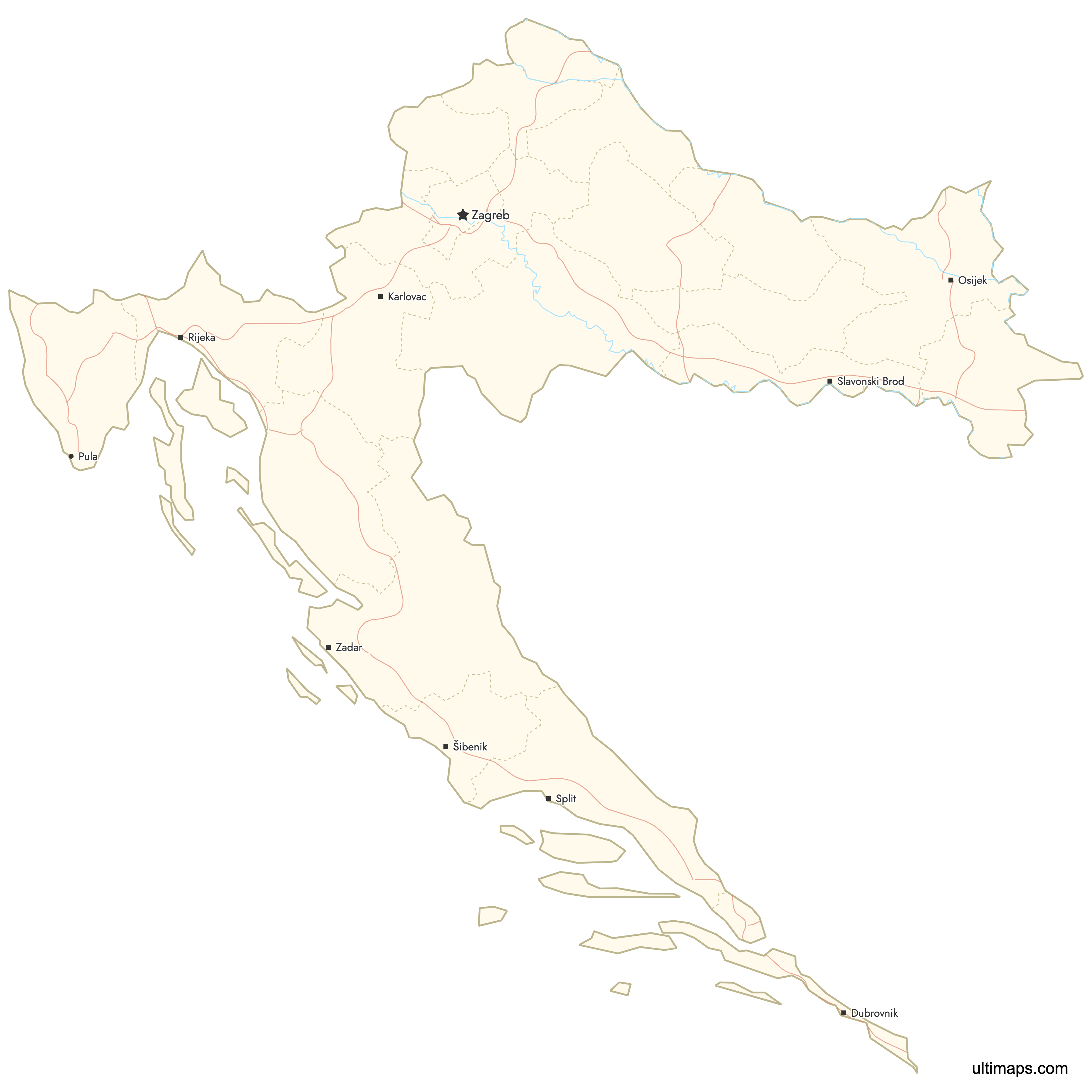
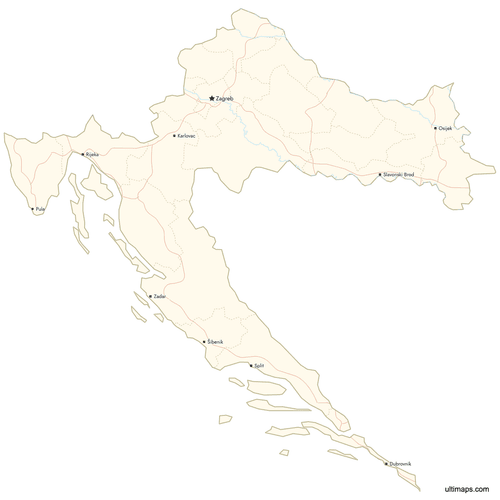 Map of Croatia with Cities and Roadspng777 KB
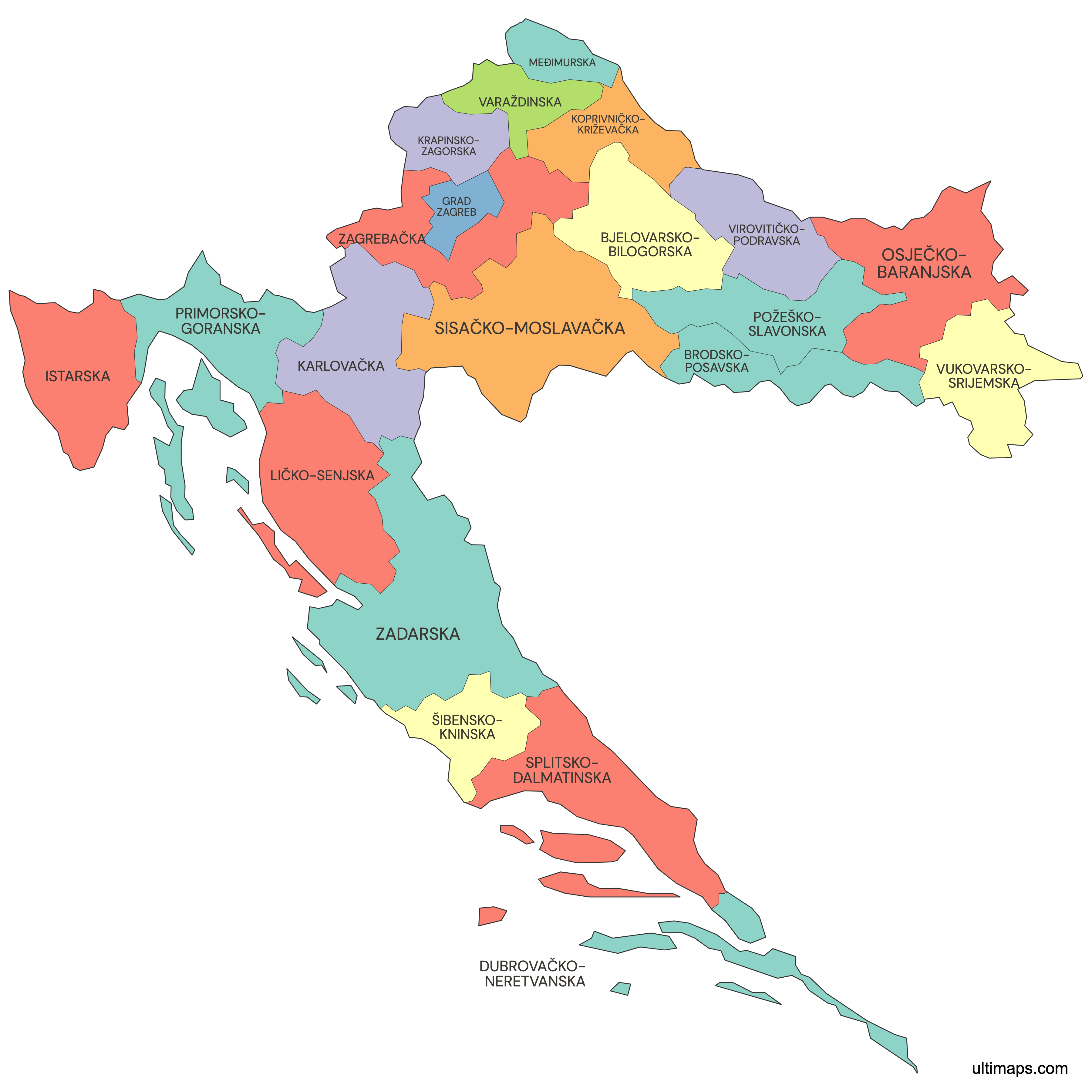
Need it without colors? The blank version of this map comes as a print-ready PDF (A4 and US Letter), a PNG and an editable SVG.
Custom Map Features
This map supports labels.
This map supports surrounding areas, roads, rivers and cities. New
This map is divided into 21 counties.
Updates
Apr 23, 2026:
- Added map of Croatia counties with surrounding countries, cities and roads
Frequently Asked Questions
Croatia has 20 counties plus the City of Zagreb, which holds county-level status, making 21 first-level administrative units, and this map shows all 21. Where you see the figure 20, the capital has been left out of the count: official Croatian usage applies the term županija to the 20 counties and treats Zagreb as a city exercising county powers. The arrangement was created in 1992. It mixes island and coastal counties along the Adriatic with inland ones running to the Hungarian, Serbian and Bosnian borders.
Lika-Senj County is Croatia's largest county by area at 5,353 km² (2,067 sq mi). It occupies the mountainous interior of the country behind the Velebit range, reaching from the Adriatic coast inland toward the border with Bosnia and Herzegovina. Lika-Senj is also the least populous unit in Croatia, with 42,748 residents recorded in the 2021 census, so the largest territory carries the smallest population. Plitvice Lakes National Park lies within its boundaries. At the other extreme, Međimurje County in the far north covers only 729.5 km² (282 sq mi).
The City of Zagreb has the largest population of any first-level unit in Croatia, with 767,131 residents in the 2021 census. It is the national capital and is counted apart from the surrounding Zagreb County. Among the 20 counties proper, the heaviest concentrations of people are in Split-Dalmatia County, which contains Split on the central Adriatic, Osijek-Baranja County in the east around Osijek, and Primorje-Gorski Kotar County, whose port city of Rijeka is the largest urban center on the northern coast. Zadar, Šibenik and Dubrovnik lead their own coastal counties.
No. Zagreb is not part of Zagreb County. The City of Zagreb is a first-level unit with county status, and Zagreb County is a separate county that wraps around it, so the two are drawn as distinct shapes on this map. The distinction matters whenever you join data: a figure published for the City of Zagreb, such as its 767,131 residents in the 2021 census, does not describe Zagreb County. Both have existed as separate units since the county system was set up in 1992.
Međimurje County is the smallest county in Croatia at 729.5 km² (282 sq mi). It sits in the extreme north of the country, lying between the Mura and Drava rivers on the Hungarian and Slovenian borders, and is the only Croatian county lying entirely north of the Drava. For comparison, Lika-Senj County covers 5,353 km² (2,067 sq mi), more than seven times its area. Small area does not mean few people: Međimurje is one of the more densely settled parts of Croatia, unlike the sparsely populated mountain counties.
Dubrovnik is in Dubrovnik-Neretva County, the southernmost of Croatia's 21 first-level units. The county runs along the far south of the Adriatic coast toward the border with Montenegro and takes in the Neretva delta as well as the islands of Korčula and Mljet. Dubrovnik serves as the county seat and is the main tourist center in the region. Other coastal counties and their principal cities are Split-Dalmatia with Split, Šibenik-Knin with Šibenik, Zadar with Zadar, and Primorje-Gorski Kotar with Rijeka.
Županija is the Croatian word for county, with the plural županije, and it names the 20 counties that form the country's top administrative tier alongside the City of Zagreb. Full Croatian county names attach the word to an adjective built from the seat or region, so Split-Dalmatia County appears as Splitsko-dalmatinska županija. English-language sources translate the term directly as county. The word derives from župan, a historic title for a regional governor, and the modern set of units in this form dates from 1992.
Croatia's best-known national parks fall into three counties. Plitvice Lakes National Park, with its terraced lakes and travertine barriers, lies mostly in Lika-Senj County, the largest county at 5,353 km² (2,067 sq mi). Paklenica National Park, at the southern end of the Velebit range, belongs to Zadar County. Šibenik-Knin County holds two: Krka National Park along the Krka river, and the Kornati archipelago offshore. Coastal counties also administer the major islands, including Krk, Cres, Lošinj and Rab in the north and Brač, Hvar, Vis, Korčula and Mljet farther south.
Everything runs in the browser, without installation or registration. Manual coloring means clicking any single unit — Istria County or the City of Zagreb included — and setting the shade yourself. The alternative is a spreadsheet with one value per county, from which Ultimaps computes a graduated scale for the 21 shapes. The palette, the map background, the label wording and typeface, and the thickness of county outlines are each set on their own. Markers cover point locations: place them on Zagreb, Split or Rijeka, or give exact coordinates, adding captions where useful. The export options are PNG, PDF and SVG.