Schengen area map with all 29 countries
The Schengen area has 29 countries: 25 EU members plus Iceland, Liechtenstein, Norway and Switzerland. Bulgaria and Romania joined fully on 1 January 2025. Ireland and Cyprus are in the EU but outside Schengen. The table lists every member with notes on its status. Download it as CSV, or embed the map free with credit.
by UltimapsLast updated
Remix opens a copy of this map, data included, for you to change. Free, no sign-up to start.
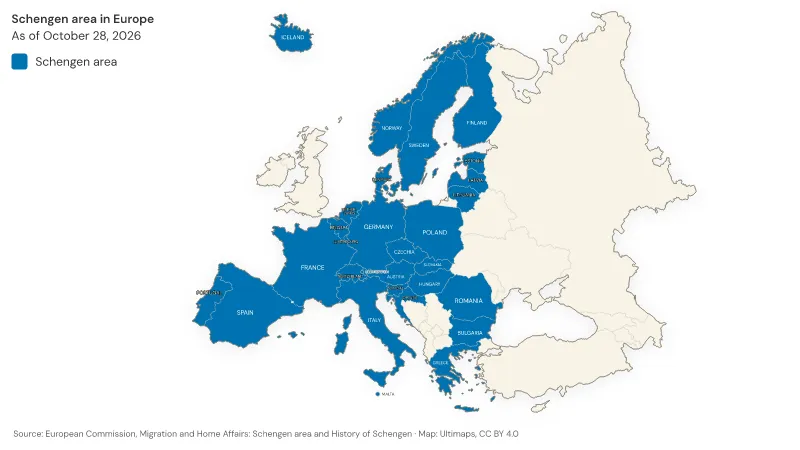
Source: European Commission, Migration and Home Affairs: Schengen area and History of Schengen (facts compiled by Ultimaps, CC BY 4.0)Data for
Data
| Region | Category | Note |
|---|---|---|
| Austria | Schengen area | Schengen acquis fully applied as of 31 March 1998 (lifting of controls began in 1997) |
| Belgium | Schengen area | Schengen Convention applied; internal border controls abolished |
| Bulgaria | Schengen area | Land border checks lifted 1 January 2025 |
| Croatia | Schengen area | Land and sea border controls lifted 1 January 2023; air borders 26 March 2023 |
| Czech Republic | Schengen area | Land and sea border controls lifted 21 December 2007; air borders 30 March 2008 |
| Denmark | Schengen area | Greenland and the Faroe Islands are not part of the Schengen area |
| Estonia | Schengen area | Land and sea border controls lifted 21 December 2007; air borders 30 March 2008 |
| Finland | Schengen area | Schengen Convention applied 25 March 2001; internal border controls abolished. Includes the Åland Islands |
| France | Schengen area | Metropolitan (European) France only |
| Germany | Schengen area | Schengen Convention applied; internal border controls abolished |
| Greece | Schengen area | Checks at internal borders lifted by 26 March 2000 (sea ports from 1 January 2000) |
| Hungary | Schengen area | Land and sea border controls lifted 21 December 2007; air borders 30 March 2008 |
| Iceland | Schengen area | Non-EU, associated through its agreement with the EU |
| Italy | Schengen area | Schengen acquis fully applied as of 31 March 1998 (lifting of controls began in 1997) |
| Latvia | Schengen area | Land and sea border controls lifted 21 December 2007; air borders 30 March 2008 |
| Liechtenstein | Schengen area | Non-EU, associated via the EU-Switzerland agreement |
| Lithuania | Schengen area | Land and sea border controls lifted 21 December 2007; air borders 30 March 2008 |
| Luxembourg | Schengen area | Schengen Convention applied; internal border controls abolished |
| Malta | Schengen area | Land and sea border controls lifted 21 December 2007; air borders 30 March 2008 |
| Netherlands | Schengen area | European Netherlands only |
| Norway | Schengen area | Non-EU, associated through its agreement with the EU |
| Poland | Schengen area | Land and sea border controls lifted 21 December 2007; air borders 30 March 2008 |
| Portugal | Schengen area | Schengen Convention applied; internal border controls abolished |
| Romania | Schengen area | Land border checks lifted 1 January 2025 |
| Slovakia | Schengen area | Land and sea border controls lifted 21 December 2007; air borders 30 March 2008 |
| Slovenia | Schengen area | Land and sea border controls lifted 21 December 2007; air borders 30 March 2008 |
| Spain | Schengen area | Schengen Convention applied; internal border controls abolished |
| Sweden | Schengen area | Schengen Convention applied 25 March 2001; internal border controls abolished |
| Switzerland | Schengen area | Non-EU. Land border controls lifted 12 December 2008; air borders 29 March 2009 |
| Cyprus | EU member bound by the Schengen acquis since accession; internal border controls not lifted (October 2026) | |
| Ireland | Not in the Schengen area: opt-out under the Schengen Protocol; takes part in some Schengen cooperation (e.g. the Schengen Information System) |