Greece Map with Regions
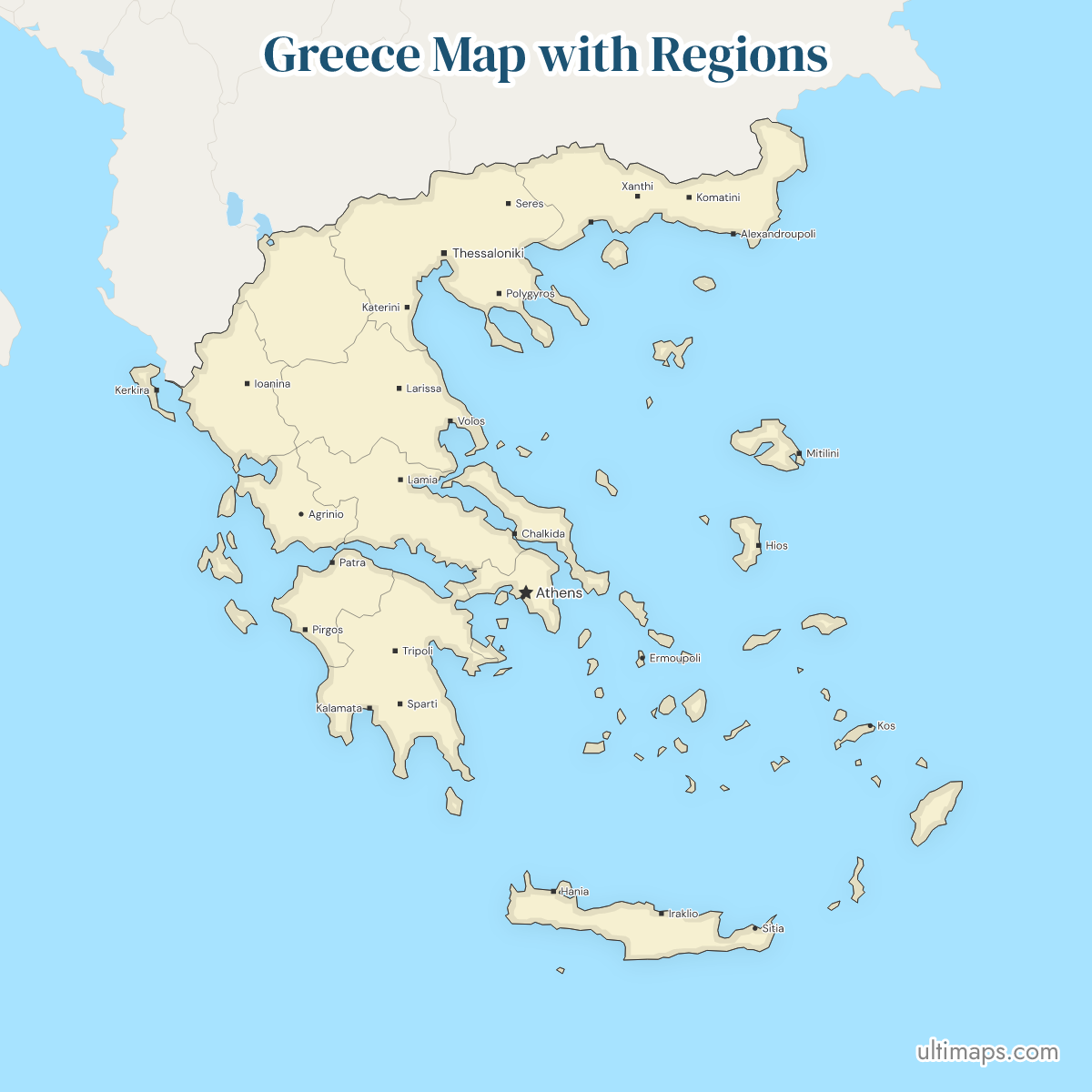
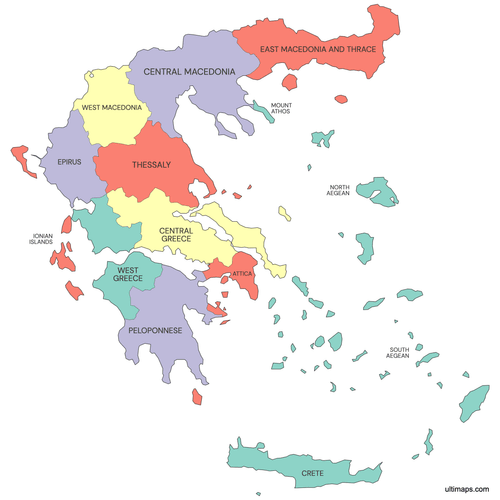
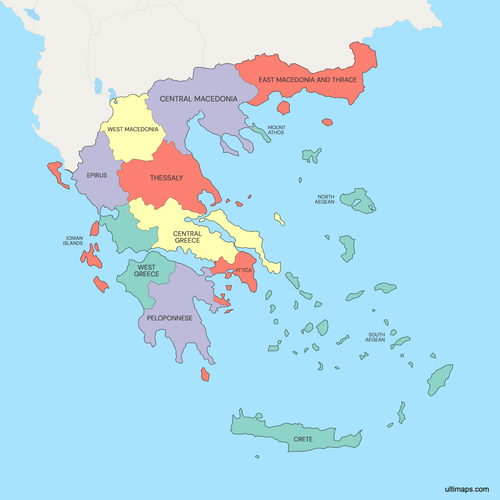
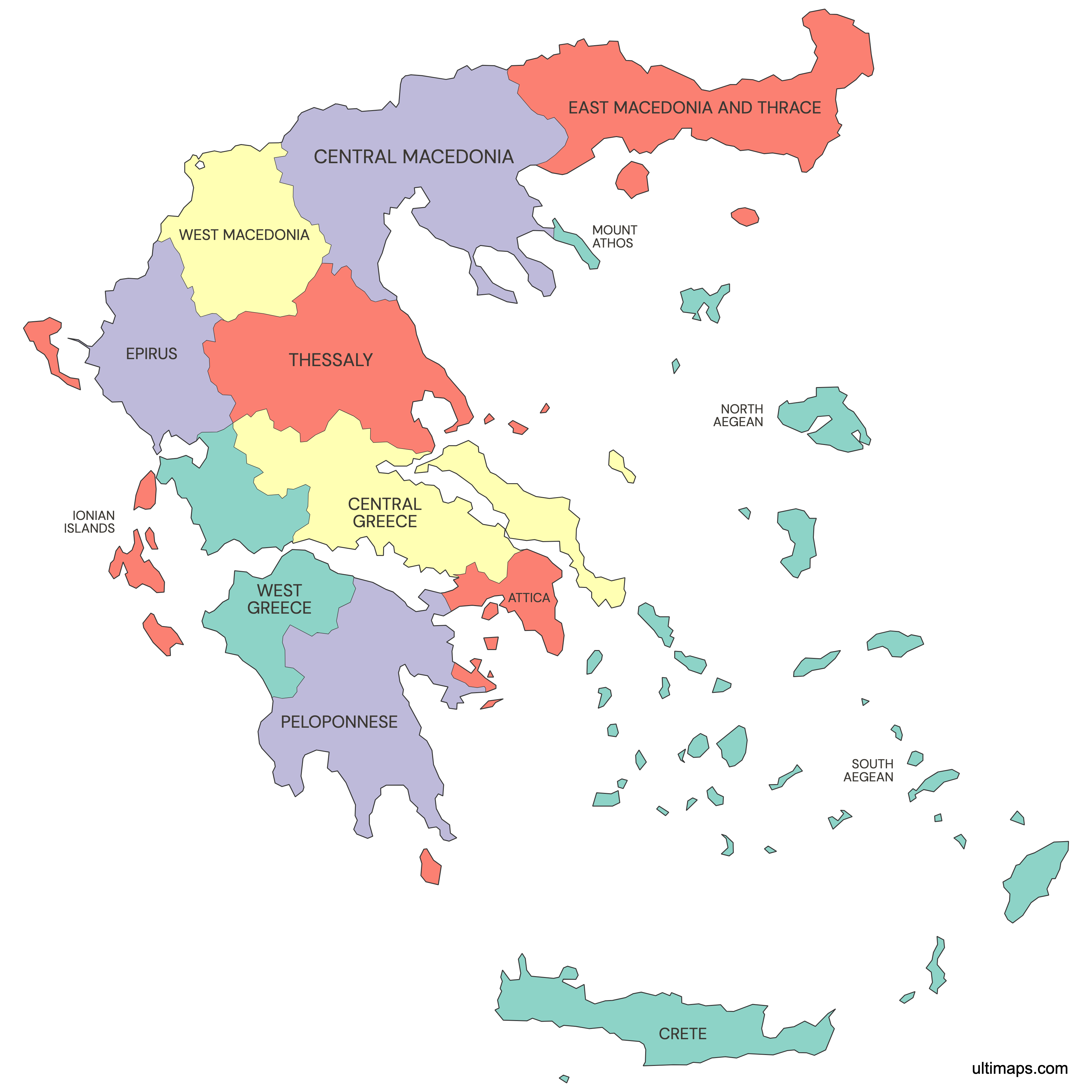
Greece is divided into 13 administrative regions, called peripheries in Greek. This map draws 14 units: the 13 regions plus Mount Athos, the autonomous monastic state on the easternmost peninsula of Halkidiki, which stands outside the ordinary regional system and is normally mapped on its own.
Four of the regions are made up entirely of islands (Crete, the Ionian Islands, North Aegean and South Aegean), while the rest run from Epirus and West Macedonia on the Albanian frontier across to East Macedonia and Thrace on the Turkish border. Attica contains Athens, Central Macedonia contains Thessaloniki. The regions date from 1987, and since 1 January 2011 each has had a directly elected governor and regional council under the Kallikratis reform.
Pan across the Aegean to tell the North Aegean and South Aegean units apart, or follow the line where Thessaly meets Central Greece. The base outline is available as a free file. Enter a value for every region and the 14 shapes are converted into a graduated data map.
Interactive Greece Map with Regions
List of Regions (14)
| # | Region |
|---|---|
| 1 | Attica |
| 2 | Central Greece |
| 3 | Central Macedonia |
| 4 | Crete |
| 5 | East Macedonia and Thrace |
| 6 | Epirus |
| 7 | Ionian Islands |
| 8 | Mount Athos |
| 9 | North Aegean |
| 10 | Peloponnese |
| 11 | South Aegean |
| 12 | Thessaly |
| 13 | West Greece |
| 14 | West Macedonia |
Greece Regions: Key Facts
- Total number of regions: 13 administrative regions; this map displays 14 units because Mount Athos, an autonomous monastic state, is drawn separately
- Most populous region: Attica, 3,814,064 residents (2021 census), about 36% of the country's population
- Least populous region: North Aegean, 194,943 residents (2021 census)
- Largest region by area: Central Macedonia, 18,811 km² (7,263 sq mi)
- Smallest region by area: Ionian Islands, 2,307 km² (891 sq mi)
- Regions with major urban centers: Attica (Athens, Piraeus), Central Macedonia (Thessaloniki), West Greece (Patras), Crete (Heraklion), Thessaly (Volos, Larissa), Epirus (Ioannina), East Macedonia and Thrace (Kavala, Alexandroupolis), Peloponnese (Kalamata, Corinth)
- Administrative center: Athens, in Attica, is the national capital
- Borders: Albania to the northwest, North Macedonia to the north, Bulgaria to the northeast and Turkey across the Evros river; the coastline faces the Ionian Sea, the Aegean Sea and the Sea of Crete
- Time zone: Eastern European Time (UTC+2), with Eastern European Summer Time (UTC+3) from late March to late October
- Boundaries established: the 13 regions were created in 1987; the Kallikratis reform made them self-governing from 1 January 2011 and introduced regional units as the second administrative level, replacing the old prefectures
Interesting Facts
- Attica has 3,814,064 residents in 3,808 km² (1,470 sq mi), close to 1,000 per km² (2021 census). Central Macedonia is nearly five times larger at 18,811 km² but has 1,795,669 residents (2021 census).
- Mount Athos is governed by its own monastic community under Greek sovereignty and falls under the spiritual jurisdiction of the Ecumenical Patriarchate. Around 1,700 to 2,000 monks live there, and the avaton rule bars women from setting foot on the peninsula.
- The four island regions together hold 1,351,703 residents (2021 census), with Crete alone accounting for 624,408 of them.
- Major landmarks by region: Meteora in Thessaly, Delphi in Central Greece, Knossos and the Samaria Gorge in Crete, Rhodes Old Town in the South Aegean, Corfu Old Town in the Ionian Islands and the Acropolis in Attica.
- West Macedonia, with 254,595 residents (2021 census), is the least populated mainland region, well behind neighboring Central Macedonia.
Free Downloads
Free for personal and commercial use with a credit to Ultimaps. See the license terms for details.
 Colored Greece Map with Regionspng626 KB
 Political Map of Greece with Regionspng620 KB
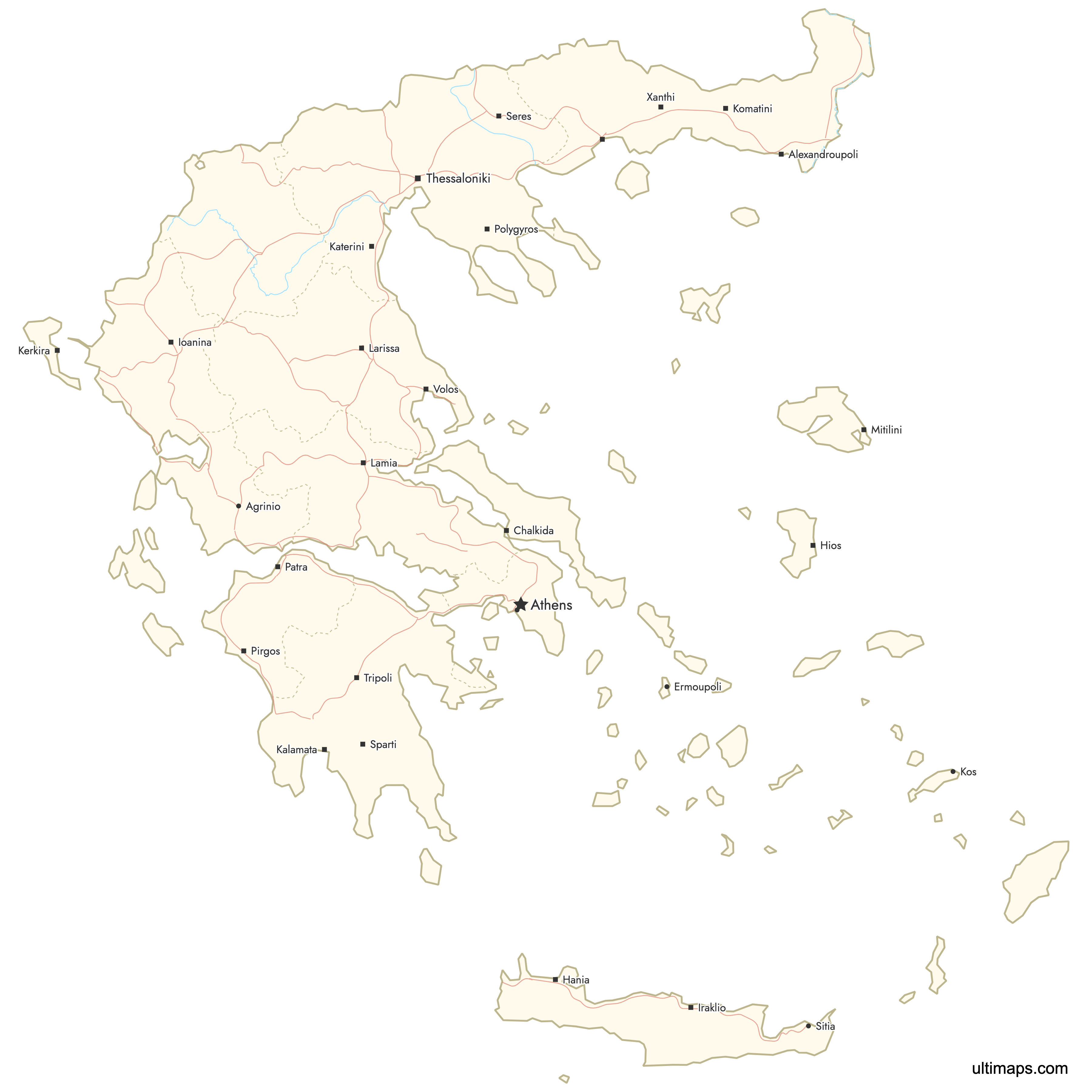
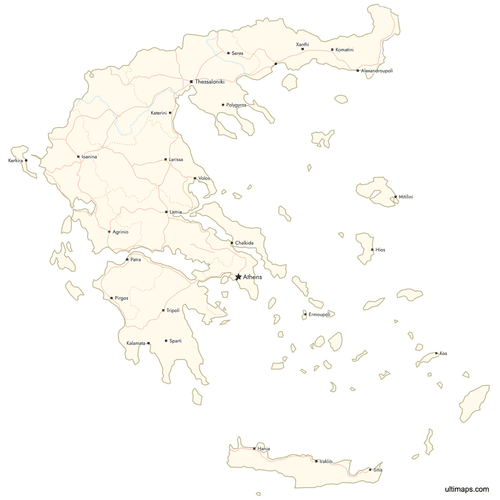 Map of Greece with Cities and Roadspng773 KB
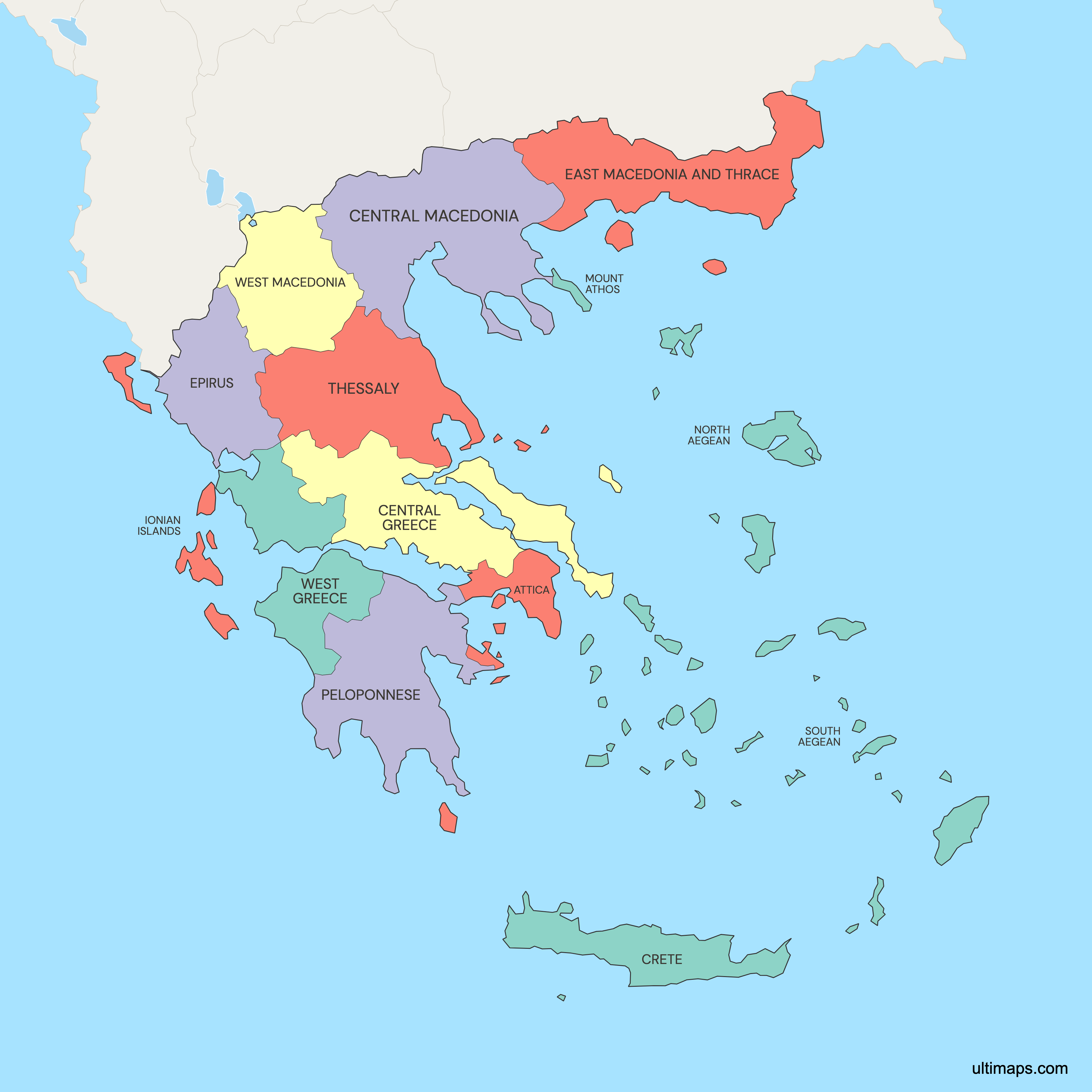
Need it without colors? The blank version of this map comes as a print-ready PDF (A4 and US Letter), a PNG and an editable SVG.
Custom Map Features
This map supports labels.
This map supports surrounding areas, roads, rivers and cities. New
This map is divided into 14 regions.
Updates
Apr 23, 2026:
- Added map of Greece Regions with surrounding countries, cities and roads
Frequently Asked Questions
Greece has 13 administrative regions: Attica, Central Greece, Central Macedonia, Crete, East Macedonia and Thrace, Epirus, the Ionian Islands, North Aegean, the Peloponnese, South Aegean, Thessaly, West Greece and West Macedonia. This map shows 14 units, because Mount Athos is drawn as a separate shape rather than folded into Central Macedonia. The 13 regions were created in 1987 and became self-governing on 1 January 2011 under the Kallikratis reform, which gave each one a directly elected governor and regional council. Beneath them sit the regional units, the second administrative tier introduced by the same reform.
Central Macedonia is the largest Greek region by area at 18,811 km² (7,263 sq mi). It runs from Mount Olympus and the Thermaic Gulf north to the frontiers with North Macedonia and Bulgaria, and includes the three prongs of the Halkidiki peninsula. Central Macedonia is also the second most populous region, with 1,795,669 residents (2021 census), and its capital Thessaloniki is the country's second city. The easternmost Halkidiki peninsula holds Mount Athos, which is not administered as part of the region. The smallest region by area is the Ionian Islands at 2,307 km² (891 sq mi).
Attica is the most populated region of Greece, with 3,814,064 residents at the 2021 census, roughly 36% of the national total. It covers 3,808 km² (1,470 sq mi) and contains Athens, the national capital, together with Piraeus, the main passenger port. That gives Attica close to 1,000 residents per km², a density no other region approaches. Central Macedonia ranks second at 1,795,669, followed by Thessaly with 688,255, West Greece with 648,220 and Crete with 624,408. All 2021 census figures come from ELSTAT, the Hellenic Statistical Authority.
North Aegean has the smallest population of any Greek region, 194,943 residents at the 2021 census, spread over Lesbos, Chios, Samos, Ikaria, Limnos and smaller islands, with Mytilene as its seat. The Ionian Islands come next at 204,532, then West Macedonia at 254,595 and Epirus at 319,991. The Ionian Islands region is also the smallest in area, 2,307 km² (891 sq mi). Because island regions cluster at the bottom of the population table, thematic maps of Greece often work better with per capita values than with raw totals.
Mount Athos is not one of Greece's 13 regions. It is an autonomous monastic state under Greek sovereignty, run by its own monastic community and placed under the spiritual jurisdiction of the Ecumenical Patriarchate. Between 1,700 and 2,000 monks live on the peninsula, and the avaton rule bars women from entering, while male visitors need a permit. Since its legal status differs from that of an ordinary region, cartographers usually give it a shape of its own. That is why this map carries 14 units while the official regional count stays at 13.
Regions (peripheries) are the first level of Greek local self-government, 13 in total, each headed by a governor and council elected directly since 1 January 2011. Regional units (perifereiakes enotites) sit one level below and divide each region into smaller districts. Both were reorganized by the Kallikratis reform of 2011, which abolished the old prefectures (nomoi) that had structured Greek administration for decades. Many regional units inherited the borders and names of those prefectures, so older maps of Greece and current ones often look similar at the second level while the top level differs.
Athens sits in Attica and Thessaloniki in Central Macedonia, the two most populous regions of Greece at 3,814,064 and 1,795,669 residents respectively (2021 census). Patras belongs to West Greece, Heraklion to Crete, Larissa and Volos to Thessaly, Ioannina to Epirus, and Kavala and Alexandroupolis to East Macedonia and Thrace. Kalamata and Corinth fall within the Peloponnese, Rhodes within the South Aegean, Mytilene within the North Aegean and Corfu within the Ionian Islands. Naming a region's largest town is the quickest way to identify it on a blank outline map.
Greece borders four countries: Albania to the northwest, North Macedonia to the north, Bulgaria to the northeast and Turkey in the far east along the Evros river. Epirus and West Macedonia meet Albania, West Macedonia and Central Macedonia meet North Macedonia, Central Macedonia and East Macedonia and Thrace meet Bulgaria, and East Macedonia and Thrace alone touches Turkey. The rest of the boundary is water: the Ionian Sea on the west, the Aegean Sea on the east and the Sea of Crete between the mainland and Crete.
A finished Greek data map typically shows all 14 shapes tinted by value, with the darkest shade over Attica. To get there, paste in a spreadsheet that pairs each region name with a number, and Ultimaps reads it and colors the 14 shapes accordingly. Single regions can also be filled by hand when you only want Crete or Epirus highlighted. You pick the color ramp, and background, label text and outline weight are edited separately. To flag a city, drop a captioned pin on Athens, Thessaloniki or Heraklion. Ultimaps runs in the browser with no registration, and saves to PNG, PDF or SVG.