Map of New Jersey Counties

This map of New Jersey shows all 21 counties, a count unchanged since 1857, when Union County was formed from part of Essex County. Bergen, Essex, Middlesex and Monmouth are the oldest, created in 1683. Trenton, the state capital, is the seat of Mercer County on the Delaware River.
The U.S. Census Bureau's July 2024 estimates put Bergen County first in population with 978,641 residents and Salem County, in the southwest along the Delaware River, last with 65,874. Land area ranks the counties differently. In the 2026 Census Gazetteer, Burlington County has the most land at 799.3 square miles (2,070 km²) and Hudson County the least at 46.2 square miles (120 km²), yet Hudson ranks fourth in population with 736,185 people.
Open the map in the free Ultimaps editor to make your own custom map of New Jersey. You can color the counties by your data, add pins and labels, and share or embed the finished map.
Interactive Map of New Jersey Counties
List of Counties (21)
| # | County | County seat | Year founded |
|---|---|---|---|
| 1 | Atlantic | Mays Landing | 1837 |
| 2 | Bergen | Hackensack | 1683 |
| 3 | Burlington | Mount Holly | 1694 |
| 4 | Camden | Camden | 1844 |
| 5 | Cape May | Cape May Court House | 1692 |
| 6 | Cumberland | Bridgeton | 1748 |
| 7 | Essex | Newark | 1683 |
| 8 | Gloucester | Woodbury | 1686 |
| 9 | Hudson | Jersey City | 1840 |
| 10 | Hunterdon | Flemington | 1714 |
| 11 | Mercer | Trenton | 1838 |
| 12 | Middlesex | New Brunswick | 1683 |
| 13 | Monmouth | Freehold | 1683 |
| 14 | Morris | Morristown | 1739 |
| 15 | Ocean | Toms River | 1850 |
| 16 | Passaic | Paterson | 1837 |
| 17 | Salem | Salem | 1694 |
| 18 | Somerset | Somerville | 1688 |
| 19 | Sussex | Newton | 1753 |
| 20 | Union | Elizabeth | 1857 |
| 21 | Warren | Belvidere | 1824 |
New Jersey Counties: Key Facts
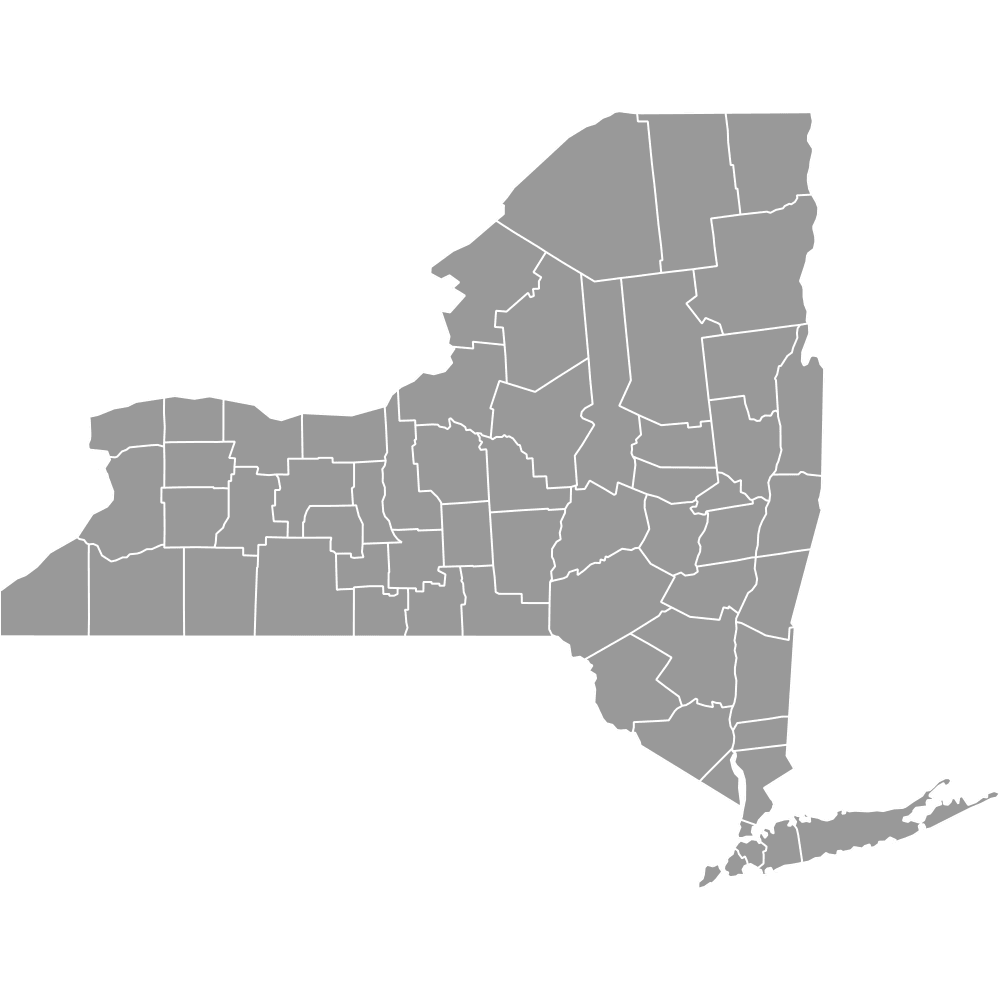
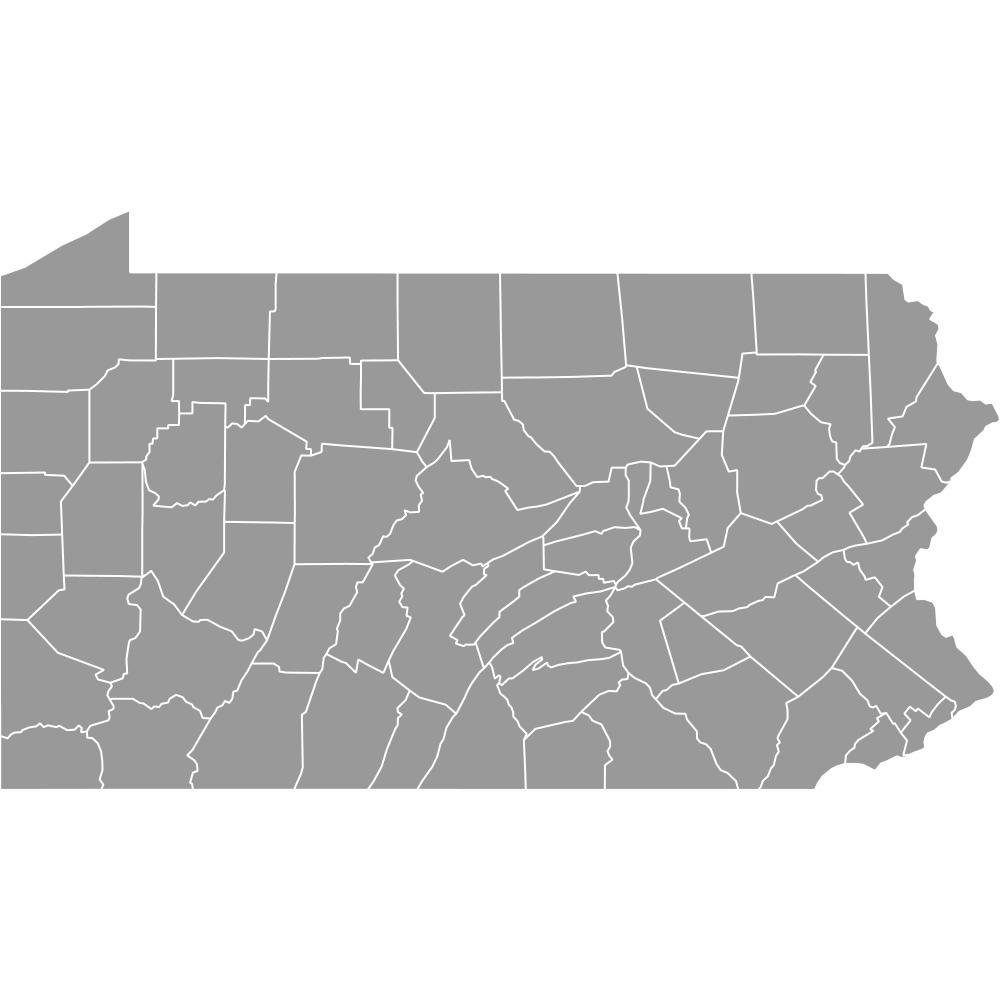
- Total number of counties: 21, a number unchanged since 1857 (Pennsylvania has 67, New York 62 and Delaware 3)
- Most populous county: Bergen County (seat: Hackensack), 978,641 (U.S. Census Bureau estimate, July 2024)
- Least populous county: Salem County (seat: Salem), 65,874 (U.S. Census Bureau estimate, July 2024)
- Largest county by area: Burlington County (seat: Mount Holly), 799.3 square miles (2,070 km²) of land (Census Gazetteer Files, 2026). Ocean County is larger when water is counted, at 914.8 square miles (2,369 km²) of land and water combined.
- Smallest county by area: Hudson County (seat: Jersey City), 46.2 square miles (120 km²) of land, or 62.4 square miles (162 km²) with water (Census Gazetteer Files, 2026)
- Counties with the largest municipalities: Essex (Newark), Hudson (Jersey City), Passaic (Paterson), Union (Elizabeth), Ocean (Lakewood and Toms River), Middlesex (Edison and Woodbridge) and Mercer (Hamilton and Trenton), home to the state's 10 most populous municipalities in the 2020 Census
- State capital: Trenton, the seat of Mercer County and the permanent capital since 1790
- Borders: New York to the north and northeast, across the Hudson River and New York Harbor in the east. Pennsylvania to the west across the Delaware River. Delaware to the southwest across the Delaware River and Delaware Bay. The Atlantic Ocean to the east and southeast.
- Time zone: Eastern Time in all 21 counties, UTC−5 in winter (EST) and UTC−4 during daylight saving time (EDT)
- Historical note: Bergen, Essex, Middlesex and Monmouth were created in 1683 in colonial East Jersey. Union County, formed from part of Essex in 1857, was the last new county, and the 21-county structure has held since then.
Interesting Facts
- Hudson County has about 15,900 residents per square mile of land (736,185 people on 46.2 square miles in 2024). Salem County has about 200.
- Cape May County, the state's southernmost, has more water than land. The 2026 Census Gazetteer lists 368.8 square miles (955 km²) of water and 251.5 square miles (651 km²) of land, the most water of any New Jersey county.
- Cape May was also the only county to lose residents between the 2020 and 2024 Census Bureau estimates, falling from 95,051 to 93,875. Ocean County grew fastest over the same period, up 4.4% to 666,434.
- Morristown in Morris County was a main headquarters for George Washington during the Revolutionary War. The sites are preserved as Morristown National Historical Park.
Free Downloads
Free for personal and commercial use with a credit to Ultimaps. See the license terms for details.
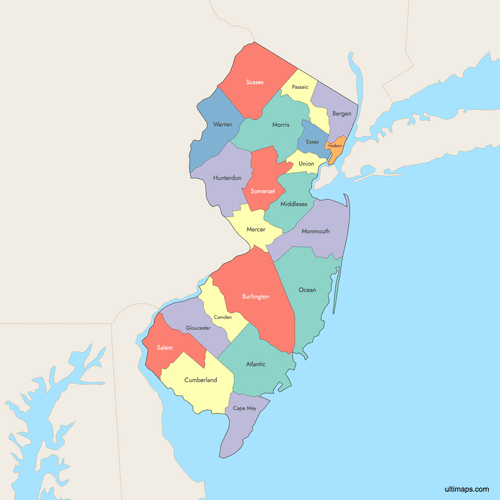 Colored Map of New Jersey Counties with Surrounding Areaspng685 KB
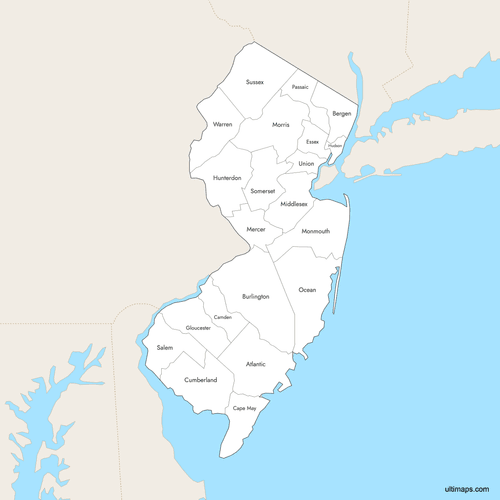 Labeled Map of New Jersey Counties with Surrounding Areaspng684 KB
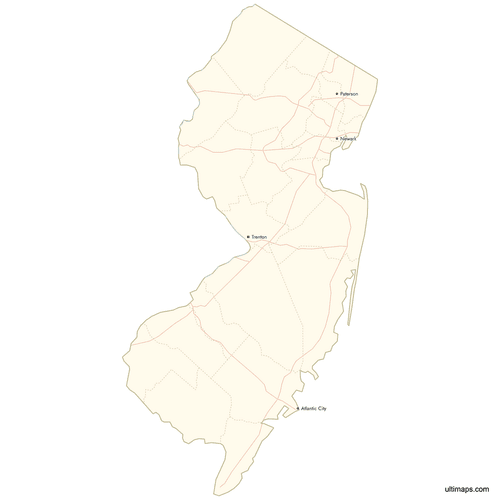 Map of New Jersey Counties with Citiespng552 KB
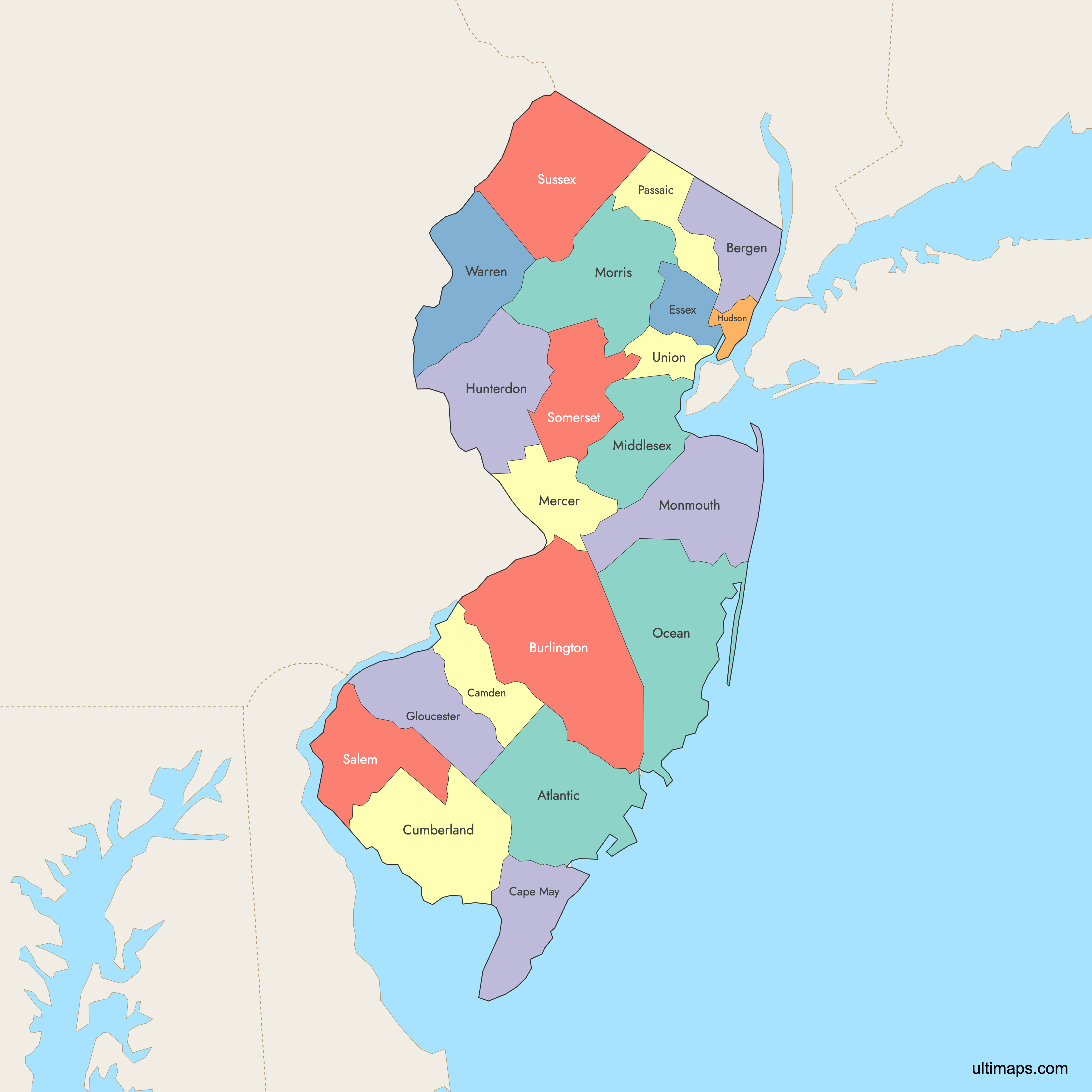
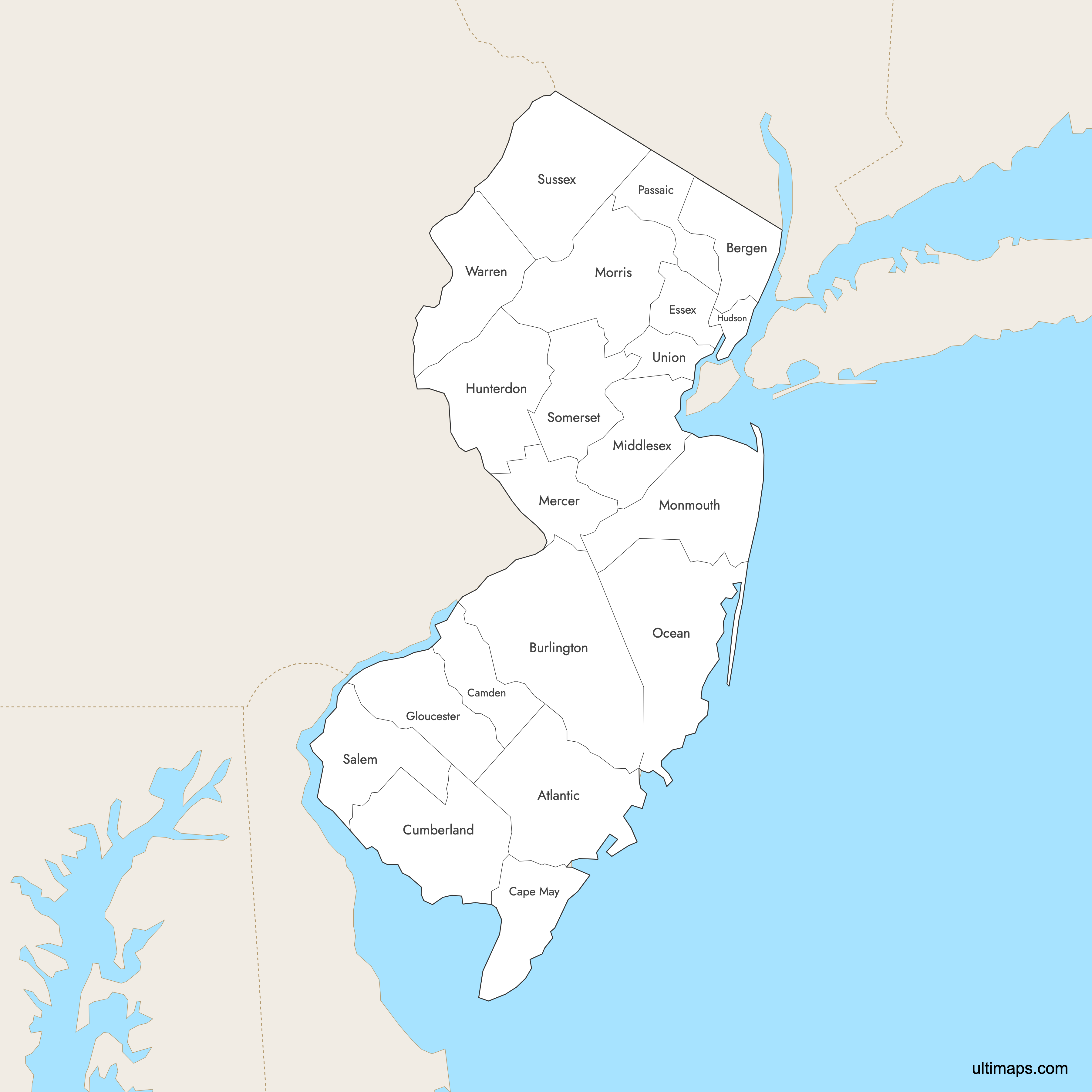
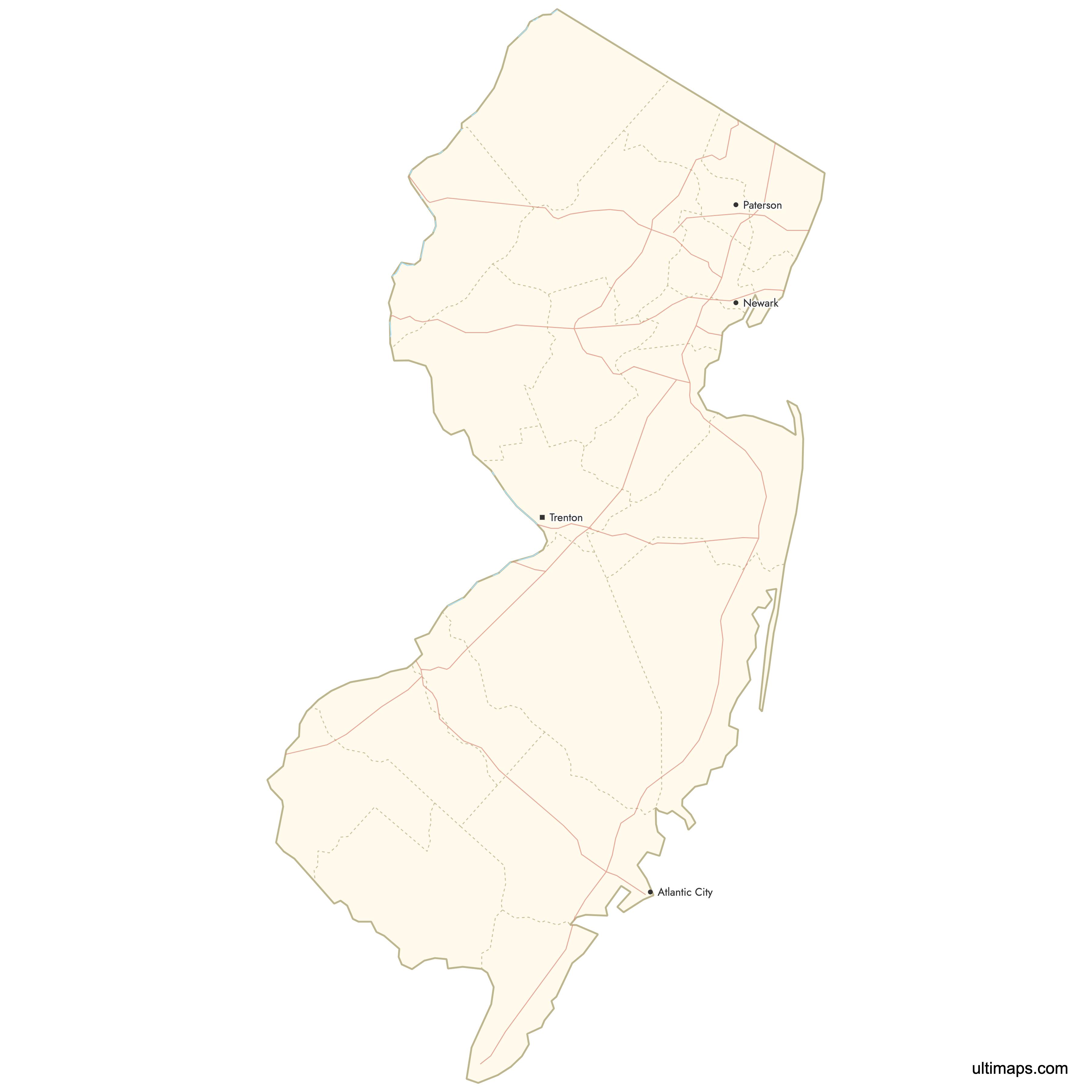
Need it without colors? The blank version of this map comes as a print-ready PDF (A4 and US Letter), a PNG and an editable SVG.
Custom Map Features
This map supports labels.
This map supports surrounding areas, roads, rivers and cities. New
This map is divided into 21 counties.
Updates
Oct 2, 2025:
- Improved map quality
- Added support for surrounding areas and lakes
Aug 26, 2024:
- Added map of New Jersey Counties
Frequently Asked Questions
New Jersey has 21 counties, and the Ultimaps map shows all 21. The count has not changed since 1857, when the state created Union County from part of Essex County. County and municipal boundaries have been adjusted since then, but no new county has been formed. The counties vary a lot in population. Bergen County had 978,641 residents in July 2024 and Salem County had 65,874, according to U.S. Census Bureau estimates, and all 21 together had 9,500,851. For comparison, neighboring Pennsylvania has 67 counties, New York has 62 and Delaware has 3. Trenton, the state capital, is the seat of Mercer County.
Burlington County is the largest county in New Jersey by land area, with 799.3 square miles (2,070 km²) according to the U.S. Census Bureau's 2026 Gazetteer Files. It borders the Delaware River opposite Pennsylvania and includes part of the Pine Barrens and Wharton State Forest. Its county seat is Mount Holly. Ocean County is larger if you count water. Ocean has 628.3 square miles of land and 286.5 square miles of water, including Barnegat Bay, for a total of 914.8 square miles (2,369 km²). Burlington has only 21.1 square miles of water, so its total is about 820 square miles (2,125 km²). Both counties are far larger than Hudson, the smallest, at 46.2 square miles of land.
Bergen County is the most populated county in New Jersey, with 978,641 residents in July 2024 according to U.S. Census Bureau estimates. It occupies the state's northeast corner on the Hudson River, where the George Washington Bridge connects it to Manhattan, and its county seat is Hackensack. MetLife Stadium and part of the New Jersey Meadowlands are also in Bergen. Middlesex County is second with 890,119 people, and Essex County, home to Newark, the state's largest city, is third with 881,527. Bergen grew by 24,930 residents between the 2020 and 2024 estimates. Middlesex added slightly more, 28,659, so the gap between the two counties narrowed.
Hudson County is the smallest county in New Jersey by area, with 46.2 square miles (120 km²) of land, or 62.4 square miles (162 km²) including water, per the U.S. Census Bureau's 2026 Gazetteer Files. Hudson is not small in population. Its 736,185 residents (2024 Census Bureau estimate) rank fourth of 21. They live in places such as Jersey City, the county seat, and Hoboken, across the Hudson River from Manhattan, at roughly 15,900 people per square mile of land. Measured by population, the smallest county is Salem County, along the Delaware River, with 65,874 residents (2024) on 331.9 square miles of land, or about 200 per square mile.
Trenton, the capital of New Jersey, is in Mercer County and is also the county seat. Trenton became the permanent state capital in 1790, 48 years before the legislature created Mercer County in 1838 from parts of Burlington, Hunterdon, Middlesex and Somerset counties. Mercer had 392,138 residents in July 2024 according to U.S. Census Bureau estimates, 12th of the 21 counties. The city lies on the Delaware River, across from Pennsylvania. Mercer County also includes Princeton, with Princeton University and Princeton Battlefield State Park.
New Jersey's oldest counties are Bergen, Essex, Middlesex and Monmouth, all formed in 1683 in the colony of East Jersey. Gloucester followed in 1686, Somerset in 1688, Cape May in 1692, and Burlington and Salem in 1694. Hunterdon (1714), Morris (1739), Cumberland (1748) and Sussex (1753) came later in the colonial period. The other eight counties date from the 1800s, each formed from older ones, for example Warren from Sussex in 1824, Camden from Gloucester in 1844 and Ocean from Monmouth in 1850. Union County, created from part of Essex in 1857, is the newest. As of 2026, 10 of the 21 counties are more than 300 years old.
Four New Jersey counties face the Atlantic Ocean. From north to south they are Monmouth, Ocean, Atlantic and Cape May, and the Jersey Shore runs through all four. Sandy Hook and Asbury Park are in Monmouth, Island Beach State Park and Long Beach Island in Ocean, Atlantic City in Atlantic County, and Wildwood and Cape May in Cape May County. These four counties hold about 71% of the water area in New Jersey's 21 counties, per the 2026 Census Gazetteer. Cape May alone has 368.8 square miles (955 km²) of water and 251.5 square miles (651 km²) of land. Cumberland, on Delaware Bay, ranks third for water at 194.5 square miles (504 km²), but it does not touch the ocean.
New Jersey has no legal definition of North, Central or South Jersey, so county lists vary by source. Transportation planning gives one formal three-way split. The North Jersey Transportation Planning Authority covers 13 counties: Bergen, Essex, Hudson, Hunterdon, Middlesex, Monmouth, Morris, Ocean, Passaic, Somerset, Sussex, Union and Warren. The Delaware Valley Regional Planning Commission, based in Philadelphia, covers Burlington, Camden, Gloucester and Mercer. The South Jersey Transportation Planning Organization covers Atlantic, Cape May, Cumberland and Salem. In everyday speech, Central Jersey usually refers to counties such as Middlesex, Monmouth, Somerset and Mercer, and you can draw your own grouping by coloring the counties on this map.
For a custom map of New Jersey, such as sales territories or county election results, use the free Ultimaps editor. You won't need an account. Pick any county, say Morris or Camden, and assign it a color by hand. Or import a spreadsheet listing the 21 county names with a value for each, such as 2024 population, and the counties are colored on a scale with a legend. Place pins on exact locations, for example an office in Newark or a venue in Atlantic City. Then adjust the palette, borders, labels and title. Exporting on the free plan gives you a standard PNG with a small Ultimaps credit, while high-resolution PNG, SVG and PDF exports are part of Pro.