Denmark Map with Regions
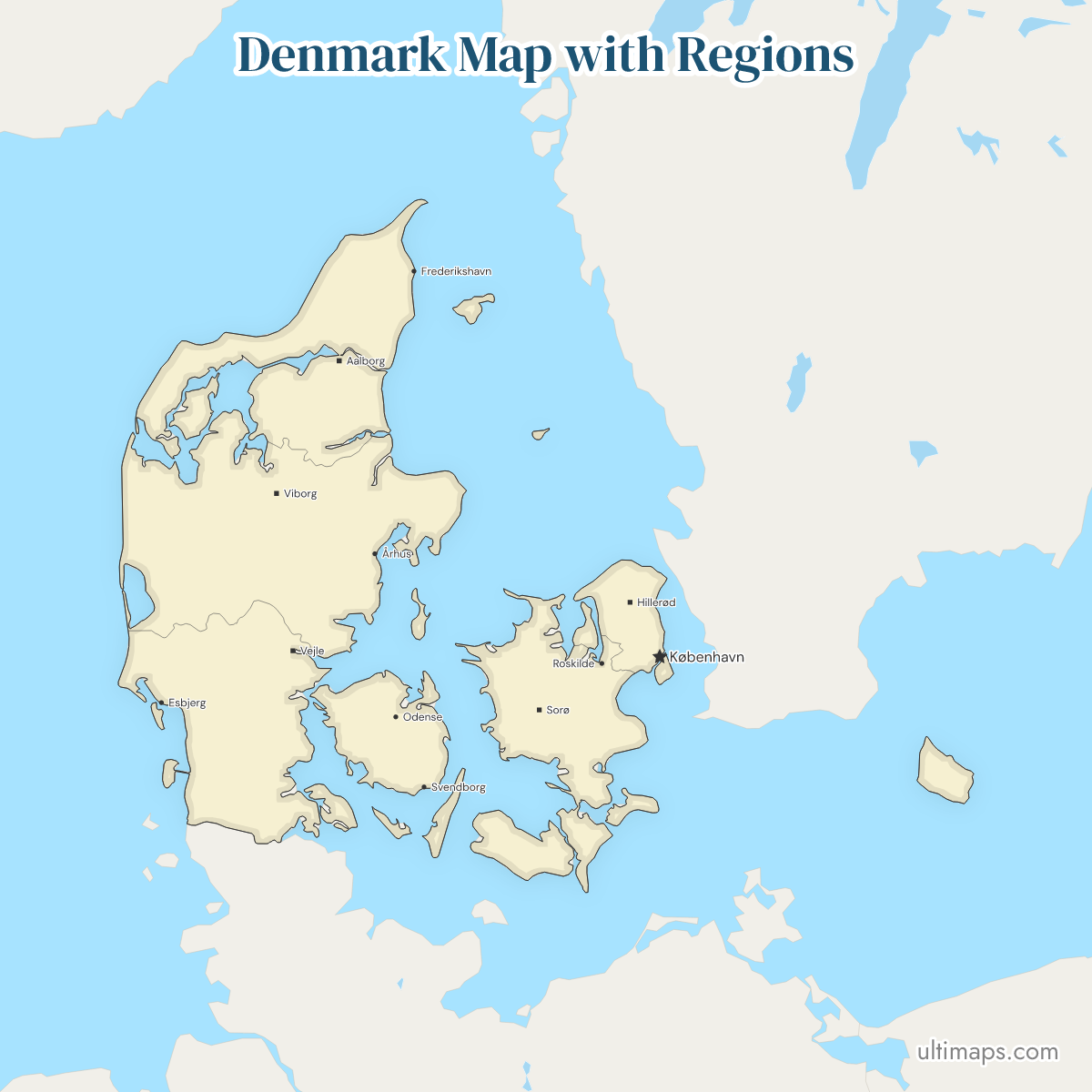
Denmark is split into 5 regions: Hovedstaden, Midtjylland, Nordjylland, Sjælland and Syddanmark. They came out of the 2007 municipal reform, which abolished the old counties and handed the new units responsibility for hospitals and public health rather than local legislation. Below them sit 98 municipalities. The same five areas serve as Denmark's NUTS 2 statistical regions, so most published Danish data breaks down along exactly these lines. Hovedstaden contains Copenhagen, the national capital. Bornholm, out in the Baltic, is administered from Hovedstaden despite sitting well east of the rest of the country. Scroll to the interactive map to check where any regional line runs. The reference copy is free, and supplying one figure per region turns the map into a thematic one.
Interactive Denmark Map with Regions
List of Regions (5)
| # | Region |
|---|---|
| 1 | Hovedstaden |
| 2 | Midtjylland |
| 3 | Nordjylland |
| 4 | Sjælland |
| 5 | Syddanmark |
Denmark Regions: Key Facts
- Total number of regions: 5, one of the smallest first-level divisions counts in Europe, subdivided into 98 municipalities
- Most populous region: Hovedstaden, 1,930,793 residents (1 January 2025, Statistics Denmark), covering Copenhagen and Frederiksberg
- Least populous region: Nordjylland, 592,768 residents (2025), centered on Aalborg
- Largest region by area: Midtjylland, 13,014 km² (5,025 sq mi) (2026, Statistics Denmark)
- Smallest region by area: Hovedstaden, 2,564 km² (990 sq mi), Bornholm included (2026)
- Regions with major urban centers: Hovedstaden (Copenhagen, Frederiksberg), Midtjylland (Aarhus, Viborg), Syddanmark (Odense, Esbjerg, Vejle), Nordjylland (Aalborg), Sjælland (Roskilde)
- National capital: Copenhagen. Regional seats are Hillerød, Viborg, Aalborg, Sorø and Vejle
- Borders: Germany by land in southern Jutland, with the North Sea to the west, the Skagerrak and Kattegat to the north, and the Baltic Sea to the east and south
- Time zone: Central European Time (UTC+1), shifting to Central European Summer Time (UTC+2)
- Boundaries established: 2007, when the municipal reform replaced the previous counties with today's five regions
Interesting Facts
- Health care is the regions' main job — hospitals account for roughly 90% of regional budgets — and the regions have no power to pass local laws.
- Bornholm lies roughly 150 km east of Zealand in the Baltic Sea, yet it is part of Hovedstaden, the region built around Copenhagen.
- Midtjylland is the biggest region by area at 13,014 km² (2026) and contains Aarhus, Denmark's second-largest city.
- Syddanmark combines the island of Funen with southern Jutland and the German border zone, spanning 12,267 km² (4,736 sq mi) (2026).
- Hovedstaden holds 1,930,793 people (2025) on 2,564 km², making it both the smallest region and much the most densely populated, at over 750 residents per km².
Free Downloads
Free for personal and commercial use with a credit to Ultimaps. See the license terms for details.
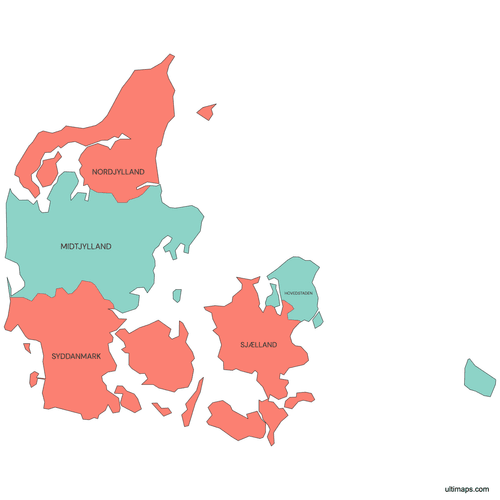 Colored Denmark Map with Regionspng470 KB
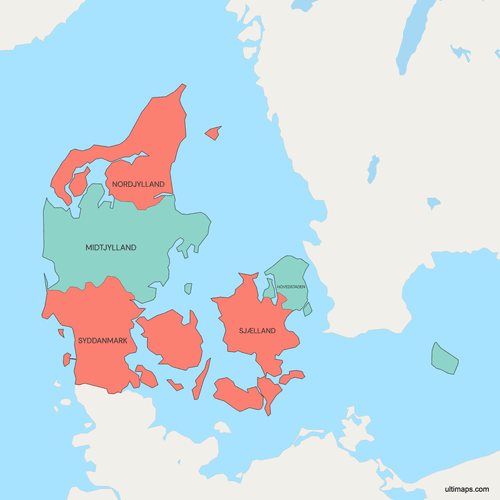 Political Map of Denmark with Regionspng681 KB
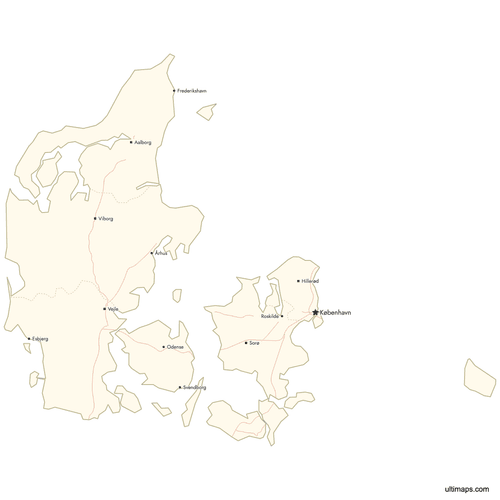 Map of Denmark with Cities and Roadspng542 KB
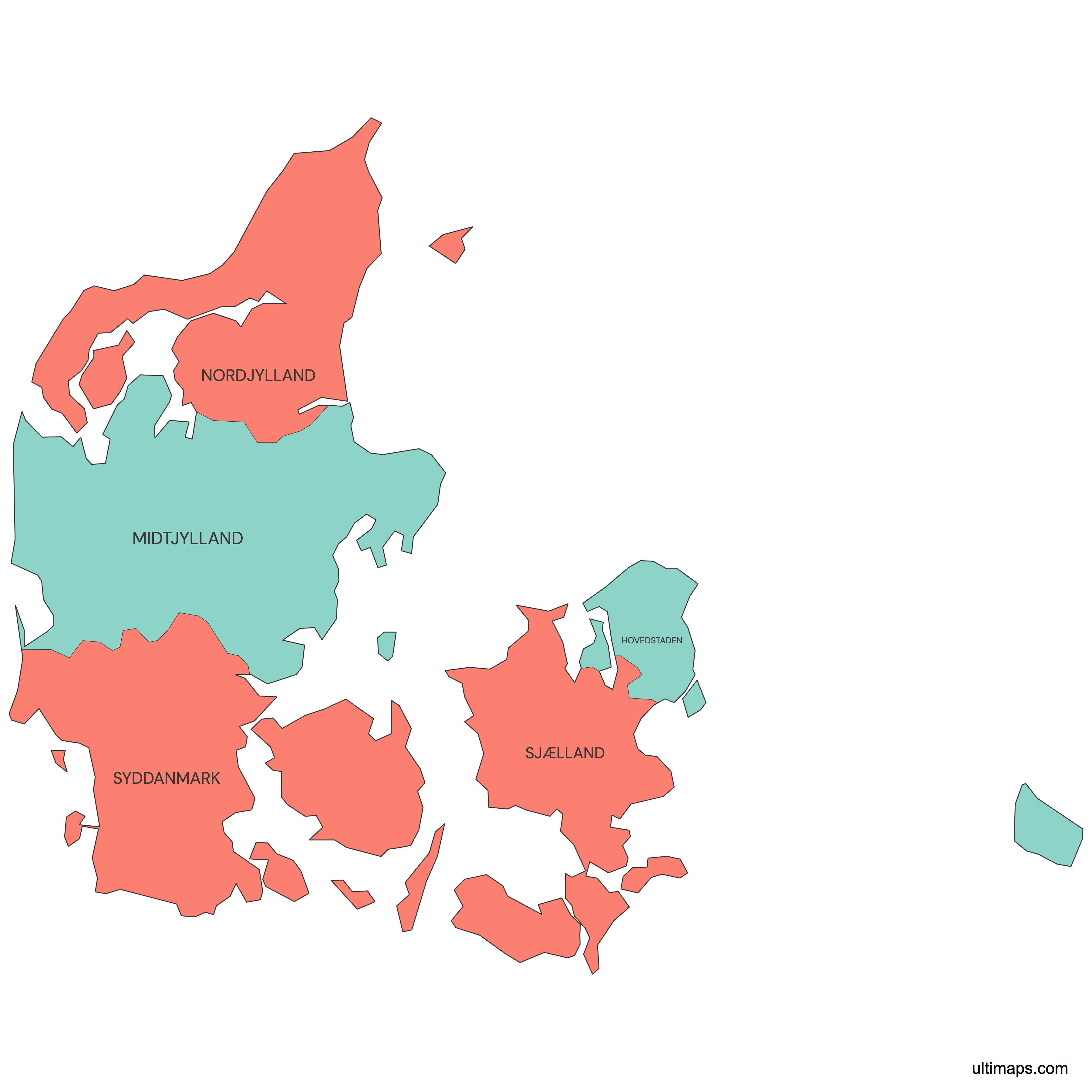
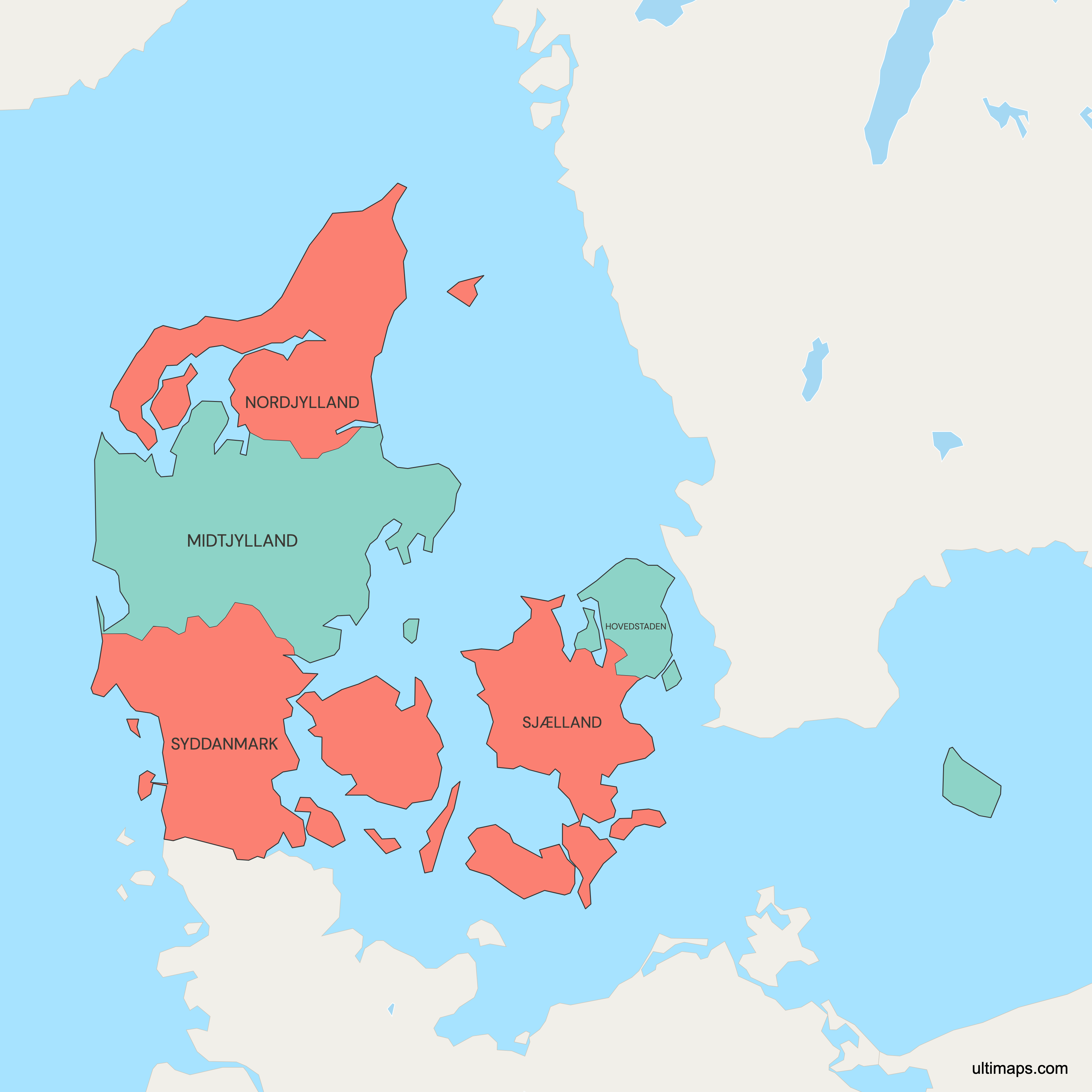
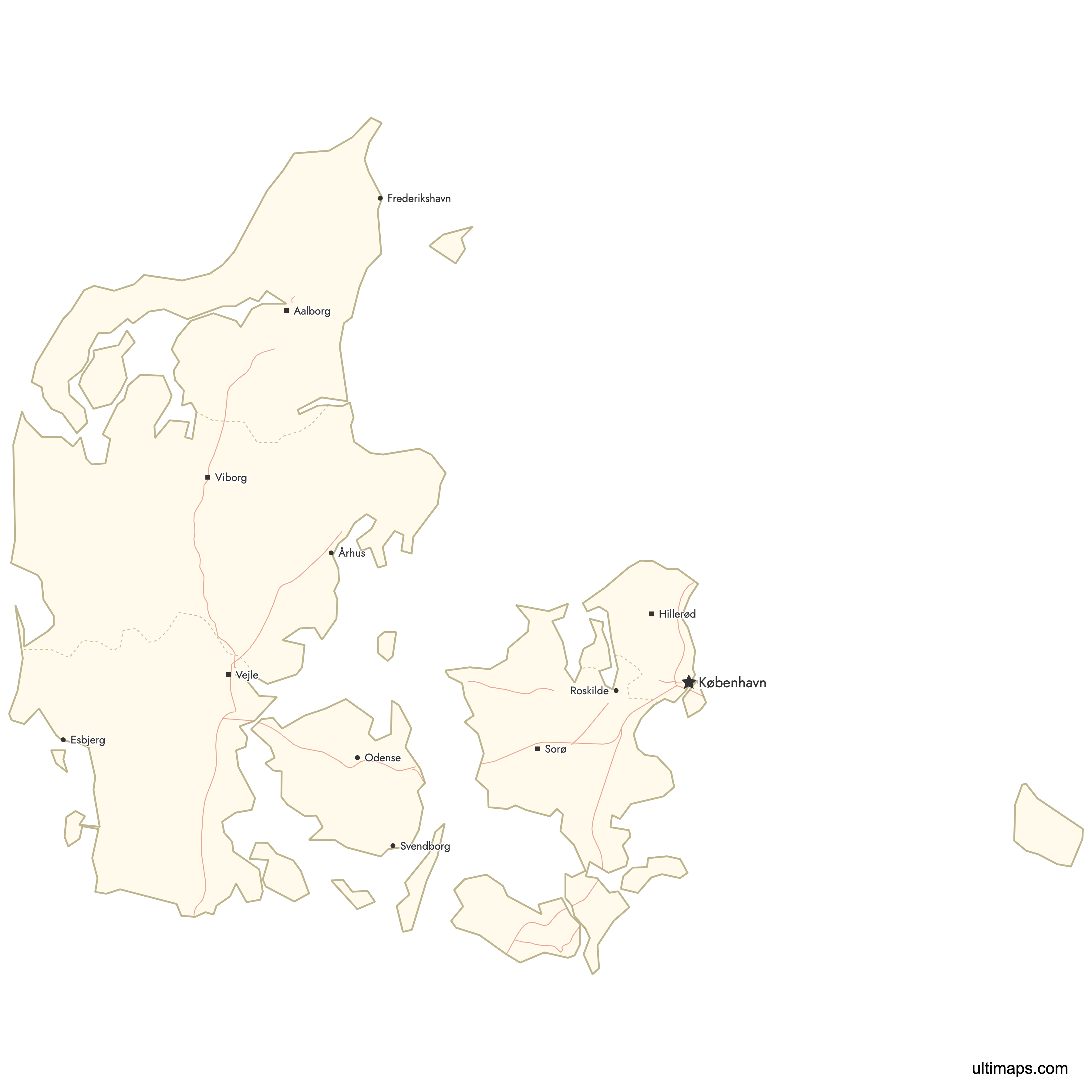
Need it without colors? The blank version of this map comes as a print-ready PDF (A4 and US Letter), a PNG and an editable SVG.
Custom Map Features
This map supports labels.
This map supports surrounding areas, roads and cities. New
This map is divided into 5 regions.
Updates
Apr 23, 2026:
- Added map of Denmark regions with surrounding countries, cities and roads
Frequently Asked Questions
Denmark has 5 regions: Hovedstaden, Midtjylland, Nordjylland, Sjælland and Syddanmark. The 2007 municipal reform created them, replacing the older county system, and they have stayed unchanged since. Each region is run by an elected regional council whose central responsibility is healthcare, including hospitals. Beneath the regions Denmark has 98 municipalities, which handle schools, social services and local planning. The Ultimaps map on this page shows all 5 regions. Because the same five units double as Denmark's NUTS 2 statistical regions, national and Eurostat datasets usually match this map without any relabeling.
Midtjylland is Denmark's largest region by area at 13,014 km² (5,025 sq mi) (2026, Statistics Denmark), covering central Jutland from the North Sea coast across to the Kattegat. Its regional seat is Viborg, though Aarhus, Denmark's second-largest city, is the dominant urban center. Syddanmark follows at 12,267 km² (4,736 sq mi), then Nordjylland at 7,885 km² (3,045 sq mi) and Sjælland at 7,227 km² (2,791 sq mi). Midtjylland is more than five times the size of Hovedstaden, the smallest region at 2,564 km² (990 sq mi), but has fewer residents at 1,373,799 (2025).
Hovedstaden is the most populous Danish region with 1,930,793 residents (1 January 2025, Statistics Denmark), and it contains Copenhagen, the national capital, along with Frederiksberg. It is also the smallest region by area at 2,564 km² (990 sq mi), which makes it by far the most densely populated. Midtjylland ranks second with 1,373,799 people and includes Aarhus. Syddanmark follows at 1,240,472, spread across Funen and southern Jutland with Odense and Esbjerg as its main cities. Sjælland has 854,902 residents and Nordjylland the fewest at 592,768 (all 2025). Nearly one in three Danes, about 32%, lives in Hovedstaden.
Copenhagen sits in Region Hovedstaden, whose name translates as the Capital Region. Hovedstaden covers the northeastern part of Zealand plus the island of Bornholm, and has 1,930,793 residents (2025) on 2,564 km² (990 sq mi). A common point of confusion: the regional administrative seat is Hillerød, about 35 km north of Copenhagen, not Copenhagen itself. Copenhagen Municipality and Frederiksberg Municipality are two of the region's separate municipalities, with Frederiksberg entirely surrounded by Copenhagen. Denmark's other regional seats are Viborg, Aalborg, Sorø and Vejle.
Yes. Bornholm is part of Region Hovedstaden even though the island lies in the Baltic Sea roughly 150 km east of Zealand and much closer to Sweden and Poland than to Copenhagen. The 2007 reform assigned it to the Capital Region rather than creating a separate unit for it. On the administrative side Bornholm forms its own municipality, Bornholms Regionskommune, which merged the island's five former municipalities and old county into a single body in 2003. On a Denmark regions map, Bornholm appears as a detached shape sharing the same color as the mainland Capital Region.
Denmark's current regions date from 1 January 2007, when the municipal reform (Strukturreformen) took effect. The reform scrapped the 13 counties that had existed since 1970 and put 5 regions in their place, while cutting the number of municipalities to 98. Powers were redistributed at the same time: regions took over hospitals and health services, municipalities absorbed most other local duties, and the state took responsibility for areas such as tax collection. No boundary changes have followed since, so the 5 regions shown here have been stable for the whole period.
Denmark's 5 regions and 98 municipalities do different jobs. The regions, created in 2007, run hospitals, psychiatric care and public health, plus regional development and some transport planning. They cannot levy their own taxes and are funded by the state and municipalities, which is why Danes commonly refer to them as health regions. Municipalities handle schools, elder care, childcare, local roads and zoning, and they do collect income tax. Both levels have directly elected councils, voted on the same day every four years. This map shows the 5 regions, not the 98 municipalities.
Open Ultimaps in a browser and start editing: no download, no registration. A pasted table with one value per region is enough for a shaded map: Ultimaps grades the five fills automatically. For one-off highlights, click any region — Nordjylland, say — and choose its color directly. The color ramp, the background, the label text and typeface, and the outline weight all have independent settings. Point locations come from markers, which you can drop on Copenhagen, Aarhus, Odense, Aalborg or a coordinate pair of your choosing, with captions where they help. Downloads come in PNG, PDF and SVG.