Bulgaria Map with Provinces
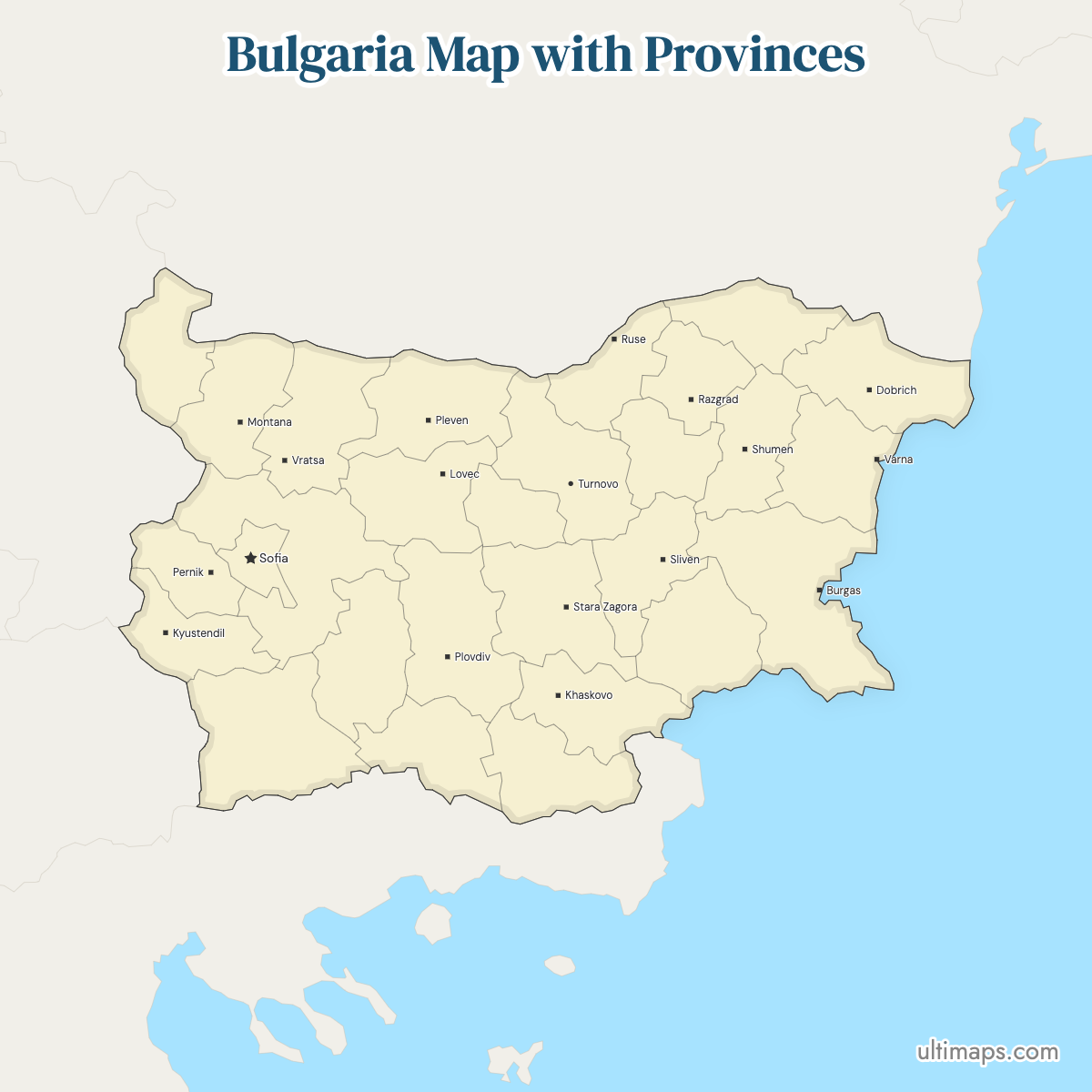
Bulgaria's first-level administrative divisions are 28 provinces, called oblasti in Bulgarian, and this map shows all 28 of them. The current arrangement has been in place since 1999, and its borders follow, approximately, the districts that existed before the 1987 reform. Underneath the provinces are 265 municipalities (obshtini). Bulgaria meets the Black Sea along its eastern edge and has land borders with Romania, Serbia, North Macedonia, Greece and Turkey, while the capital occupies a province of its own, Sofia City, which is distinct from the Sofia Province wrapped around it.
Move around the interactive map to compare province shapes or locate a provincial center. There is no charge for the blank outline. Give Ultimaps one figure per oblast and all 28 shapes are recolored into a thematic map.
Interactive Bulgaria Map with Provinces
List of Provinces (28)
| # | Province |
|---|---|
| 1 | Blagoevgrad |
| 2 | Burgas |
| 3 | Dobrich |
| 4 | Gabrovo |
| 5 | Grad Sofiya |
| 6 | Haskovo |
| 7 | Kardzhali |
| 8 | Kyustendil |
| 9 | Lovech |
| 10 | Montana |
| 11 | Pazardzhik |
| 12 | Pernik |
| 13 | Pleven |
| 14 | Plovdiv |
| 15 | Razgrad |
| 16 | Ruse |
| 17 | Shumen |
| 18 | Silistra |
| 19 | Sliven |
| 20 | Smolyan |
| 21 | Sofia |
| 22 | Stara Zagora |
| 23 | Targovishte |
| 24 | Varna |
| 25 | Veliko Tarnovo |
| 26 | Vidin |
| 27 | Vratsa |
| 28 | Yambol |
Bulgaria Provinces: Key Facts
- Total number of provinces: 28 oblasti, the country's first-level units, divided further into 265 municipalities (obshtini)
- Most populous province: Sofia City (Grad Sofiya) - 1,274,290 (2021 census)
- Least populous province: Vidin - 75,408 (2021 census)
- Largest province by area: Burgas - about 7,748 km² (2,991 sq mi), NSI figures
- Smallest province by area: Sofia City - about 1,349 km² (521 sq mi), NSI figures
- Other population centers: Plovdiv 634,497, Varna 432,198, Burgas 380,286, Stara Zagora 296,507, Pazardzhik 229,814 (all 2021 census)
- Capital: Sofia, seat of the national government and its own province, Sofia City, surrounded by the separate Sofia Province
- Borders: Romania to the north across the Danube, Serbia and North Macedonia to the west, Greece and Türkiye to the south, and the Black Sea to the east
- Time zone: Eastern European Time (UTC+2), moving to Eastern European Summer Time (UTC+3)
- Boundaries established: 1999, replacing the nine-region system used through the 1990s
Interesting Facts
- The 1999 provinces were not a new design. They match, roughly, the 28 districts Bulgaria used before the 1987 administrative reform, so the current map restored a much older pattern.
- Sofia City holds 1,274,290 people while Vidin holds 75,408 (2021 census), a gap of more than 16 to 1 between the largest and smallest province.
- English sources label the same unit province, region, district or oblast, and some of them count "27 provinces plus the capital province", which is another way of writing 28.
- Vidin, the least populous province, contains the Belogradchik Rocks. Shumen has the Madara Rider, Kyustendil has Rila Monastery, and Kardzhali has the rock complex at Perperikon.
- Plovdiv Province holds both the Roman Theatre in Plovdiv and Bachkovo Monastery, while Silistra Province contains the Srebarna Nature Reserve on the Danube.
Free Downloads
Free for personal and commercial use with a credit to Ultimaps. See the license terms for details.
 Colored Bulgaria Map with Provincespng657 KB
 Political Map of Bulgaria with Provincespng713 KB
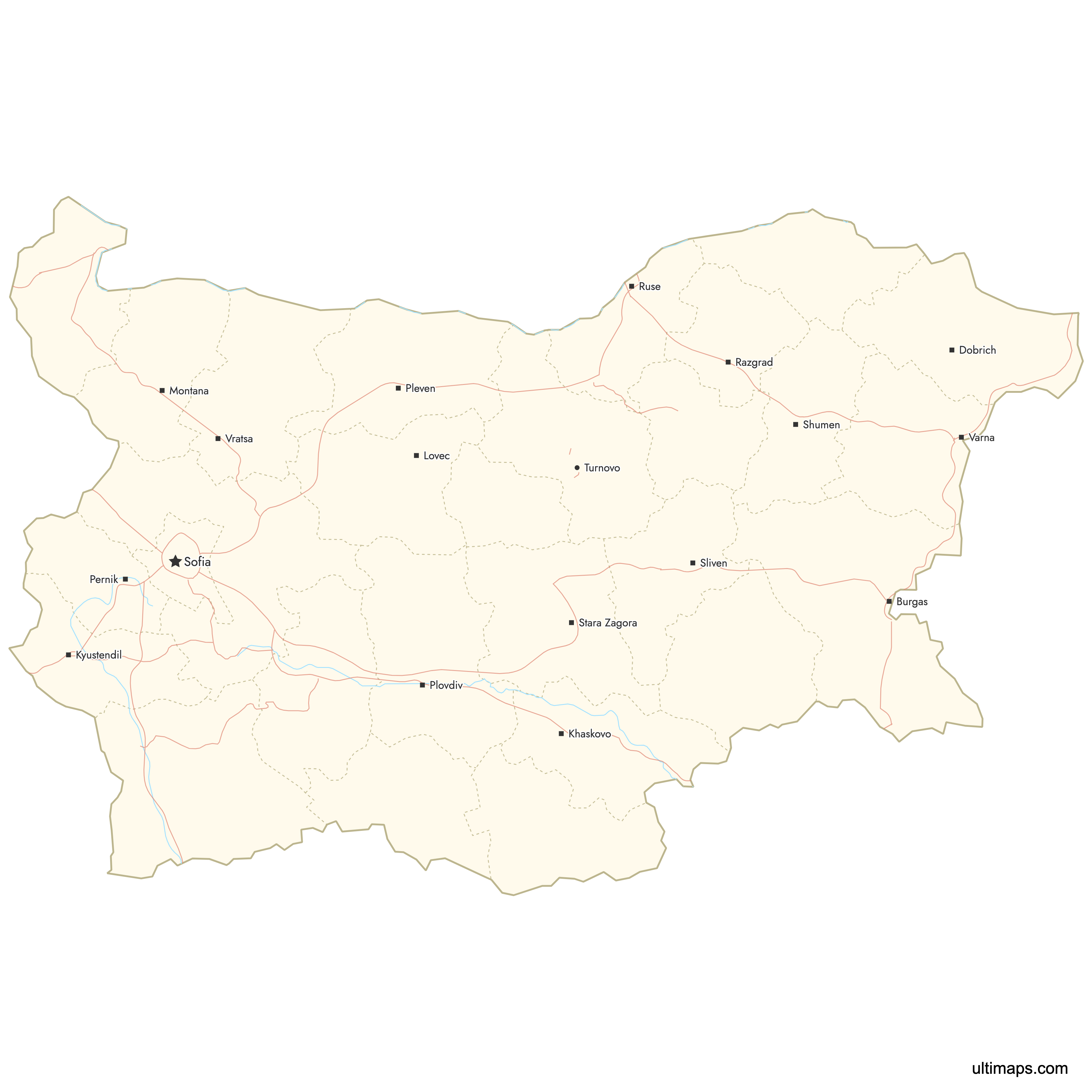
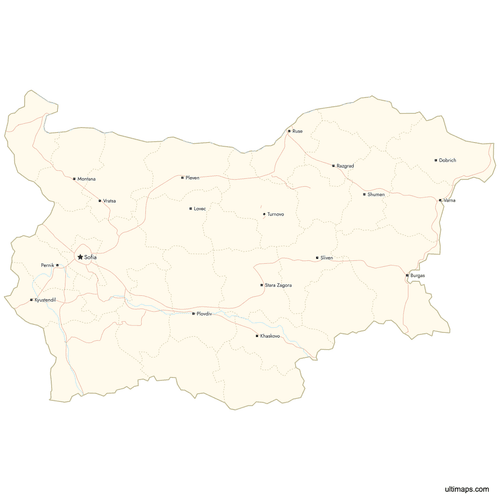 Map of Bulgaria with Cities and Roadspng780 KB


Need it without colors? The blank version of this map comes as a print-ready PDF (A4 and US Letter), a PNG and an editable SVG.
Custom Map Features
This map supports labels.
This map supports surrounding areas, roads, rivers and cities. New
This map is divided into 28 provinces.
Updates
May 14, 2026:
- Added map of Bulgaria Provinces with surrounding countries, cities and roads
Frequently Asked Questions
Bulgaria has 28 provinces, known as oblasti in Bulgarian, and this map displays all 28. They are Blagoevgrad, Burgas, Dobrich, Gabrovo, Sofia City (Grad Sofiya), Haskovo, Kardzhali, Kyustendil, Lovech, Montana, Pazardzhik, Pernik, Pleven, Plovdiv, Razgrad, Ruse, Shumen, Silistra, Sliven, Smolyan, Sofia, Stara Zagora, Targovishte, Varna, Veliko Tarnovo, Vidin, Vratsa and Yambol. The set dates from 1999. Some English sources describe the country as having 27 provinces plus a capital province, which produces the same total of 28 first-level units.
Burgas is the largest of Bulgaria's 28 provinces by area at roughly 7,748 km² (2,991 sq mi), stretching from the Black Sea coast inland across the southeast. That is about 7% of Bulgaria's 110,994 km² (42,855 sq mi). Sofia Province, the ring of territory around the capital, is second at around 7,062 km² (2,727 sq mi). At the other end, Sofia City covers only about 1,349 km² (521 sq mi), making the capital province the smallest by area even though it holds the most people.
Sofia City is the most populated province in Bulgaria, with 1,274,290 residents (2021 census). It contains Sofia, the national capital, and functions as the country's main metropolitan area. Plovdiv Province follows with 634,497, then Varna Province with 432,198, Burgas Province with 380,286 and Stara Zagora Province with 296,507 (all 2021 census). Varna and Burgas are Bulgaria's principal Black Sea ports. The smallest population belongs to Vidin Province in the northwest, at 75,408 (2021 census).
Sofia is both, and the two names cover different areas. Sofia is Bulgaria's capital city, and it sits inside Sofia City Province (Grad Sofiya, sometimes written Sofia-Grad), a province of about 1,349 km² (521 sq mi) with 1,274,290 people (2021 census). Separately, Sofia Province is a larger, mostly rural province that surrounds the capital and has its own administration. When a table lists both "Sofia" and "Sofia City", those are two distinct units, not a duplicate entry.
Bulgaria's provinces are called oblasti in Bulgarian, singular oblast. English-language sources translate the term inconsistently: you will find the same 28 units labeled provinces, regions, districts or simply oblasts, depending on the publisher. Statistical agencies and mapping datasets often keep the transliteration oblast to avoid confusion with the 265 municipalities (obshtini) that make up the second tier. Older archival maps of the same territory may carry Ottoman-era terms such as vilâyeti, which describe historical divisions rather than today's provinces.
Bulgaria's current 28 provinces were created in 1999, replacing the nine-region structure used earlier in the decade. The 1999 boundaries were not new inventions. They correspond approximately to the 28 districts that existed before Bulgaria's 1987 administrative reform, so the reform restored a division many Bulgarians already recognized. Below the provinces, the country is organized into 265 municipalities. The province layer has stayed stable since 1999, which is why datasets from different years usually line up with the same 28 shapes.
Bulgaria has 265 municipalities, called obshtini, sitting one level below the 28 provinces. Each province contains several municipalities, and the municipality is the unit with an elected mayor and council, so most local government data in Bulgaria is published at that level. Provincial governors, by contrast, are appointed. If your dataset is broken down by obshtina rather than oblast, you can aggregate the 265 figures up to the 28 provinces before applying them to this map.
Bulgaria borders five countries: Romania to the north, Serbia and North Macedonia to the west, and Greece and Türkiye to the south. The Danube forms most of the Romanian border, touching provinces such as Vidin, Ruse and Silistra. The Black Sea forms the entire eastern coastline, along Dobrich, Varna and Burgas provinces. Border provinces include Blagoevgrad next to North Macedonia and Greece, Kardzhali and Haskovo near the Turkish and Greek frontiers, and Vidin, Montana, Pernik and Kyustendil along the Serbian side.
Making a custom Bulgaria map takes nothing beyond a browser: Ultimaps requires no installation and no registration. Provinces can be colored one at a time — Smolyan or Ruse, for instance, each given a fill you choose — or all together, by importing a table of 28 values that Ultimaps turns into a graduated scale. Adjustments to the palette, the background, the borders and the labels are made independently of one another. For point locations, add markers on Sofia, Plovdiv or Varna, or enter coordinates yourself, and give each one a caption. Download the completed design in PNG, PDF or SVG form.