Ukraine Map with Regions
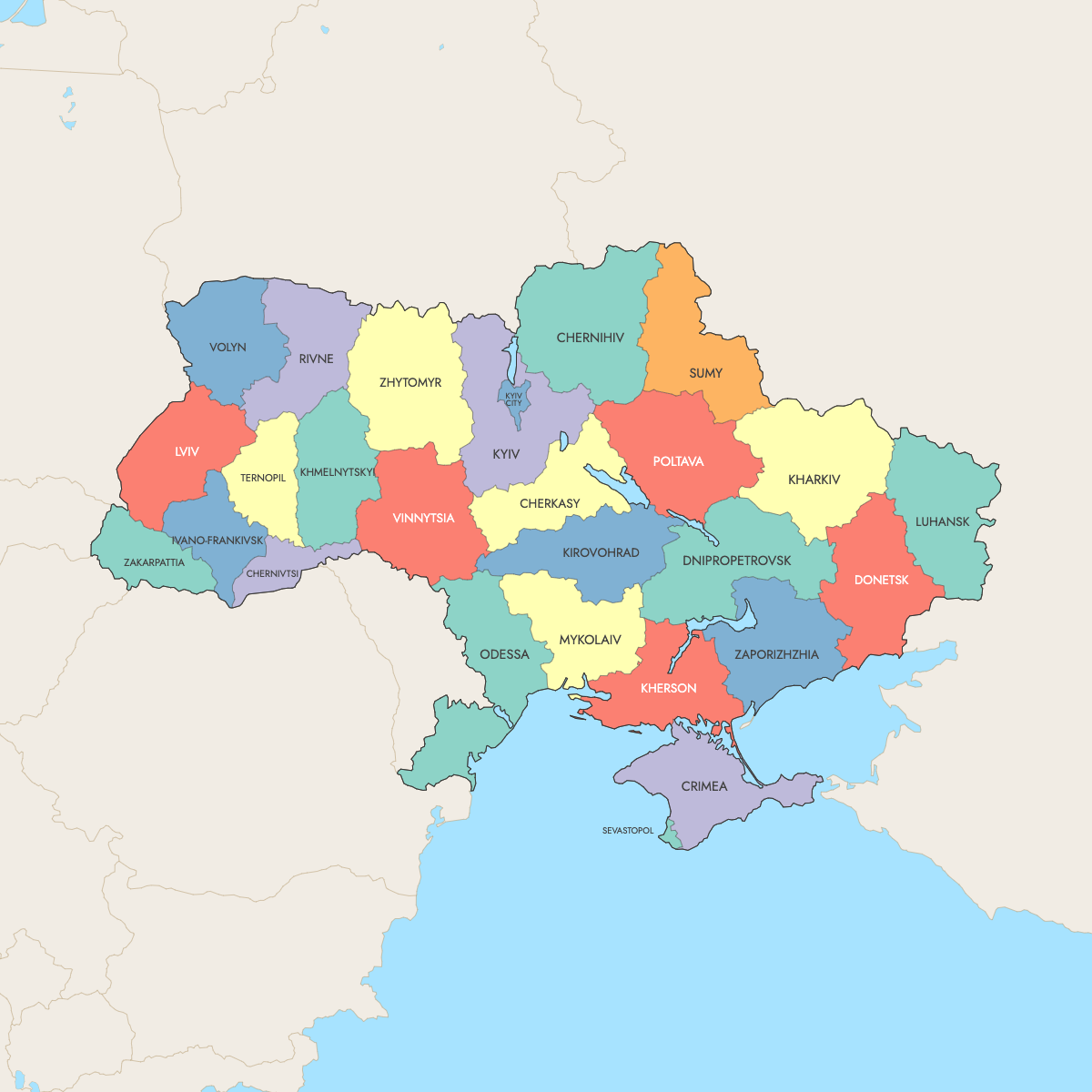
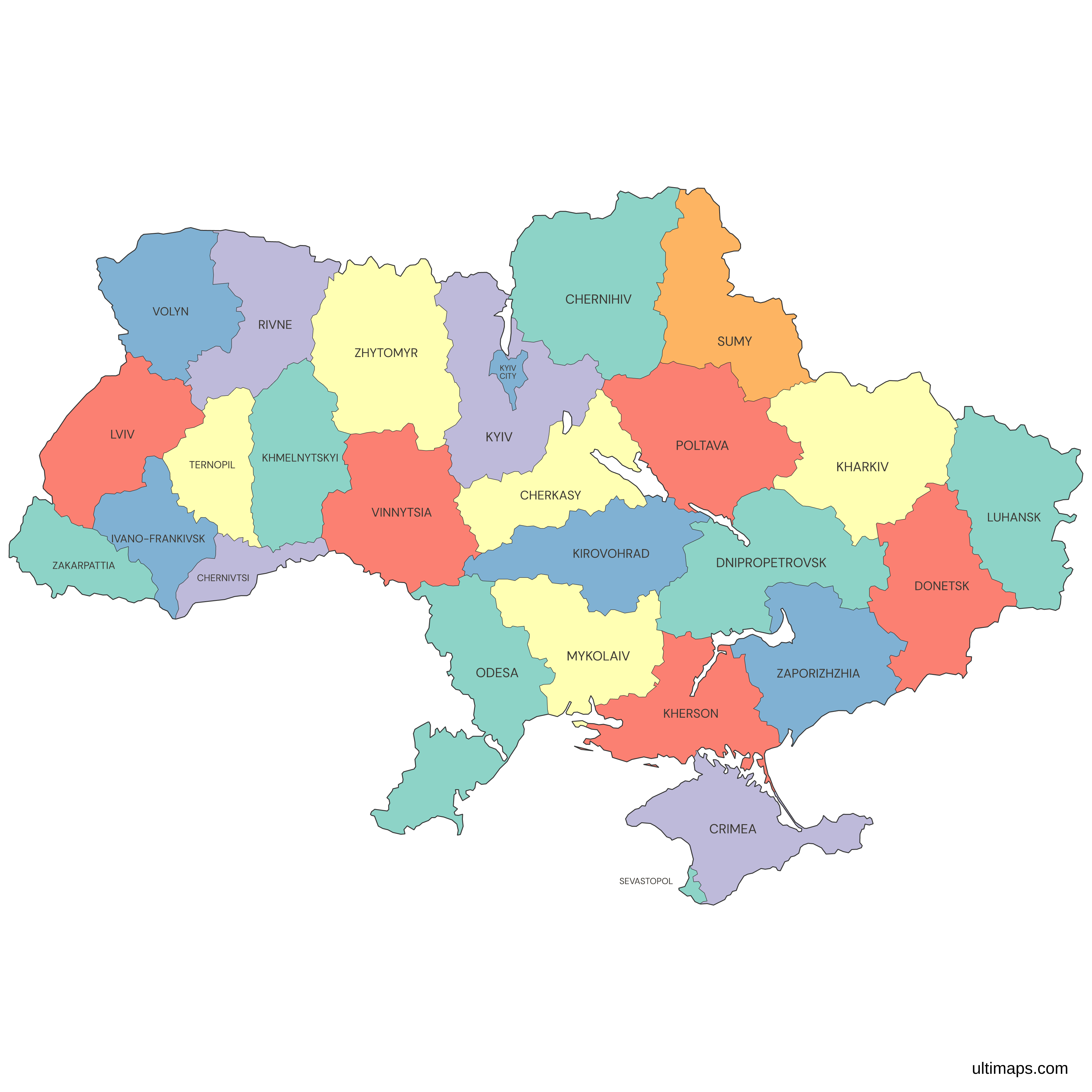
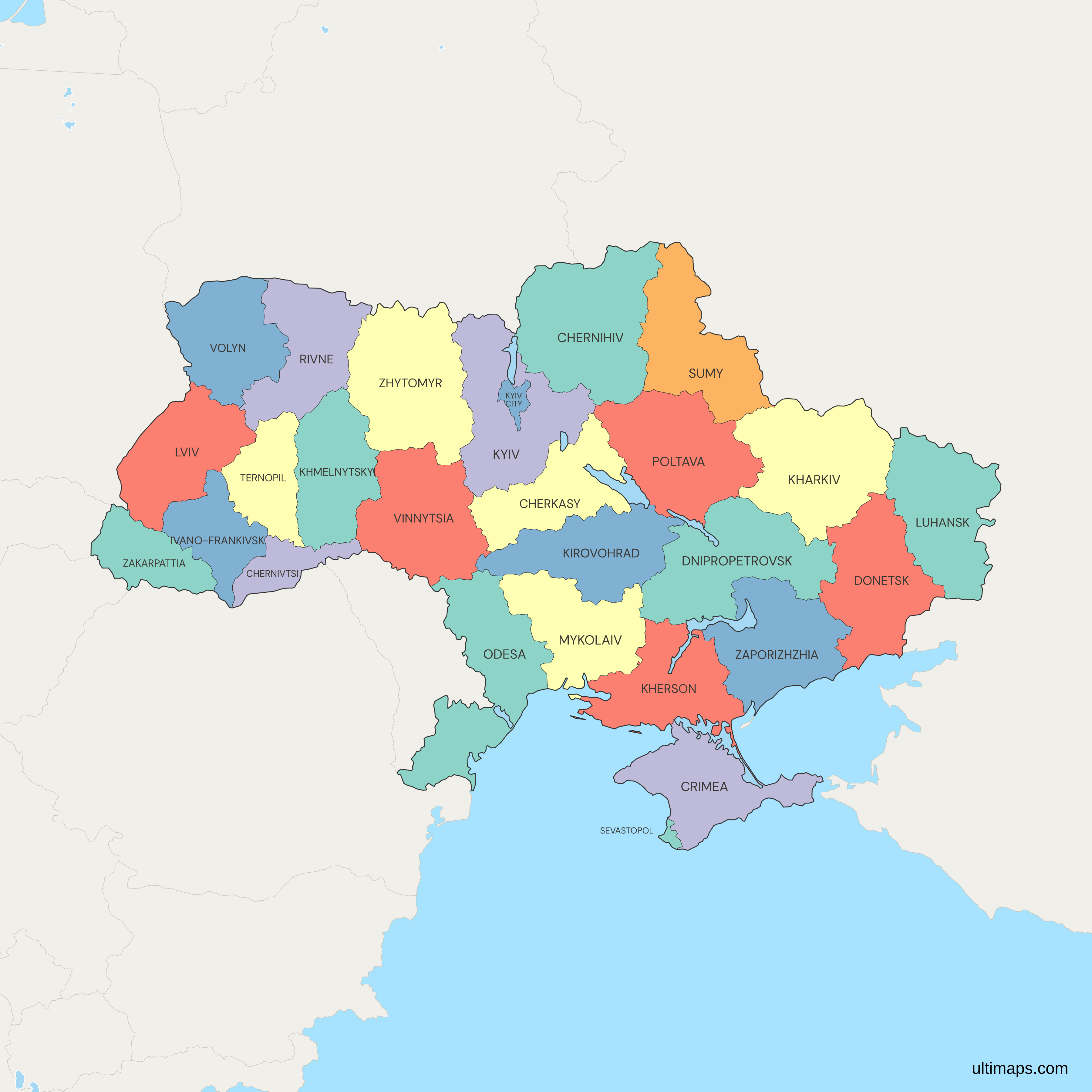
Ukraine's top administrative level holds 27 units: 24 oblasts, the Autonomous Republic of Crimea, and two cities with special status, the capital Kyiv and Sevastopol. All 27 are drawn on this map. Crimea and Sevastopol are internationally recognized as Ukrainian territory and have been under Russian control since 2014, and parts of several eastern and southern oblasts have been occupied since 2022, but the constitutional boundaries shown here are unchanged. The territory runs from the Carpathians in the west to the Donbas coalfield in the east, with Black Sea and Sea of Azov coastlines along the south. Open the interactive version below to follow any oblast line or find a regional center. A reference copy downloads for free; given a list of 27 values, the map renders as a choropleth instead.
Interactive Ukraine Map with Regions
List of Regions (27)
| # | Region |
|---|---|
| 1 | Cherkasy |
| 2 | Chernihiv |
| 3 | Chernivtsi |
| 4 | Crimea |
| 5 | Dnipropetrovsk |
| 6 | Donetsk |
| 7 | Ivano-Frankivsk |
| 8 | Kharkiv |
| 9 | Kherson |
| 10 | Khmelnytskyi |
| 11 | Kirovohrad |
| 12 | Kyiv |
| 13 | Kyiv City |
| 14 | Luhansk |
| 15 | Lviv |
| 16 | Mykolaiv |
| 17 | Odesa |
| 18 | Poltava |
| 19 | Rivne |
| 20 | Sevastopol |
| 21 | Sumy |
| 22 | Ternopil |
| 23 | Vinnytsia |
| 24 | Volyn |
| 25 | Zakarpattia |
| 26 | Zaporizhzhia |
| 27 | Zhytomyr |
Ukraine Regions: Key Facts
- Total number of regions: 27 top-level units (24 oblasts, 1 autonomous republic, 2 cities with special status)
- Most populous region: Donetsk Oblast, 4,059,372 (1 January 2022 estimate)
- Least populous region: the city of Sevastopol, about 386,000 (last Ukrainian estimate, 2014)
- Largest region by area: Odessa Oblast, 33,310 km² (12,868 sq mi)
- Smallest region by area: the city of Kyiv, 839 km² (324 sq mi), with Sevastopol next at 864 km² (333 sq mi)
- Regions with major urban centers: Kyiv City (national capital), Kharkiv Oblast (Kharkiv), Dnipropetrovsk Oblast (Dnipro), Lviv Oblast (Lviv), Odessa Oblast (Odesa), Donetsk Oblast (Donetsk), Zaporizhzhia Oblast (Zaporizhzhia)
- Capital: Kyiv, which is both the national capital and one of the two special-status cities
- Borders: Russia, Belarus, Poland, Slovakia, Hungary, Romania and Moldova, with coastlines on the Black Sea and the Sea of Azov
- Time zones: Eastern European Time (UTC+2), moving to Eastern European Summer Time (UTC+3)
- Historical note: the first-level regions are enumerated in the 1996 Constitution of Ukraine, and their boundaries have not been redrawn since independence in 1991, although control over some areas changed in 2014 and 2022
Interesting Facts
- Donbas is not an administrative region. The name covers the Donets Coal Basin spanning Donetsk Oblast and Luhansk Oblast, which reporting often treats as one area.
- Older ethnographic regions such as Galicia, Volhynia, Podolia and Sloboda Ukraine appear on cultural maps but have no place in the current administrative system.
- Odessa Oblast is roughly 40 times the size of the city of Kyiv (33,310 km² against 839 km²), the widest area gap among the 27 units.
- UNESCO-listed sites are spread across the regions: Kyiv Pechersk Lavra and Saint Sophia Cathedral in Kyiv, the historic center of Lviv, and the Residence of Bukovinian and Dalmatian Metropolitans in Chernivtsi.
- Kherson Oblast holds the Askania-Nova biosphere reserve, and Zaporizhzhia Oblast contains Khortytsia Island in the Dnipro river at Zaporizhzhia.
Free Downloads
Free for personal and commercial use with a credit to Ultimaps. See the license terms for details.
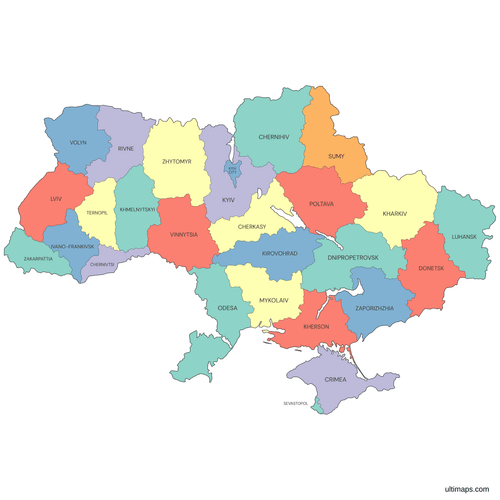 Colored Ukraine Map with Regionspng585 KB
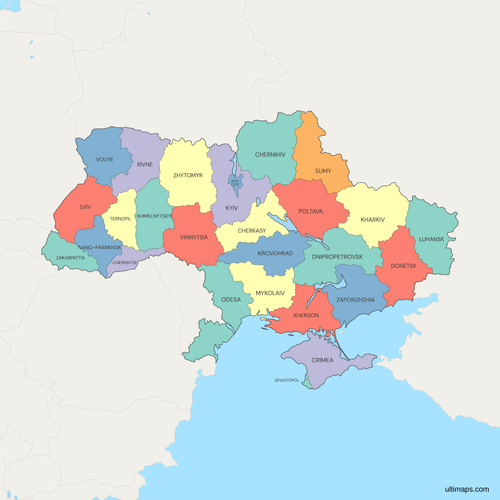 Political Map of Ukraine with Regionspng699 KB
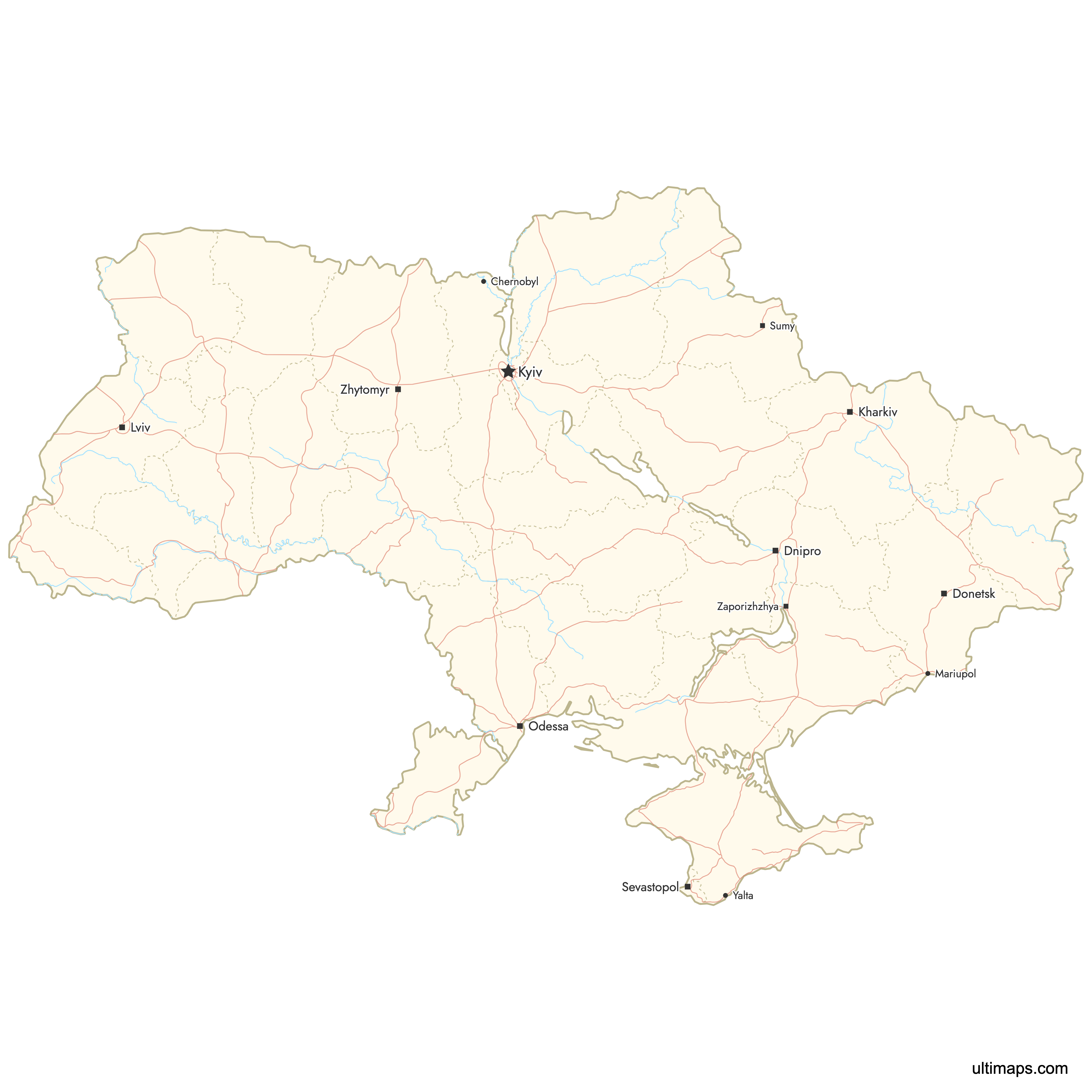
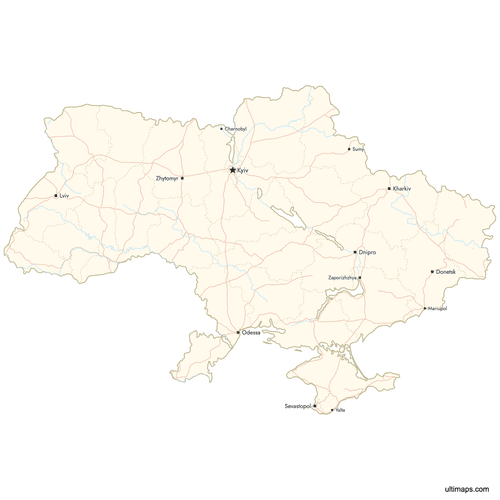 Map of Ukraine with Cities and Roadspng814 KB
Need it without colors? The blank version of this map comes as a print-ready PDF (A4 and US Letter), a PNG and an editable SVG.
Custom Map Features
This map supports labels.
This map supports surrounding areas, roads, rivers and cities. New
This map is divided into 27 regions.
Updates
Apr 23, 2026:
- Added map of Ukraine Regions with surrounding countries, cities and roads
Frequently Asked Questions
Ukraine has 27 top-level regions: 24 oblasts, the Autonomous Republic of Crimea, and two cities with special status, Kyiv and Sevastopol. That is the count shown on this map. Some simplified sources say Ukraine has 24 regions and then list Crimea, Kyiv and Sevastopol separately, which describes the same territory in a different way rather than a different division. Each oblast is normally named after its administrative center, so Poltava Oblast is run from Poltava and Rivne Oblast from Rivne. Kyiv is unusual because it serves as the national capital and as a region in its own right.
Odessa Oblast is Ukraine's largest region by area at 33,310 km² (12,868 sq mi), stretching along the northwestern Black Sea coast with the port city of Odesa as its center. The smallest unit sits at the other end of the scale: the city of Kyiv covers 839 km² (324 sq mi), about a fortieth of Odessa Oblast, with Sevastopol next at 864 km² (333 sq mi). Because two of the 27 units are municipal territories rather than provinces, area comparisons across Ukraine mix very large oblasts with two small urban regions. Kyiv City is likewise a compact unit surrounded by, but not part of, Kyiv Oblast.
Donetsk Oblast is Ukraine's most populous region, with 4,059,372 residents in the state estimate of 1 January 2022, centered on the city of Donetsk in the Donbas industrial belt. Kyiv City is the largest single urban center in the country and counts as a separate region. The least populated unit is Sevastopol, at about 386,000 people in the last Ukrainian estimate from 2014 — state statistics have not covered Crimea since the occupation. These figures predate much of the wartime displacement, so the number of people actually living in the eastern and southern oblasts today differs from the registered totals. Administrative boundaries on the map stay fixed regardless of population movement.
An oblast is Ukraine's standard province-level region, with an administrative center and an elected regional council. Kyiv and Sevastopol belong to no oblast at all. They are cities with special status, governed under separate national legislation and counted as top-level units alongside the 24 oblasts. Crimea forms a third category, the Autonomous Republic of Crimea, which holds recognized autonomy and has Simferopol as its capital. Together that makes the 27 regions drawn on this map: 24 oblasts, 1 autonomous republic and 2 special-status cities. Kyiv City sits inside the ring of Kyiv Oblast without being part of it.
Crimea is internationally recognized as part of Ukraine. Russia has controlled the peninsula since 2014, yet Ukraine and most governments worldwide continue to treat the Autonomous Republic of Crimea and the city of Sevastopol as Ukrainian regions, and the Constitution of Ukraine defines them that way. This map follows the recognized administrative division, so Crimea and Sevastopol appear as two of the 27 regions with their pre-2014 outlines. Legal status and de facto control are separate matters. A regions map shows the legal division, which is why nothing here reflects the occupation.
Donbas is short for the Donets Coal Basin, the industrial area covering Donetsk Oblast and Luhansk Oblast in eastern Ukraine. The two oblasts get grouped in reporting because they share coal mining, heavy metallurgy and, since 2014, the same conflict history. On this map they remain what they are administratively: two separate regions, with Donetsk Oblast the country's most populous at 4,059,372 people (1 January 2022 estimate) and Luhansk Oblast bordering it to the northeast. No official boundary, council or capital corresponds to the Donbas as a whole, so it never appears as a unit on an administrative map.
Ukraine's regional boundaries did not change after 2014 or after the full-scale invasion in 2022. What shifted was control. Russia took Crimea and Sevastopol in 2014 and occupied parts of Donetsk, Luhansk, Zaporizhzhia and Kherson oblasts from 2022. The oblast-level structure is enumerated in the 1996 Constitution of Ukraine and has held steady since independence in 1991, so the 27 units drawn here match the ones in place at independence. If your project needs to show occupied territory, treat it as a separate layer or assign values to the affected regions and let the shading carry that information.
Kyiv, Odesa, Lviv, Kharkiv and Dnipro are romanized from Ukrainian, while Kiev, Odessa, Lvov and Kharkov come through Russian. Ukraine's official transliteration standard, adopted in 2010, produces Kyiv, and international media and institutions shifted to it broadly from 2018 onward. Region names carry the same split: Odesa Oblast and Odessa Oblast mean one region, listed here at 33,310 km² (12,868 sq mi). Dnipropetrovsk Oblast kept its name even though its center Dnipropetrovsk became Dnipro in 2016. When you import data, check that your spelling of each region matches the labels on the map.
Ukraine region maps live entirely in the Ultimaps editor, which opens in the browser and requires no account on the free tier. Coloring from data is quickest: paste two columns, region names beside their figures, and the 27 shapes take on graduated shading. Manual coloring also works, one unit at a time — Lviv Oblast, Poltava Oblast or any other. Palette, background, label wording, typeface and boundary weight are all configured in their own places. To flag a city, drop a pin over Kyiv, Kharkiv or Odesa, or type coordinates for anywhere else, then add a caption. Exporting produces a PNG, PDF or SVG file, whichever you select.