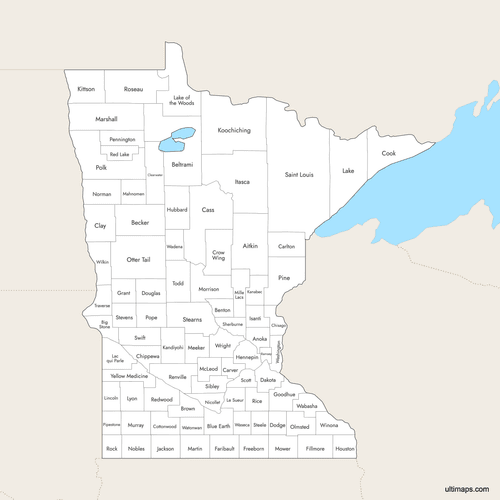
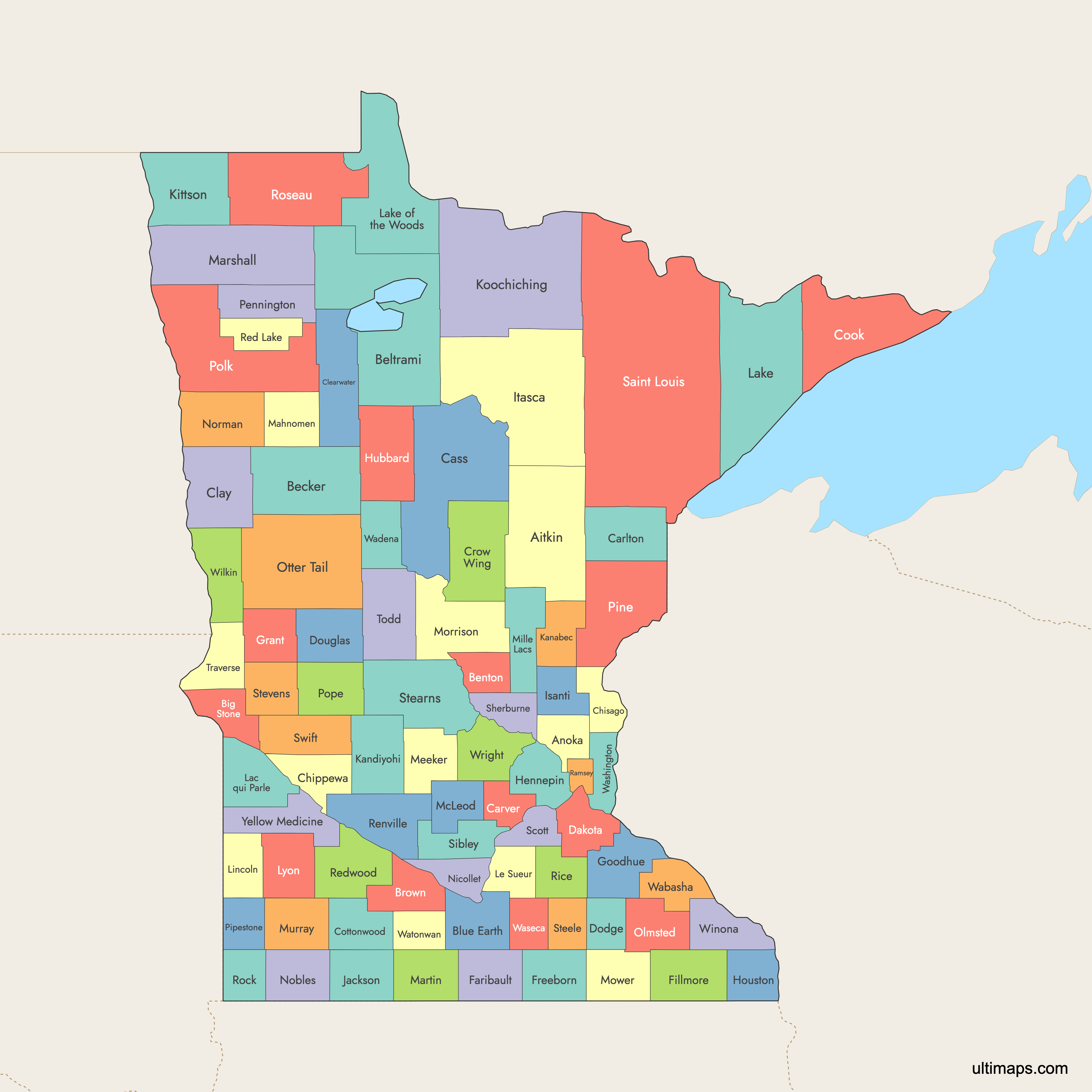
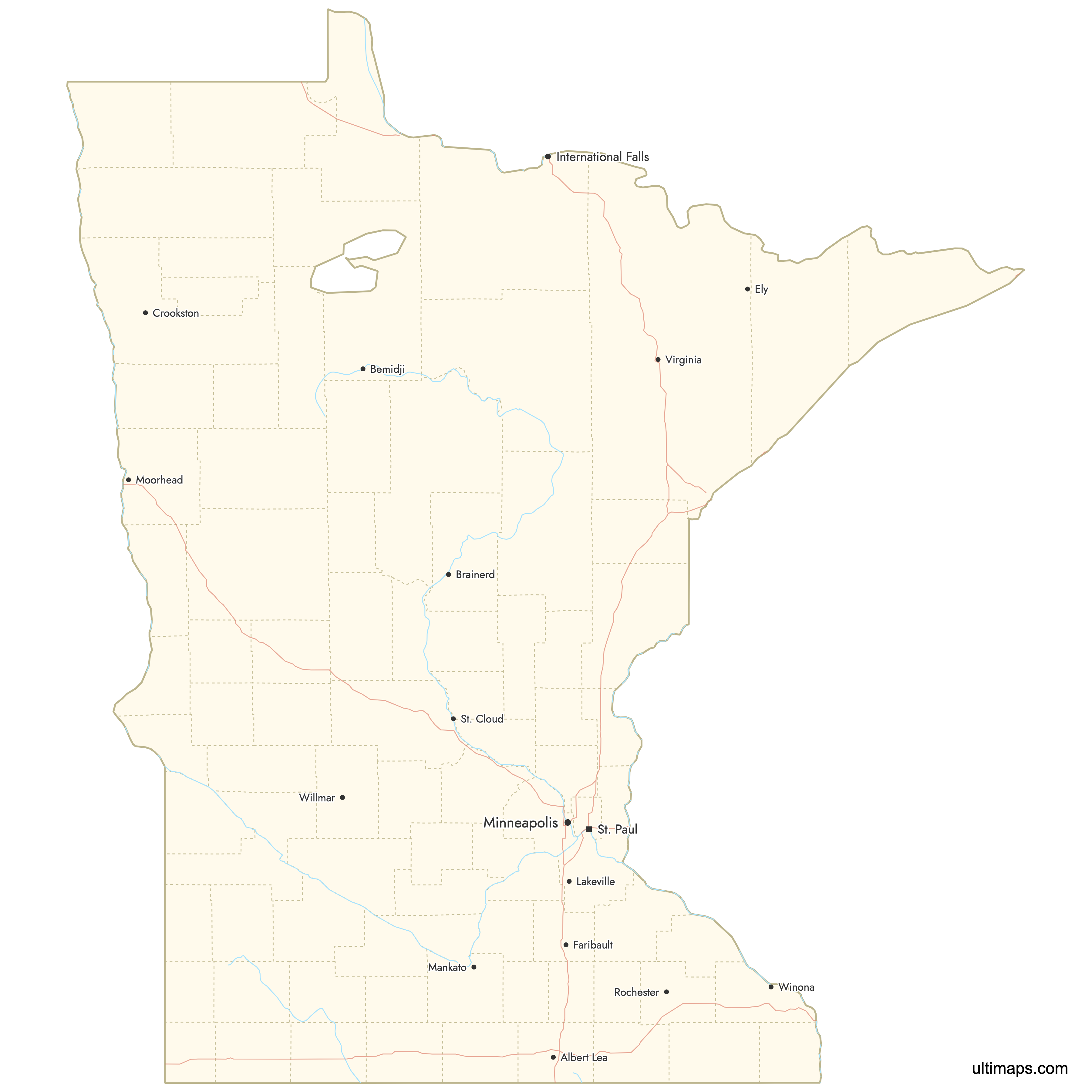
Map of Minnesota Counties
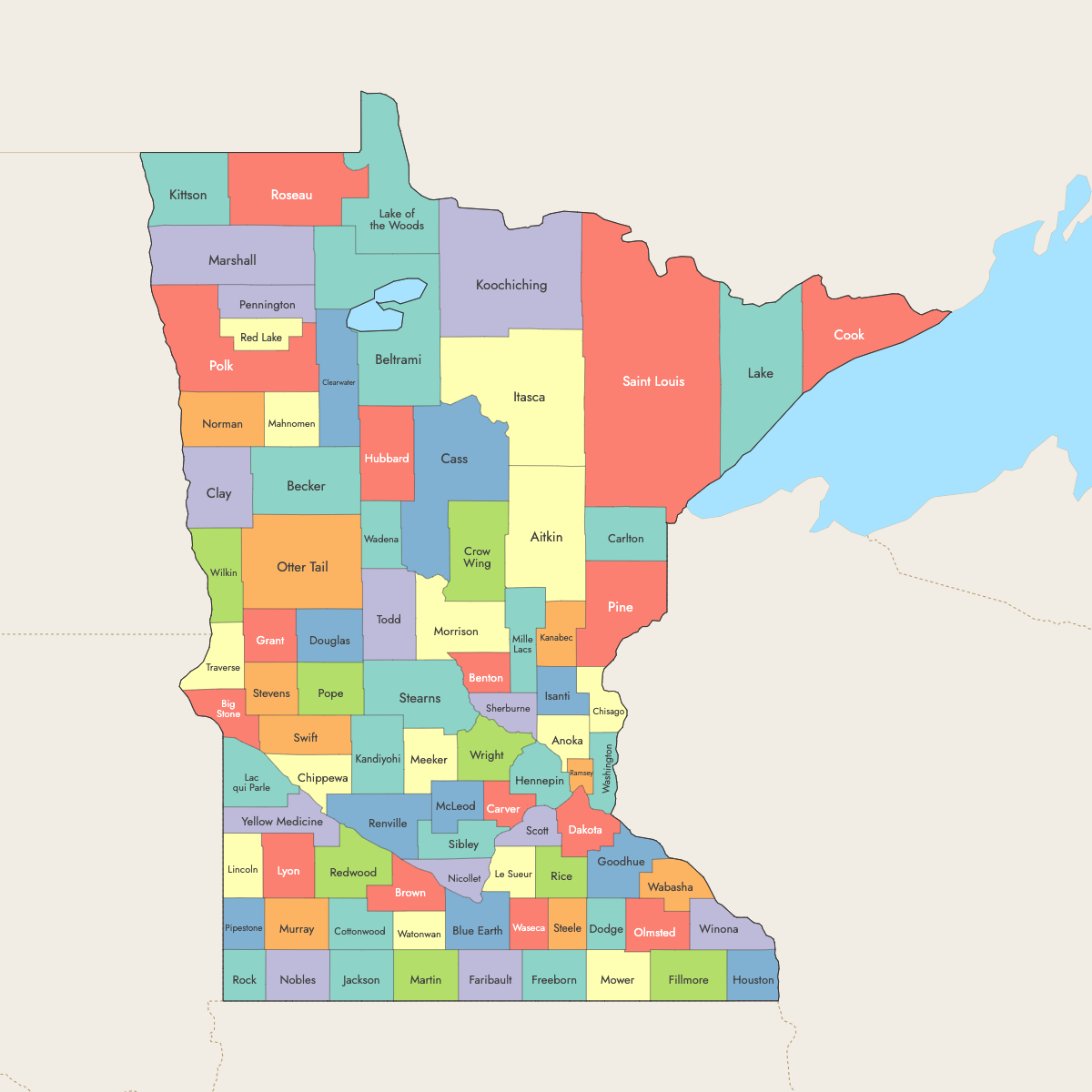
This map of Minnesota shows all 87 counties, with land areas ranging from 152.3 square miles (394 km²) in Ramsey County to 6,248.1 square miles (16,183 km²) in St. Louis County, according to the US Census Bureau's 2026 Gazetteer Files. Ramsey is the smallest county, but it contains Saint Paul, the state capital, and had 542,015 residents in the Census Bureau's 2024 estimates. Only Hennepin County, which contains Minneapolis, has more people, with 1,273,334 in the same estimates.
Northern Minnesota holds the six largest counties by land: St. Louis, Koochiching, Itasca, Beltrami, Lake and Cass. The newest county, Lake of the Woods, was created in 1923 and includes the Northwest Angle, the northernmost point in the contiguous United States. Hover over a county on the interactive map to see its name.
Open the map in the free Ultimaps editor to make your own custom map of Minnesota. You can color the counties by your data, add pins and labels, and share or embed the finished map.
Interactive Map of Minnesota Counties
List of Counties (87)
| # | County | Land area (sq mi) | Water area (sq mi) | Population (2024) |
|---|---|---|---|---|
| 1 | Aitkin | 1,821.30 | 173.50 | 16,335 |
| 2 | Anoka | 422 | 24.10 | 376,840 |
| 3 | Becker | 1315 | 130.10 | 35,444 |
| 4 | Beltrami | 2,504.70 | 550.50 | 46,762 |
| 5 | Benton | 408.30 | 4.70 | 41,881 |
| 6 | Big Stone | 499.10 | 28.90 | 5,067 |
| 7 | Blue Earth | 747.80 | 17.70 | 70,700 |
| 8 | Brown | 611.30 | 7.20 | 25,710 |
| 9 | Carlton | 861.20 | 14 | 36,745 |
| 10 | Carver | 353.90 | 22 | 112,628 |
| 11 | Cass | 2,021.50 | 392.50 | 31,442 |
| 12 | Chippewa | 581.20 | 6.70 | 12,299 |
| 13 | Chisago | 414.90 | 27.50 | 59,105 |
| 14 | Clay | 1,045.20 | 7.50 | 66,848 |
| 15 | Clearwater | 999 | 31.10 | 8,630 |
| 16 | Cook | 1,452.60 | 1,887.20 | 5,571 |
| 17 | Cottonwood | 640 | 8.60 | 11,338 |
| 18 | Crow Wing | 998.50 | 158.20 | 68,642 |
| 19 | Dakota | 562.60 | 24.30 | 453,156 |
| 20 | Dodge | 439.40 | 0.300 | 21,242 |
| 21 | Douglas | 636.90 | 83.30 | 39,933 |
| 22 | Faribault | 712.50 | 9.40 | 13,886 |
| 23 | Fillmore | 861.30 | 0.800 | 21,502 |
| 24 | Freeborn | 707.20 | 15.20 | 30,314 |
| 25 | Goodhue | 756.70 | 22.80 | 47,982 |
| 26 | Grant | 547.80 | 27.70 | 6,109 |
| 27 | Hennepin | 554 | 52.70 | 1,273,334 |
| 28 | Houston | 552.10 | 16.70 | 18,352 |
| 29 | Hubbard | 926 | 73.50 | 22,050 |
| 30 | Isanti | 435.80 | 15.90 | 43,687 |
| 31 | Itasca | 2,667.50 | 260.30 | 45,442 |
| 32 | Jackson | 703 | 16.30 | 9,861 |
| 33 | Kanabec | 521.60 | 12.10 | 16,608 |
| 34 | Kandiyohi | 797.40 | 65 | 44,674 |
| 35 | Kittson | 1099 | 4.80 | 3,992 |
| 36 | Koochiching | 3,104.70 | 51.30 | 11,594 |
| 37 | Lac qui Parle | 765 | 13.10 | 6,636 |
| 38 | Lake | 2,109.10 | 881.80 | 10,698 |
| 39 | Lake of the Woods | 1,297.70 | 482.20 | 3,797 |
| 40 | Le Sueur | 448.80 | 25.20 | 29,458 |
| 41 | Lincoln | 536.80 | 11.60 | 5,564 |
| 42 | Lyon | 714.40 | 7.30 | 25,577 |
| 43 | Mahnomen | 557.90 | 25 | 5,296 |
| 44 | Marshall | 1,775.10 | 37.80 | 8,771 |
| 45 | Martin | 712.30 | 17.20 | 19,561 |
| 46 | McLeod | 491.50 | 14.10 | 36,780 |
| 47 | Meeker | 608 | 36.60 | 23,491 |
| 48 | Mille Lacs | 572.30 | 109.20 | 27,577 |
| 49 | Morrison | 1,125.10 | 28.30 | 34,520 |
| 50 | Mower | 711.30 | 0.200 | 40,900 |
| 51 | Murray | 704.70 | 14.80 | 8,044 |
| 52 | Nicollet | 448.30 | 18.30 | 34,493 |
| 53 | Nobles | 715.10 | 7.40 | 21,969 |
| 54 | Norman | 872.80 | 3.90 | 6,284 |
| 55 | Olmsted | 653.50 | 1.20 | 166,424 |
| 56 | Otter Tail | 1,971.60 | 252.70 | 60,884 |
| 57 | Pennington | 616.50 | 1.70 | 13,652 |
| 58 | Pine | 1,411.30 | 23.30 | 30,319 |
| 59 | Pipestone | 465.10 | 0.900 | 9,100 |
| 60 | Polk | 1971 | 26.80 | 30,413 |
| 61 | Pope | 674.60 | 42.40 | 11,495 |
| 62 | Ramsey | 152.30 | 17.80 | 542,015 |
| 63 | Red Lake | 432.40 | 0.100 | 3,882 |
| 64 | Redwood | 878.60 | 3.20 | 15,254 |
| 65 | Renville | 982.90 | 4.20 | 14,453 |
| 66 | Rice | 495.80 | 20.10 | 69,025 |
| 67 | Rock | 482.50 | 0.300 | 9,525 |
| 68 | Roseau | 1,671.70 | 6.50 | 15,265 |
| 69 | Saint Louis | 6,248.10 | 612.40 | 200,794 |
| 70 | Scott | 356.10 | 12.20 | 157,206 |
| 71 | Sherburne | 432.90 | 18.20 | 103,059 |
| 72 | Sibley | 589 | 11.60 | 15,194 |
| 73 | Stearns | 1,342.90 | 47 | 163,997 |
| 74 | Steele | 429.60 | 2.70 | 37,434 |
| 75 | Stevens | 563.70 | 11.70 | 9,819 |
| 76 | Swift | 742 | 10.10 | 9,666 |
| 77 | Todd | 945.10 | 34.40 | 25,955 |
| 78 | Traverse | 573.90 | 12 | 3,134 |
| 79 | Wabasha | 523 | 26.60 | 21,574 |
| 80 | Wadena | 536.30 | 7 | 14,437 |
| 81 | Waseca | 423.40 | 9.60 | 18,684 |
| 82 | Washington | 384.80 | 38.50 | 283,960 |
| 83 | Watonwan | 434.90 | 4.80 | 11,204 |
| 84 | Wilkin | 751 | 0.200 | 6,268 |
| 85 | Winona | 626.20 | 15.40 | 49,973 |
| 86 | Wright | 661.20 | 53.20 | 154,593 |
| 87 | Yellow Medicine | 759.10 | 4.10 | 9,373 |
Data sources, all public domain:
- Land area and Water area: US Census Bureau, Gazetteer Files (2026).
- Population: US Census Bureau, County Population Estimates (Vintage 2024).
Minnesota Counties: Key Facts
- Total number of counties: 87, unchanged since 1923 (only 13 states have more)
- Most populous county: Hennepin County (Minneapolis), 1,273,334 (US Census Bureau estimate, July 1, 2024)
- Least populous county: Traverse County, on the North Dakota and South Dakota line, 3,134 (2024 estimate)
- State population: 5,793,151, the sum of all 87 counties (2024 estimate)
- Largest county by area: St. Louis County, 6,248.1 square miles (16,183 km²) of land (Census Gazetteer Files, 2026)
- Smallest county by area: Ramsey County, 152.3 square miles (394 km²) of land (Census Gazetteer Files, 2026)
- Largest cities: Minneapolis and Bloomington (Hennepin County), Saint Paul (Ramsey County), Rochester (Olmsted County) and Duluth (St. Louis County), the five most populous in the 2020 Census
- Twin Cities metro: Anoka, Carver, Dakota, Hennepin, Ramsey, Scott and Washington counties, with 3,199,139 residents, or 55% of the state (2024 estimate)
- Capital: Saint Paul, the county seat of Ramsey County and site of the Minnesota State Capitol
- Borders: North Dakota, mostly along the Red River of the North, South Dakota to the west, Iowa to the south, Wisconsin to the east, partly along the St. Croix and Mississippi rivers, Michigan through a water boundary in Lake Superior, and Canada (Manitoba and Ontario) to the north, including the Rainy River and Lake of the Woods
- Lake Superior counties: Cook, Lake and St. Louis
- Time zone: Central Time in all 87 counties (UTC−6, or UTC−5 during daylight saving time)
- Historical note: Minnesota became the 32nd state on May 11, 1858. Its county system was complete in 1923, when Lake of the Woods County was created.
Interesting Facts
- St. Louis County has 6,248.1 square miles (16,183 km²) of land, more than twice the 2,785.7 square miles (7,215 km²) of the seven Twin Cities metro counties combined (2026 Gazetteer).
- Water outweighs land in Cook County, at the state's northeastern tip: 1,887.2 square miles (4,888 km²) of water and 1,452.6 square miles (3,762 km²) of land, per the 2026 Gazetteer Files. Much of that water is Lake Superior.
- Wright County, northwest of Minneapolis, grew 9.0% between 2020 and 2024, from 141,875 to 154,593 residents. That was the fastest rate of any Minnesota county in Census Bureau estimates.
- Hennepin County is named for Father Louis Hennepin, a 17th-century explorer known for early European accounts of the upper Mississippi.
Free Downloads
Free for personal and commercial use with a credit to Ultimaps. See the license terms for details.
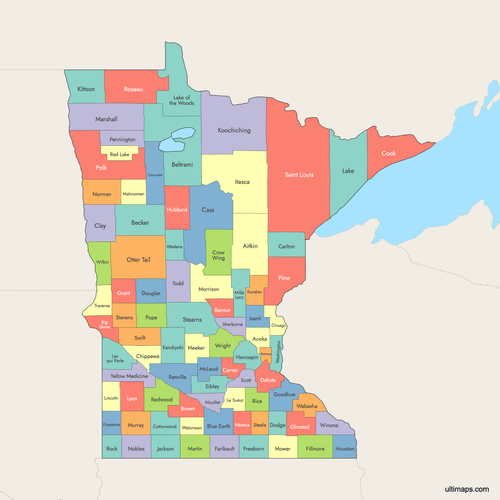 Colored Map of Minnesota Counties with Surrounding Areaspng656 KB
 Labeled Map of Minnesota Counties with Surrounding Areaspng632 KB
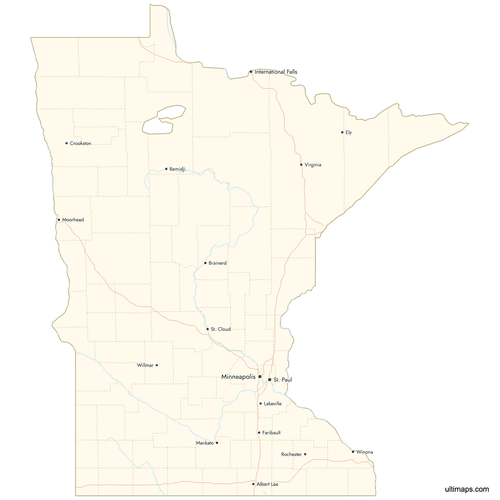 Map of Minnesota Counties with Citiespng637 KB
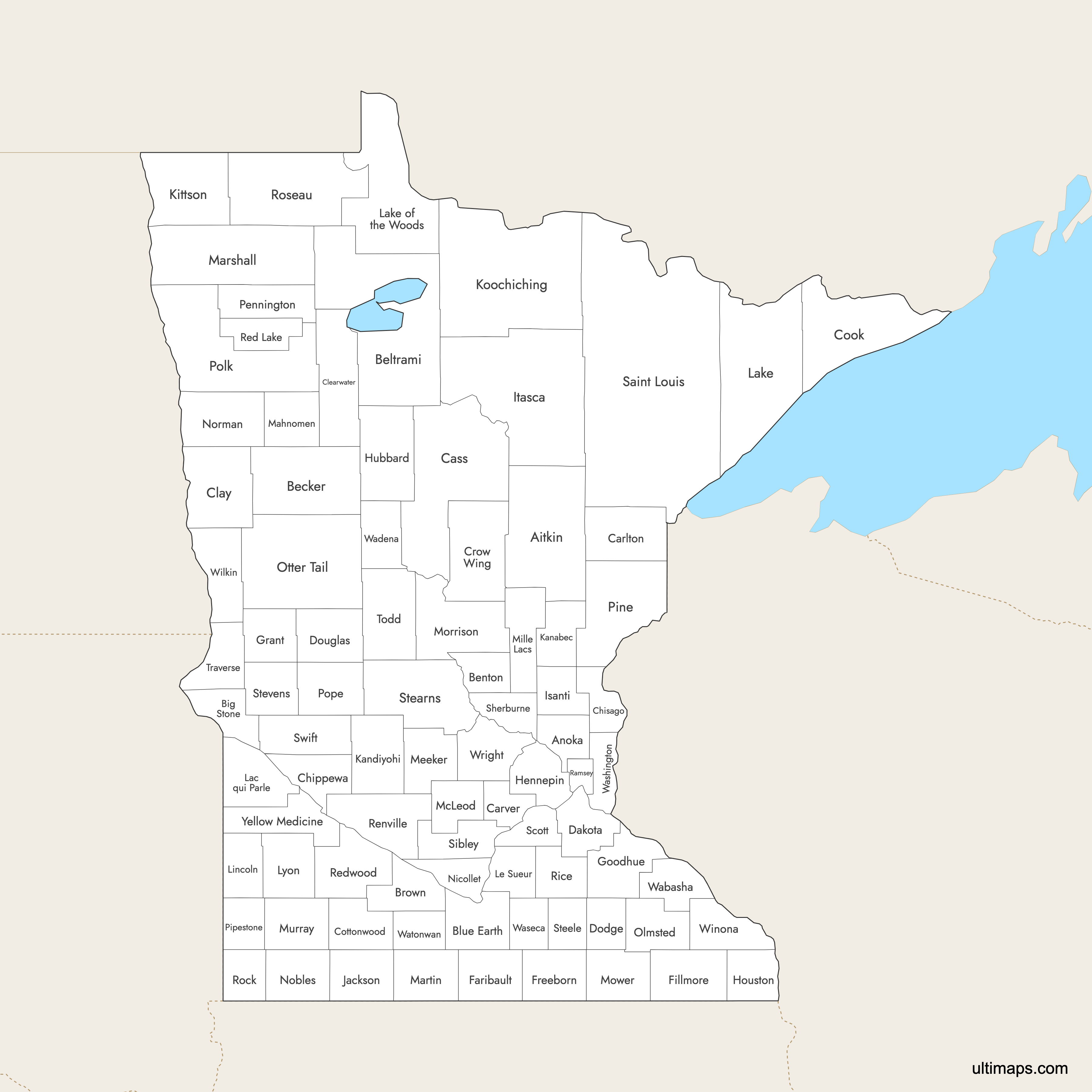
Need it without colors? The blank version of this map comes as a print-ready PDF (A4 and US Letter), a PNG and an editable SVG.
Custom Map Features
This map supports labels.
This map supports surrounding areas, roads, rivers and cities. New
This map is divided into 87 counties.
Updates
Oct 2, 2025:
- Improved map quality
- Added support for surrounding areas and lakes
Aug 26, 2024:
- Added map of Minnesota Counties
Frequently Asked Questions
Minnesota has 87 counties, and the total has not changed since 1923, when Lake of the Woods County was created as the newest. Minnesota's first nine counties were created by the territorial legislature in 1849, nine years before Minnesota became the 32nd state on May 11, 1858. Only 13 states have more counties, led by Texas with 254. Minnesota's counties differ widely in size. St. Louis County has 41 times as much land as Ramsey County, according to the US Census Bureau's 2026 Gazetteer Files. Population ranges from 1,273,334 in Hennepin County to 3,134 in Traverse County in Census Bureau estimates for July 1, 2024.
St. Louis County is the largest county in Minnesota by area. The US Census Bureau's 2026 Gazetteer Files list 6,248.1 square miles (16,183 km²) of land and 612.4 square miles (1,586 km²) of water, which gives the county more land than the whole state of Connecticut. St. Louis County runs from Duluth, the county seat and Minnesota's main Lake Superior port, north through the Iron Range to the Ontario border. Koochiching County is a distant second at 3,104.7 square miles (8,041 km²) of land. St. Louis County also ranks sixth in population, with 200,794 residents in Census Bureau estimates for 2024.
Hennepin County is the most populated county in Minnesota, with 1,273,334 residents in US Census Bureau estimates for July 1, 2024. Hennepin alone accounts for 22% of Minnesota's 5,793,151 residents. Minneapolis, the county seat, is in Hennepin County, along with Bloomington and the Mall of America. Ramsey County, home to Saint Paul, ranks second with 542,015, less than half of Hennepin's total. Hennepin County's population fell by 8,388 between 2020 and 2024, from 1,281,722. Over the same period the suburban Dakota, Anoka and Washington counties each gained more than 12,000 residents.
Ramsey County is the smallest county in Minnesota, with 152.3 square miles (394 km²) of land according to the US Census Bureau's 2026 Gazetteer Files. It also ranks second in population, with 542,015 residents in 2024 estimates. That works out to about 3,560 people per square mile, the highest density of any Minnesota county. Ramsey County contains Saint Paul, the state capital and county seat, as well as the Minnesota State Capitol. The next smallest counties by land are Carver, at 353.9 square miles (917 km²), and Scott, at 356.1 square miles (922 km²). Both are also in the Twin Cities area.
Traverse County is the least populated county in Minnesota, with 3,134 residents in US Census Bureau estimates for July 1, 2024. That is down from 3,360 in 2020, a loss of 226 people, or 6.7%. No other Minnesota county lost a larger share of its residents in that period. Traverse County is on the western edge of the state, bordering both North Dakota and South Dakota, and has 573.9 square miles (1,486 km²) of land, per the 2026 Gazetteer Files. Three other counties had fewer than 4,000 people in 2024: Lake of the Woods with 3,797, Red Lake with 3,882 and Kittson with 3,992.
The Twin Cities metro area is usually defined as seven Minnesota counties: Anoka, Carver, Dakota, Hennepin, Ramsey, Scott and Washington. These are the seven counties covered by the Metropolitan Council, the regional planning agency. Together they had 3,199,139 residents in US Census Bureau estimates for July 1, 2024, or 55% of Minnesota's 5,793,151. They cover 2,785.7 square miles (7,215 km²) of land, per the 2026 Gazetteer Files. Hennepin and Ramsey, which contain Minneapolis and Saint Paul, were the only two of the seven to lose residents between 2020 and 2024. Washington County gained 15,560, the largest increase of any Minnesota county. The Census Bureau's Minneapolis-St. Paul-Bloomington metro area is larger and extends into Wisconsin.
Lake Itasca, the source of the Mississippi River, is in Clearwater County, Minnesota, not Itasca County. The lake is inside Itasca State Park, which lies mainly in Clearwater County and extends into Hubbard and Becker counties. Itasca County is named after the lake but lies farther east. Its county seat is Grand Rapids, and the Mississippi flows through the county after leaving the headwaters. The two counties also differ in size. Clearwater County had 8,630 residents in 2024 Census Bureau estimates and 999 square miles (2,587 km²) of land. Itasca County had 45,442 residents and 2,667.5 square miles (6,909 km²) of land, per the 2026 Gazetteer Files.
The Northwest Angle belongs to Lake of the Woods County, which was created in 1923 and is the newest of Minnesota's 87 counties. The Angle is the northernmost point in the contiguous United States. Lake of the Woods and land in Manitoba separate it from the rest of Minnesota, so the only road to it runs through Canada. Lake of the Woods County, with Baudette as its seat, had 3,797 residents in US Census Bureau estimates for 2024. The 2026 Gazetteer Files give the county 1,297.7 square miles (3,361 km²) of land and 482.2 square miles (1,249 km²) of water.
You can make a custom map of Minnesota in four steps in the Ultimaps editor, which is free and needs no sign-up. First, color the counties. Select Olmsted, Stearns or any other county and give it a color by hand. Or import a spreadsheet of the 87 county names with a value for each, and the counties are colored on a scale with a legend. Second, place pins on exact sites, such as a store in Duluth or a clinic in Rochester. Third, adjust the palette, borders, labels and title. Fourth, export the map. A standard PNG with a small Ultimaps credit is free. High-resolution PNG, SVG and PDF exports require the Pro plan.