Netherlands Map with Provinces
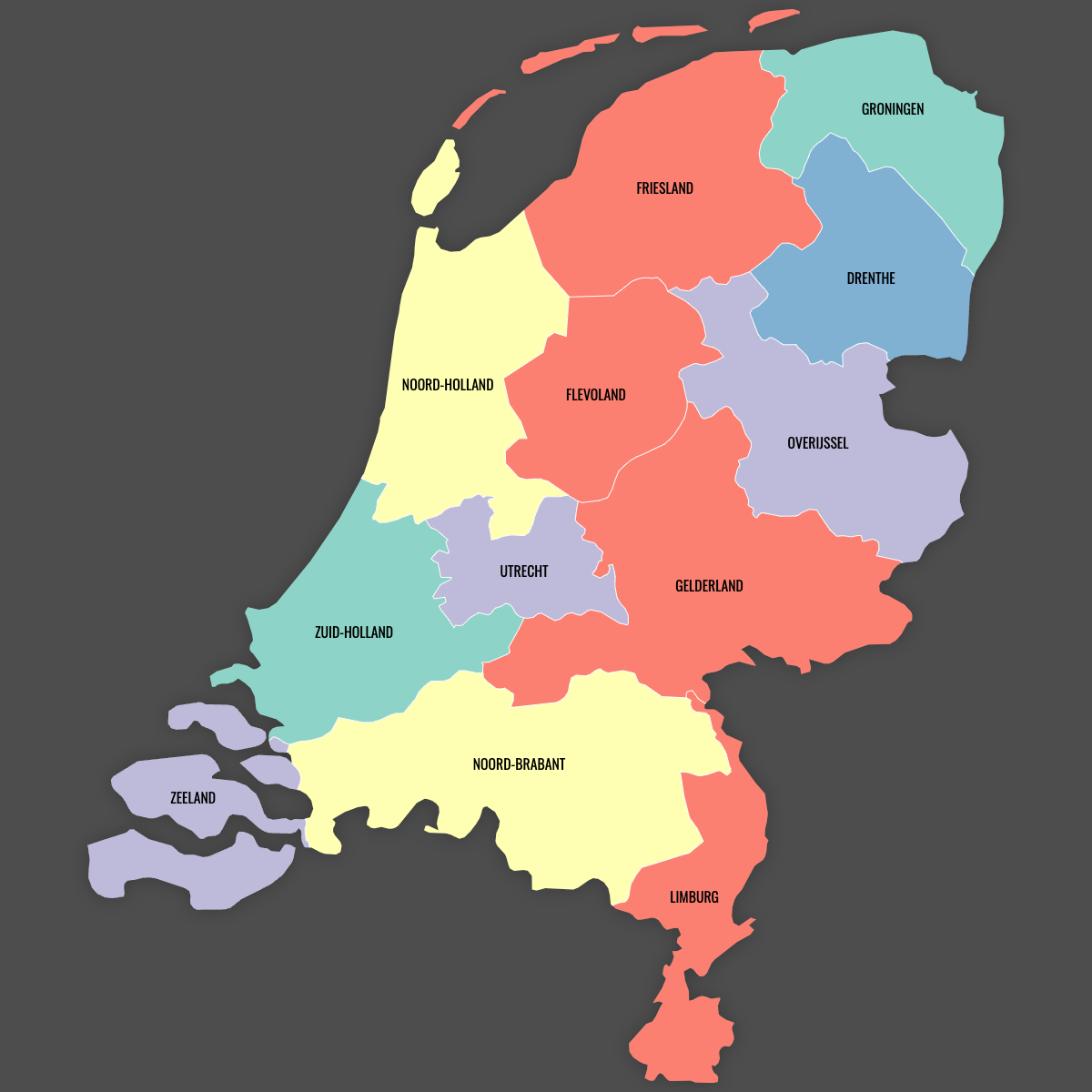
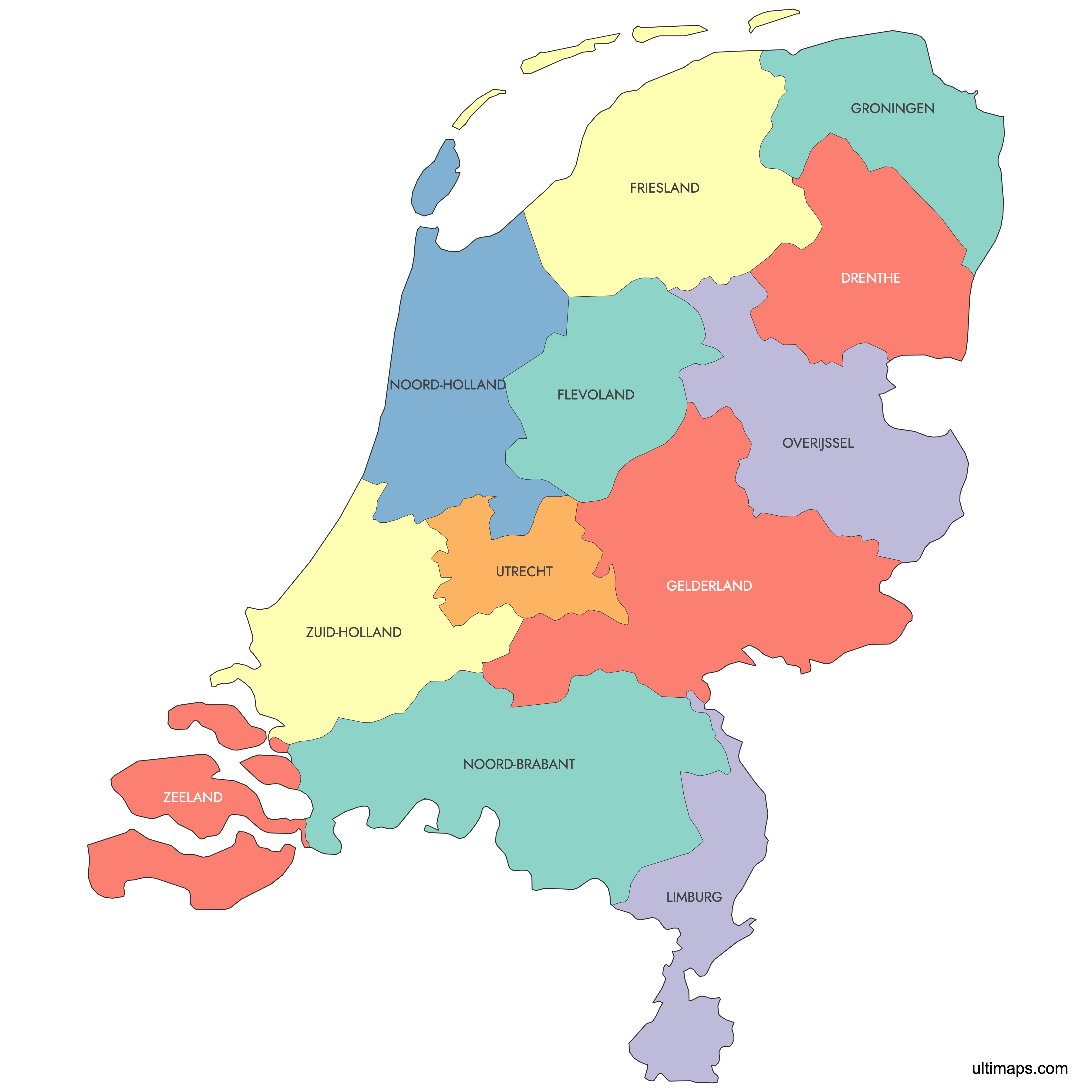
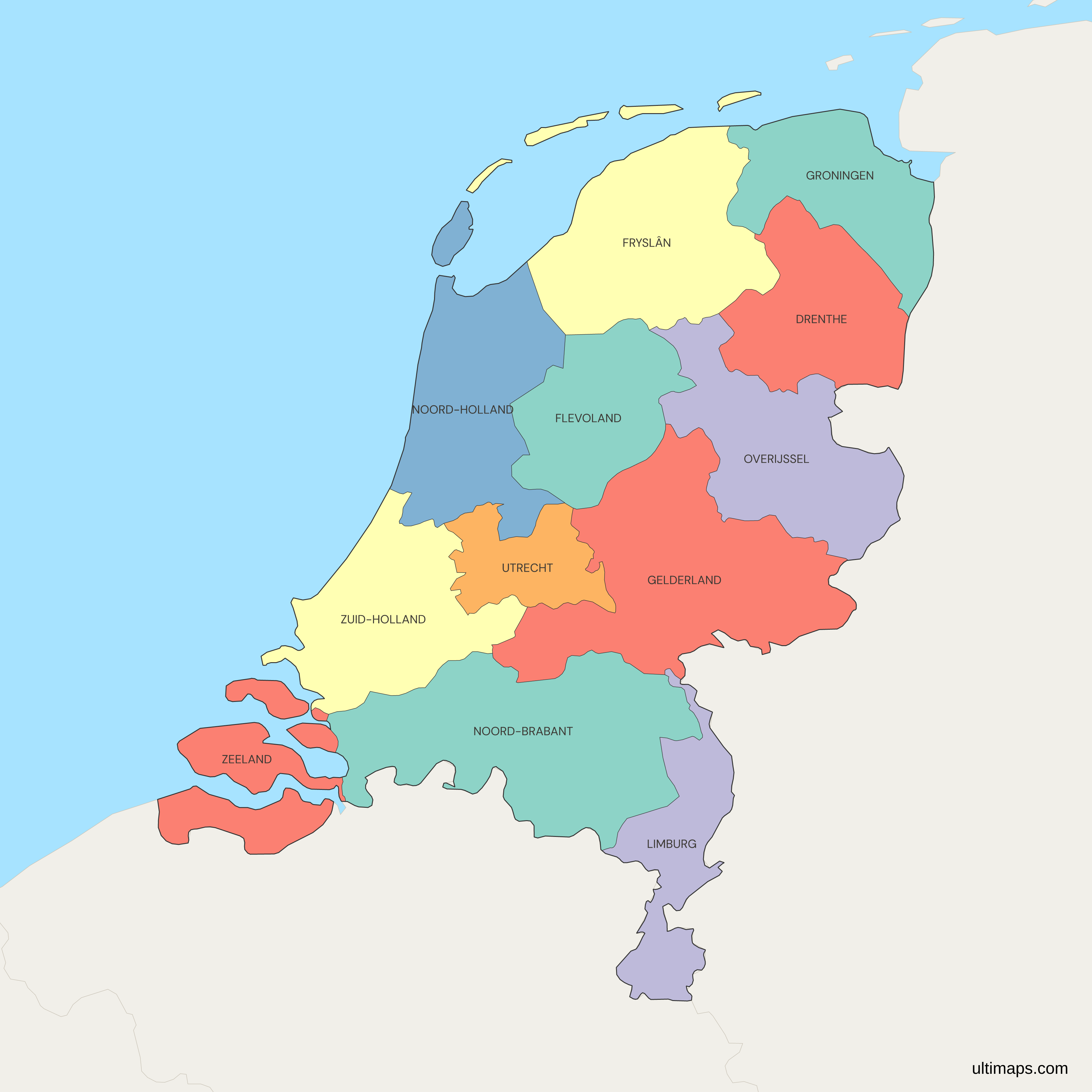
Twelve provinces make up this map of the Netherlands. The count has not changed since 1 January 1986, when Flevoland became the 12th province. Flevoland was built on land reclaimed from the former Zuiderzee. Amsterdam, the national capital, is in North Holland. The government and parliament sit in The Hague, the provincial capital of South Holland. South Holland (Zuid-Holland) is also the most populous province, with 3,863,397 residents on 1 January 2025 according to Eurostat. Zeeland has the fewest people, 392,969 on that date.
The area rankings change depending on whether you count water. Friesland (Fryslân) is the largest by total area at 5,753 km² (2,221 sq mi), and much of that is part of the IJsselmeer and the Wadden Sea. Gelderland has the most land, about 4,960 km² (1,915 sq mi), per Statistics Netherlands (CBS). The map covers only the European Netherlands. Bonaire, Sint Eustatius and Saba are special municipalities outside any province, so they are not drawn. To map your own data, paste one value per province into the editor and it colors the 12 provinces on a scale.
Interactive Netherlands Map with Provinces
List of Provinces (12)
| # | Province | Population (2025) | GDP per capita (EUR, 2024) | Unemployment rate (%, 2025) | Life expectancy at birth (years, 2024) |
|---|---|---|---|---|---|
| 1 | Drenthe | 506,529 | 44,700 | 3.60 | 81.40 |
| 2 | Flevoland | 456,395 | 48,200 | 3.70 | 81.90 |
| 3 | Fryslân | 664,222 | 45,500 | 4 | 81.70 |
| 4 | Gelderland | 2,161,358 | 53,300 | 3.40 | 81.90 |
| 5 | Groningen | 602,833 | 54,600 | 4.50 | 80.70 |
| 6 | Limburg | 1,135,328 | 51,400 | 3 | 81.60 |
| 7 | Noord-Brabant | 2,664,047 | 64,600 | 3.50 | 82 |
| 8 | Noord-Holland | 2,992,016 | 81,500 | 3.80 | 82.10 |
| 9 | Overijssel | 1,195,789 | 54,100 | 3.70 | 81.70 |
| 10 | Utrecht | 1,409,144 | 75,600 | 3.80 | 82.40 |
| 11 | Zeeland | 392,969 | 52,600 | 2.20 | 82.10 |
| 12 | Zuid-Holland | 3,863,397 | 60,000 | 4.80 | 82 |
Data sources, all reuse with acknowledgement:
- Population: Eurostat, Population on 1 January (demo_r_pjanaggr3).
- GDP per capita: Eurostat, Gross domestic product at current market prices by NUTS 3 regions, euro per inhabitant (nama_10r_3gdp).
- Unemployment rate: Eurostat, Unemployment rates by NUTS 2 regions, ages 15-74 (lfst_r_lfu3rt).
- Life expectancy at birth: Eurostat, Life expectancy at birth by NUTS 2 regions (demo_r_mlifexp).
Provinces of the Netherlands: Key Facts
- Total number of provinces: 12, and all 12 appear on this map. For comparison, neighboring Belgium has 10 provinces and Germany has 16 states.
- Most populous province: South Holland (Zuid-Holland), home to Rotterdam and The Hague, with 3,863,397 residents (Eurostat, 1 January 2025). That is 21.4% of the 18,044,027 people in the 12 provinces.
- Least populous province: Zeeland, with 392,969 residents (Eurostat, 1 January 2025)
- Largest province by area: Friesland (Fryslân) by total area, at 5,753 km² (2,221 sq mi) including inland and coastal water. Measured by land alone, Gelderland is the largest at about 4,960 km² (1,915 sq mi) (CBS).
- Smallest province by area: Utrecht by total area, at 1,560 km² (602 sq mi). Measured by land alone, Flevoland is the smallest at about 1,410 km² (544 sq mi) out of a 2,412 km² (931 sq mi) total (CBS).
- Major urban centers: Amsterdam (North Holland), Rotterdam and The Hague (South Holland), Utrecht (Utrecht province), Eindhoven (North Brabant) and Almere (Flevoland)
- Capital and seat of government: Amsterdam, in North Holland, is the capital under the Constitution. The government, parliament and Supreme Court are in The Hague, in South Holland.
- Borders: Germany to the east, along Groningen, Drenthe, Overijssel, Gelderland and Limburg. Belgium to the south, along Zeeland, North Brabant and Limburg. The North Sea to the west and north, including the Wadden Sea off North Holland, Friesland and Groningen.
- Time zone: Central European Time (UTC+1), and Central European Summer Time (UTC+2) from late March to late October
- Boundary history: Holland was split into North Holland and South Holland in 1840. Limburg took its present shape after the 1839 Treaty of London. Flevoland became the 12th province on 1 January 1986.
Interesting Facts
- Flevoland grew faster than any other province between 2015 and 2025. Its population rose from 401,791 to 456,395, an increase of 13.6% (Eurostat).
- North Holland had a GDP per capita of 81,500 EUR in 2024, about 1.8 times the 44,700 EUR recorded in Drenthe (Eurostat).
- Texel, the largest of the Dutch Wadden Islands, belongs to North Holland. Vlieland, Terschelling, Ameland and Schiermonnikoog belong to Friesland.
- The Vaalserberg in southern Limburg rises to about 322 m, the highest point in the European Netherlands. It sits where the borders of the Netherlands, Belgium and Germany meet.
Free Downloads
Free for personal and commercial use with a credit to Ultimaps. See the license terms for details.
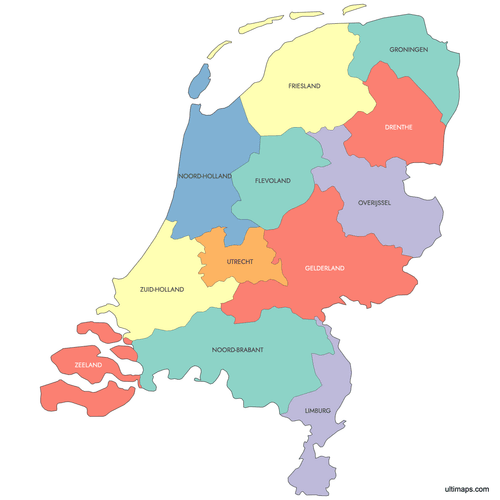 Colored Netherlands Map with Provincespng483 KB
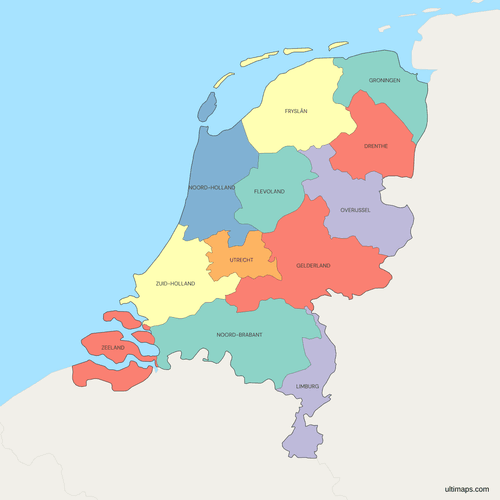 Political Map of the Netherlands with Provincespng474 KB
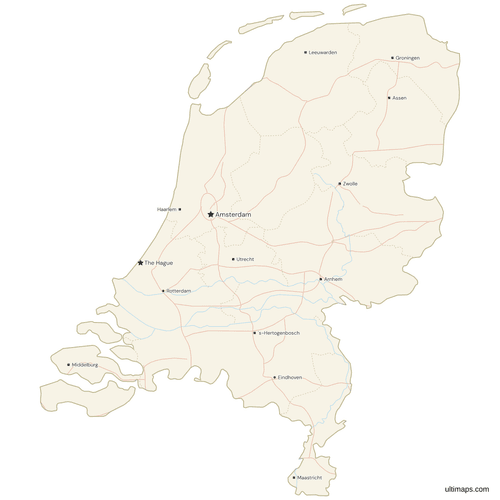 Map of the Netherlands with Cities and Roadspng692 KB
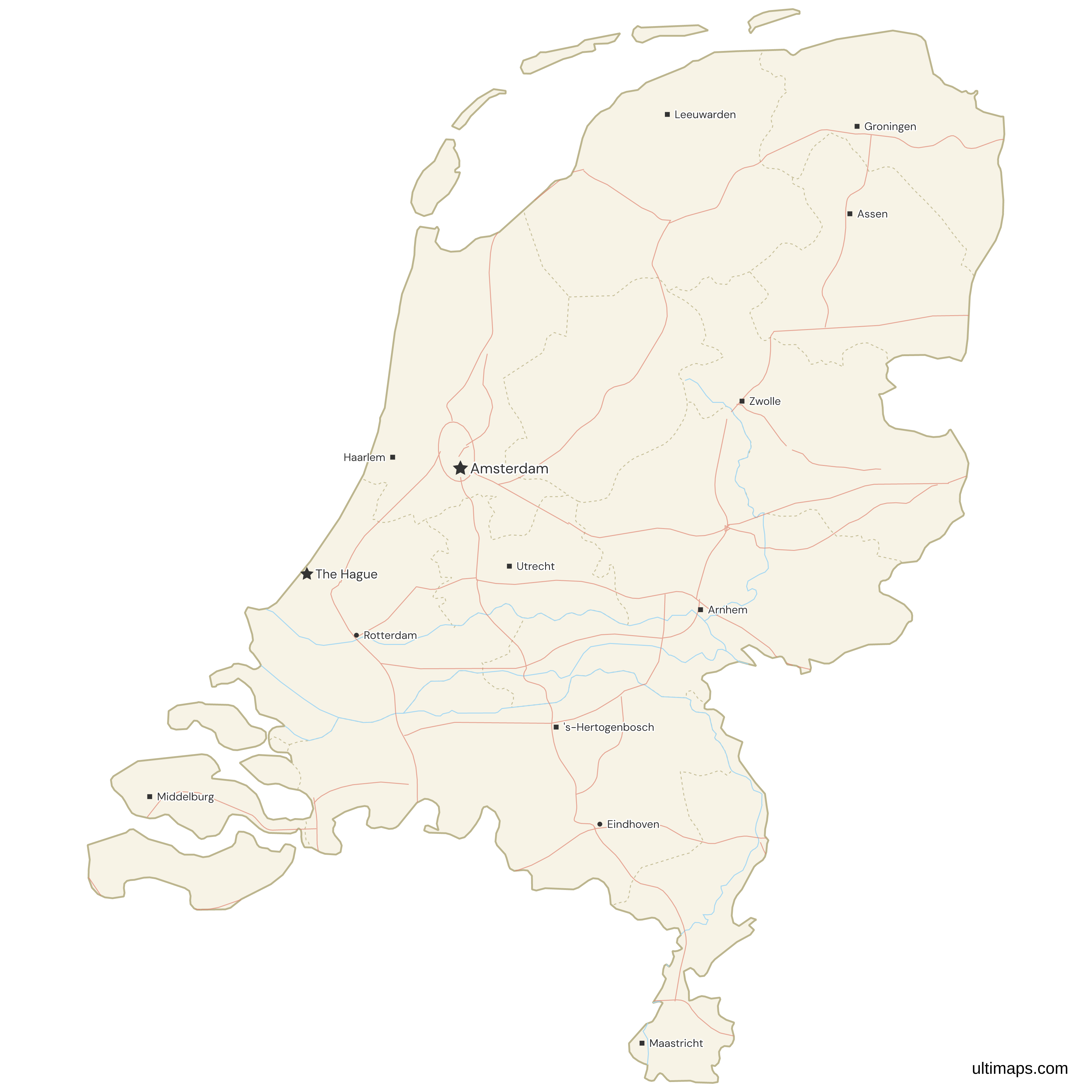
Need it without colors? The blank version of this map comes as a print-ready PDF (A4 and US Letter), a PNG and an editable SVG.
Custom Map Features
This map supports labels.
This map supports surrounding areas, roads, rivers and cities. New
This map is divided into 12 provinces.
Updates
Jun 12, 2025:
- Added map of Dutch Provinces
Frequently Asked Questions
The Netherlands has 12 provinces: Drenthe, Flevoland, Friesland, Gelderland, Groningen, Limburg, North Brabant, North Holland, Overijssel, South Holland, Utrecht and Zeeland. All 12 appear on this map. The provinces are the level of government between the national state and about 340 municipalities. The count rose from 11 to 12 on 1 January 1986, when Flevoland became a province on land reclaimed from the former Zuiderzee. Each province has an elected council, the Provinciale Staten, and a King's Commissioner appointed by the Crown. On 1 January 2025 the 12 provinces had a combined population of 18,044,027 (Eurostat). Bonaire, Sint Eustatius and Saba belong to the Netherlands but are not part of any province.
Friesland (Fryslân) is the largest Dutch province by total area at 5,753 km² (2,221 sq mi). A large part of that total is water, because the province includes part of the IJsselmeer, part of the Wadden Sea and the islands of Vlieland, Terschelling, Ameland and Schiermonnikoog. Measured by land alone, Gelderland is the largest province, with about 4,960 km² (1,915 sq mi) of land out of a 5,136 km² (1,983 sq mi) total, according to Statistics Netherlands (CBS). The smallest province by total area is Utrecht, at 1,560 km² (602 sq mi). Flevoland has the least land, about 1,410 km² (544 sq mi), because open water covers much of its 2,412 km² (931 sq mi) total.
South Holland (Zuid-Holland) is the most populous province of the Netherlands, with 3,863,397 residents on 1 January 2025 according to Eurostat. That is 21.4% of the 18,044,027 people living in the 12 provinces. Rotterdam, the country's main port city, is in South Holland. So is The Hague, which is both the seat of the Dutch government and the provincial capital. Leiden, Delft and Dordrecht are also in the province. North Holland ranks second with 2,992,016 residents, followed by North Brabant with 2,664,047. Zeeland, in the southwestern delta of the Rhine, Meuse and Scheldt, has the smallest population of any province, 392,969 in the 2025 Eurostat figures.
Amsterdam is the capital of the Netherlands under the Dutch Constitution, and it is in the province of North Holland. The Hague, in South Holland, is where the government, the parliament (States General), the Supreme Court and most foreign embassies are located. The Hague is also the provincial capital of South Holland. Amsterdam is not the capital of its own province. That role belongs to Haarlem, west of Amsterdam. As a result, the country's two national centers are in its two most populous provinces. On 1 January 2025, South Holland had 3,863,397 residents and North Holland had 2,992,016 (Eurostat). Dutch monarchs are inaugurated in Amsterdam's Nieuwe Kerk.
Holland is a region in the western Netherlands, not the name of the whole country. Today it consists of two of the 12 provinces, North Holland and South Holland. They formed a single province of Holland until it was split in 1840. The two provinces include Amsterdam, Rotterdam, The Hague, Haarlem and Leiden. Their combined population was 6,855,413 on 1 January 2025 (Eurostat), about 38% of the national total of 18,044,027. Holland led Dutch trade and politics for centuries, so the name came into wide use abroad for the whole country. Since January 2020, the Dutch government has used only "the Netherlands" in official international communication.
Bonaire, Sint Eustatius and Saba are part of the Netherlands, but they are not provinces and do not appear on this map. Since 10 October 2010, the three Caribbean islands have been public bodies, usually called special municipalities, and together they are known as the Caribbean Netherlands. They report directly to the national government instead of a province. They use the US dollar and are on Atlantic Standard Time (UTC-4). Aruba, Curaçao and Sint Maarten are different. They are separate constituent countries within the Kingdom of the Netherlands. The 12 provinces on this map cover only the European Netherlands, and the Eurostat total of 18,044,027 residents (2025) counts only that area.
Friesland and Fryslân are two names for the same province in the northern Netherlands. Fryslân is the West Frisian spelling and has been the province's official name since 1 January 1997. This map uses that form in its region titles. West Frisian is an official language in the province alongside Dutch. The provincial capital is Leeuwarden, which is Ljouwert in Frisian. Fryslân had 664,222 residents on 1 January 2025 (Eurostat), making it 8th of the 12 provinces by population. With 5,753 km² (2,221 sq mi), water included, it is the largest province by total area. English and Dutch speakers still commonly use the name Friesland.
Flevoland is the newest province of the Netherlands. It was established on 1 January 1986. Nearly all of its land was reclaimed from the Zuiderzee in the 20th century. The Noordoostpolder was drained in 1942, Eastern Flevoland in 1957 and Southern Flevoland in 1968. Lelystad is the provincial capital, and Almere is the largest city. Flevoland had the fastest growth of any province over the last decade. Its population rose from 401,791 in 2015 to 456,395 on 1 January 2025 (Eurostat), an increase of 13.6%. Flevoland also has the smallest land area of any province, about 1,410 km² (544 sq mi), because the Markermeer and IJsselmeer cover much of its 2,412 km² (931 sq mi) total.
The editor on this page runs in your browser and requires no sign-up. To mark sales territories or survey areas, pick a province and choose its color. To map numbers, enter one value for each of the 12 provinces and the editor builds a choropleth with a matching legend. You can place pins on specific locations such as Schiphol, the Port of Rotterdam or a branch office. Free exports are standard PNG files with a small Ultimaps credit. PDF, SVG and high-resolution PNG exports require the Pro plan.